
The Devil as a Yes or No Answer

- Arcana
- Major Arcana, card 15
- Element
- Earth, Capricorn
- Yes or no
- No
attachmenttemptationhabitsmaterialism
releasebreaking freereclaiming power
The Devil is a no card in a yes or no reading. Drawn upright, it advises against the thing you asked about, because it points to temptation, compulsion and choices made out of fear or craving. Drawn reversed, it leans yes, because the chains are loosening and the pattern is being seen for what it is.
That is the short version, and it holds up well. The longer version matters, because the Devil is one of the few cards where the wording of your question can flip the answer. Ask “Will this be good for me?” and you get a firm no. Ask “Can I break free of this?” and the same card becomes a challenging yes. Below is how to read it in each area of life, how to tell which way it is leaning, and when to set the card aside altogether.
The short answer: upright is a no
If you pull the Devil upright for a plain yes or no question, read it as no. The card shows two figures chained to a pedestal under a horned figure. Whatever you asked about, the card says it is tied to something that has a hold on you: a craving, a fear, a person, a story you keep telling yourself.
A no from the Devil is rarely about forbidden things in a moral sense. It is a warning that the choice in front of you may not really be a free choice. If part of you already feels “I can’t say no to this,” the card is naming that feeling out loud.
It also helps to know what the card is not. It does not predict evil, a curse or punishment. In most readings the Devil is a mirror, not a threat, and its whole message is that you are less trapped than you feel. If you want the full picture of the card outside a yes or no setting, see the Devil tarot card meaning.
Why the Devil leans no
Yes or no answers in tarot come from the energy of the card. Cards of growth, openness and flow (like the Sun or the Ace of Wands) read as yes. Cards of blockage, delay or illusion read as no. The Devil sits firmly in the second group because its core themes are bondage, addiction, materialism and the shadow self.
Think about what a yes would require. A yes means the path is clear and the outcome is good for you. The Devil shows a path where your judgment is clouded by appetite. Even when the thing you want is available, the card suggests you may not be choosing it freely, or that it will cost more than you expect.
It also carries the number fifteen, which reduces to six, the number of the Lovers. That link is useful: the Devil is the shadow side of connection, where attraction becomes attachment and attachment becomes dependence. The Devil follows Temperance, the card of balance and moderation, and it is what appears when moderation is gone.
The Devil reversed as a yes
Reversed, the Devil leans yes, and the reason is simple. The chains that were taut upright are slipping. You have noticed the pattern, named it, or started to step away. That is real progress, and the card reads that progress as permission.
The yes comes with a caveat. Reversed, the Devil often marks the start of freedom, not the finish. Seeing the cage is not the same as walking out of it, so questions like “Will I quit this?” get a yes that depends on follow-through. Read it as “yes, and you will have to do the work.” For a deeper look at the card in this position, see the Devil reversed.
Reversed can also, on occasion, point the other way: denial. Some readers see a reversed Devil as someone refusing to admit the grip, or relapsing after a brief break. Look at your question and your gut. If the question is about escaping, lean yes. If the question is about whether a problem is truly gone, be honest about whether you are still hiding from it. If you are unsure how to treat upside-down cards in general, how to read reversed tarot cards explains the options.
Read The Devil for your question
Upright: A no to the relationship as it stands: the pull is strong, but it runs on obsession, control or fear rather than trust.
Reversed: A cautious yes to leaving or healing a tangled bond, because the grip is loosening and honest love becomes possible.
Upright: They feel strongly drawn and may be gripped by jealousy, craving or a need to hold on, which is not the same as feeling safe with you.
Reversed: Feelings are cooling or clearing as they see the pattern, and they may step back or finally speak plainly.
Upright: A no to the shiny offer or the job that owns you: golden handcuffs, overwork and deals that cost your values.
Reversed: A yes to quitting, renegotiating or walking away from a role that has been draining you.
Upright: A no to impulse spending, risky debt and any plan driven by greed, panic or a need to prove something.
Reversed: A yes to getting out from under debt or a spending habit, as long as you follow awareness with a real plan.
Upright: Name what has a hold on you, then test whether the chain is as tight as it feels, because it usually is looser than you think.
Reversed: Keep going: you have seen the pattern, so use that clarity to make one concrete change this week.
Upright: A no to the habit, substance or extreme routine in question, and a sign to ask for support instead of white-knuckling it alone.
Reversed: A yes to recovery and new routines, with the reminder that relapse is a risk and help is worth accepting.
How your question changes the answer
The Devil does not answer every question the same way, and it is worth knowing which kind of question you asked. Here is a quick guide to how the wording shifts the result:
- “Should I do this?” or “Will this work out?” gets a no from the upright Devil.
- “Will I get what I want quickly?” can be a yes with a cost, since the Devil is the card of indulgence and the quick hit.
- “Can I break this habit, leave this job or end this cycle?” gets a yes, because the card is about facing the chain.
- “Is something unhealthy going on here?” gets a yes, because the card shows where you may be giving your power away.
This is why a good question matters more than any card. If you want help phrasing yours, questions for tarot reading has examples that work well for simple answers, and the yes or no tarot reading tool lets you draw one card fast.
The Devil yes or no for love
In love, the upright Devil is a no. Questions like “Is this person right for me?”, “Will we be happy together?” or “Should I commit?” get a clear warning. The card describes chemistry that outruns trust, jealousy, secrecy, possessiveness, and relationships where one person shrinks so the other can feel secure.
Be careful with how you read this. The Devil does not say the other person is a villain, and it does not say your attraction is fake. The pull may be very real. The message is that the relationship, as it works now, runs on grip. That could be you gripping them, them gripping you, or both of you holding on because letting go feels worse.
For a new connection, a no from the Devil is a flag to slow down and watch how you act around this person: do you feel more like yourself or less? If you want to know what the person in question feels, the Devil as feelings goes into that side. Reversed in love, the card is a yes to loosening an unhealthy bond, to honest conversation, or to finally walking away from a cycle that was hurting you.
Reconciliation and “will they come back”
When people ask whether an ex will return, the upright Devil is usually a no, or at least a “this is not a clean reunion.” It points to a magnetic pull that may bring you back together without solving what broke you apart. If you do reunite, the card warns the same cycle could repeat.
Notice what you are really asking. If your question is “Will I be able to stop wanting them?” the Devil flips and becomes a yes, since the card is about the chain, and the chain can come off. Many people find this reading more useful than a simple prediction.
A reversed Devil about an ex is a stronger yes to moving on. It says the hold is weakening, the obsession is fading and you are seeing the relationship clearly. If you are also thinking about contact, give yourself time first, and ask only what you can act on.
Try this: Write your question twice: once as “Will X happen?” and once as “What do I need to see or change about X?” Draw for the second version and compare how the Devil reads against the first.
The Devil yes or no for career
At work, the upright Devil is a no for the offer that looks too good, the job that owns your evenings, or the deal that asks you to bend your values. It is the card of golden handcuffs: high pay or status that keeps you in place long after the work stopped meaning anything.
Ask “Should I take this job?” and the card tells you to look closely at what it costs and who holds the power. Ask “Should I stay in this role?” and the answer is often no, especially when you feel unable to leave. Ask “Is my boss or workplace controlling?” and it is a yes.
Reversed, the Devil is a yes to quitting, renegotiating terms, or setting boundaries around your time. It supports you walking away from a role that drained you, provided you have a plan for what comes next. For a card that supports building something solid instead, the Ace of Pentacles is a good contrast.
The Devil yes or no for money
Money questions bring out the Devil’s materialism. Upright, it is a no to impulsive buying, high-interest debt, get-rich plans and anything driven by greed or panic. It also appears when money has become a stand-in for security, status or control.
If your question is “Should I buy this?” the Devil asks whether you want it or want the feeling it gives. If your question is “Will I get out of debt?” the answer upright is a “not yet, and not without changing the habit behind it.”
Reversed, the Devil leans yes for questions about getting free of debt, ending a spending cycle or cutting ties with a financial arrangement that was holding you down. The yes is real, but it depends on a plan. Awareness alone does not pay a balance.
The Devil card symbols
Choose a symbol to read what it means on the card.
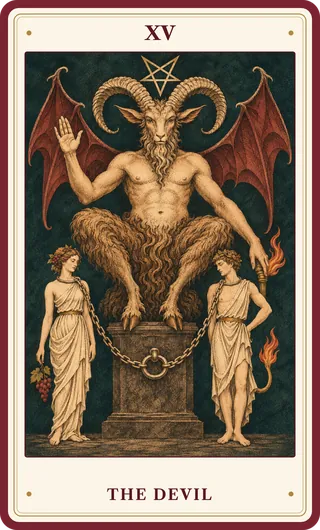
Horned goat-like figure
The Devil figure, often called Baphomet, is half beast and half human, a picture of appetite without restraint. He rules the scene only because the two people below agree to look up at him.
Inverted pentagram
The pentagram above his head points downward, putting matter and instinct above spirit. It marks a mindset where the material and the urgent beat the meaningful.
Raised right hand
His hand is lifted in a gesture that mirrors the blessing of the Hierophant, but twisted. It shows false authority, a promise of power that is really a demand for submission.
Downward torch
He holds a torch pointing at the ground, ready to set the man's tail alight. It stands for desire that burns whatever it touches when it is left unchecked.
Loose chains
The chains around the man and woman hang slack and could be lifted off. They are the heart of the card: the trap is real, but the lock is not.
Nude man and woman
They echo Adam and Eve from the Lovers card, now with small horns and tails. They show a bond that has lost its innocence and turned into dependence.
Tail of flame and tail of grapes
The man's tail burns, hinting at lust and obsession, while the woman's tail carries grapes, hinting at indulgence. Both show how appetite is feeding the chain.
The Devil yes or no for health
In health readings, the Devil points to habits that have a grip: substances, compulsive eating or restriction, screen time, overwork, or anything done to escape a feeling. Upright, it is a no to the habit or routine you asked about, and a prompt to look at what the habit is protecting you from.
Please treat this card as a nudge, not a diagnosis. Tarot cannot assess your health, and anything involving addiction, self-harm or a medical concern deserves real support from a doctor, counsellor or helpline. If the card feels uncomfortably accurate, take that as a sign to reach out rather than carry it alone.
Reversed, the Devil is a yes to recovery, new routines and breaking a hold. It also reminds you that setbacks are part of change, and that help makes a lasting difference.
When the Devil can be a yes
Though it is mostly a no, there are a few situations where the Devil is a yes, and knowing them keeps you from misreading it.
First, as the answer to “Is something off here?” or “Do I have a pattern I need to look at?” Second, as a yes to temptation you already know the cost of: the card says you can have it, but it will not be free. Third, as an answer to questions about freeing yourself, where the card names the chain so you can remove it.
This is why the card feels so strange in a yes or no reading. It can say “no, don’t do this” and “yes, you have a problem to face” in the same breath. If you find that confusing, draw a second card for clarity, such as Temperance, which would suggest balance and moderation as the way through.
What the card’s image tells you
The Devil’s picture holds the answer if you look closely. The man and woman stand beneath the horned figure with chains around their necks, but those chains are loose enough to lift off. That detail is why the card is a no for most questions and a yes for questions about freedom: the trap exists, and so does the exit.
Look at the figures too. They are nude, horned and tailed, with a flame on the man’s tail and grapes on the woman’s. They are echoes of the couple in the Lovers, now changed by appetite. In a yes or no reading, this suggests the situation involves two parties feeding each other’s habit, or one person feeding their own.
Finally, the inverted pentagram and the downward torch show matter and instinct ranked above spirit. If your question is driven by what feels urgent rather than what feels true, expect a no.
Try this: Look at your Devil card for one minute and find the chains. Then ask yourself, “If I lifted one link off today, which one would it be?” Write that down as your next step.
Position and neighbouring cards
A single card gives you a lean, and the cards around it can sharpen or soften it. In a three-card reading, a Devil in the first position says the issue starts with attachment or temptation. In the middle it is the current obstacle. In the last it is a warning about where things end up if nothing changes.
Pairings are also useful:
- The Devil with the Tower suggests a sudden break from something unhealthy, which is a painful but liberating yes to change.
- The Devil with Temperance suggests moderation is the way out, a yes to balance.
- The Devil with the Lovers points to passion that needs honesty before it can become love.
- The Devil with the Sun suggests joy returning once the hold is released.
If you pull the Devil as part of a 3 card tarot reading, read the whole line before landing on a yes or no. A supportive card after the Devil changes the picture a lot.
Safety comes before any card
If something in your situation involves pressure, threats, control or harm, the answer is no no matter what you draw. The Devil in this case is not a puzzle to solve. It is a reminder to trust your instincts, get distance and speak to someone you trust or a professional service.
The same goes for questions that put your health or safety at stake. Tarot can help you think, but it should not be the thing that decides whether you stay in a harmful situation. A yes or no card is a conversation starter with yourself, not a command.
It also helps to avoid asking the same question repeatedly until you get the answer you want. If the Devil appears and you do not like it, that reaction is itself information. Sit with it before you draw again.
Common mistakes when reading the Devil
The first mistake is reading the card as evil, or as a sign of something supernatural going wrong. The Devil is about human patterns, not dark forces. The second is treating a no as a final ruling, when it is a warning and an invitation to look closer.
The third is ignoring the reversal and assuming the answer must be gloomy. A reversed Devil is one of the most hopeful cards for questions about change. The fourth is asking vague questions. “Will things be okay?” is too wide for a card that thrives on specifics.
Last, remember that the Devil is a lean, not a law. Use it with your own judgment, the facts of your situation and the people who know you well. If the card names something you have been avoiding, that alone may be its most useful answer.
Try this: Pull the Devil’s answer to one sharp question, then write one action you can take within 48 hours that loosens the chain, however small.
Questions readers ask
Is the Devil a yes or no card?
The Devil upright is a no card. It points to temptation, unhealthy attachment and choices driven by fear or craving. The only time it leans yes is when your question is about breaking free, ending a pattern or facing the truth.
Is the Devil reversed a yes?
Usually yes, with a condition. Reversed, the Devil shows chains loosening and a pattern being seen for what it is, so questions about escape, recovery or change get a yes. Questions about a smooth, easy result get a slower, more qualified answer.
Does the Devil mean no in love?
Upright, it is a no to the relationship as it currently runs, especially if it involves jealousy, control or an on and off cycle. It does not mean the other person is evil. It means the connection is built on grip rather than trust.
Is the Devil a no for getting back with an ex?
Generally yes, it is a no, because it describes a pull you may struggle to resist and a cycle that could repeat. If you ask whether you can finally let go of them, the same card can answer yes.
Can the Devil mean yes?
Yes. It can mean yes to the question 'Do I need to look at this honestly?' or 'Can I break this habit?' It can also be a costly yes to something tempting, where you get what you want but pay a price.
Should I trust a yes or no tarot answer from the Devil?
Treat it as a lean, not a verdict. If something in your situation involves pressure, coercion or harm, the answer is no whatever any card says, and talking to a trusted person or professional is the right next step.