
Seven of Pentacles Reversed (Meaning in Love, Work & Life)

- Arcana
- Minor Arcana, Suit of Pentacles
- Element
- Earth
- Yes or no
- Yes
patiencelong-term investment
setbackspoor planningfinancial worry
The Seven of Pentacles reversed means that your effort and your results have fallen out of step. You may be impatient for a harvest that is not ready, avoiding an honest look at something that is not working, pouring energy into the wrong thing, or scattering yourself across too many projects. It is a card of review and correction, and it rarely means all is lost.
In the upright position, the farmer pauses to judge what he has grown. Reversed, that pause goes wrong in one of a few ways, and the skill in reading the card is working out which way it has gone for you. This guide covers each meaning, how the card reads in love, work, money, health and as someone’s feelings, and a simple way to decide whether to keep going or change course.
Seven of Pentacles reversed at a glance
Think of the reversed card as a question: is the work I am doing actually producing what I want? The answer may be “not yet”, “not at all”, or “I don’t want to look”. Those are very different situations, and the card can describe any of them.
Common keywords include:
- Impatience and wanting a quick harvest
- Poor returns on time, money or care
- Wasted effort or the wrong investment
- Scattered energy and lack of focus
- Giving up too early
- Avoiding an honest review
- Fatigue from effort that feels pointless
Waite’s original divinatory meaning for the reversed card centres on anxiety about money, especially money that has been lent or put at risk. Modern readers have widened that into any investment of time, energy or emotion. Both ideas point to the same worry: I have put something in, and I am not sure it will come back.
What the upright card shows, and what flips
To read the reversal well, start from the upright picture. A young farmer leans on his tool and studies a bush hung with pentacles. He has done the planting and the watering, and now he waits and evaluates. The upright card is about patience, long-term thinking and checking that your effort is paying off. You can read more in the upright Seven of Pentacles meaning.
When the card turns upside down, the qualities the farmer needs are the ones under strain. Patience becomes restlessness. Honest assessment becomes avoidance or panic. Steady investment becomes scattered or misdirected spending. The plant may still be healthy, or it may not, but the person looking at it is no longer calm and clear-headed.
If you are new to upside-down cards, our guide to reading reversed tarot cards explains the main approaches: reversal as the opposite, as blocked energy, or as a softer, internal version of the upright. The Seven of Pentacles works well with the “blocked” view, because the growth is real but something is interfering with how you tend or judge it.
The four main ways this card shows up
Most reversed Seven of Pentacles readings fall into one of four patterns. Check which one fits your question before you settle on an interpretation.
- Impatience. The work is progressing, but waiting feels intolerable. You want fruit now, and you are tempted to dig the plant up to check the roots.
- Avoidance. You are staying busy so you do not have to ask whether the thing is working. Constant motion becomes a way of not looking.
- A poor investment. You have looked, and the honest answer is that the returns are weak. The project, job, deal or relationship is costing more than it gives.
- Scattered effort. You are tending too many plants at once, so none of them gets enough water.
These patterns can overlap. Someone who is impatient may also be scattered, since jumping between projects is a common reaction to slow results. Still, naming the main one gives you a clear next step. Impatience needs more time or a better measure of progress. Avoidance needs an honest review. A poor investment needs a decision. Scatter needs focus.
Try this: Write down the one project, job or relationship the card seems to point at. Under it, finish four sentences: “I am impatient about…”, “I am avoiding looking at…”, “This is costing me more than it returns because…”, “I am spreading myself across…”. The sentence you write fastest is probably your answer.
Read Seven of Pentacles for your question
Upright: A relationship is growing slowly and steadily, and you are patient enough to let it ripen.
Reversed: One person is giving far more than they receive, or someone is pushing for results the bond is not ready to give.
Upright: They are invested in you and quietly assessing how things are growing.
Reversed: They feel impatient, unsure or disappointed, and may be pulling back or testing whether the effort is worth it.
Upright: Your long-term work is paying off and you are right to pause and review it.
Reversed: Effort and reward have drifted apart, so you may be overworked, underpaid, scattered or stuck in the wrong project.
Upright: Steady saving and patient investing are building real security.
Reversed: Returns are poor, spending has gone on things that will not grow, or you are tempted to cash out too early.
Upright: Stop, look honestly at what you have grown, and keep tending it.
Reversed: Audit where your time and money are going, then either commit properly or redirect your effort.
Upright: Small healthy habits are adding up, and results will show with time.
Reversed: Routines are not delivering, you feel drained by effort without progress, or you are quitting a plan too soon.
Seven of Pentacles reversed in love
In a love reading, the reversed card most often points to an imbalance. One person may be doing the emotional heavy lifting, planning the dates, making the effort to talk, and wondering when it will be returned. You may feel you have invested years in a relationship and are now asking whether it was a sound investment.
It can also describe a worry that all the groundwork you laid is slipping away. You built something with care, and now it feels fragile. Here the card is less about the relationship being bad and more about your anxiety over what you stand to lose. A calm conversation about expectations usually helps more than another quiet year of effort.
For new relationships, the card warns against forcing the pace. Pushing for a label, exclusivity or a commitment before the connection has had time to grow can damage the thing you want. For singles, it can show that your attention is so fixed on work or material goals that love has no room to take root, or that you are giving up on dating too soon because results feel slow.
What it means as someone’s feelings
When the card describes what another person feels about you, it suggests mixed emotions with a practical edge. They may be impatient, uncertain or disappointed with how things are going, and quietly weighing whether the connection is worth what it asks of them. They are not necessarily cold. They are counting the cost.
Sometimes the reversed card shows a person who invested a lot early on and now feels that the return has dried up. Other times it shows someone who is holding back because they do not want to put more in until they see more come back. Neither is the same as lack of interest, but both mean the relationship needs clearer communication.
If you are drawing the card about a crush or someone you are just getting to know, read it as hesitation about the pace. They may like you but feel unsure it is going anywhere, or worry about investing before things are clear. Ask directly, rather than reading silence as a verdict.
For a reconciliation or a second chance
If you ask about getting back with an ex, the reversed Seven of Pentacles is a cautious card. It suggests that the work needed has not been done, or that one or both of you would be investing in a pattern that has already failed to produce a good result. Hope alone is not enough here.
That said, the card does not forbid reconciliation. It asks what has actually changed. If the same effort imbalance, the same arguments or the same unmet needs are still in place, then putting more time in is likely to give the same weak returns. If real changes have been made and tested over time, a second try can be a sound investment.
A useful test is to ask whether you would start this relationship today, knowing what you know. The reversed Seven of Pentacles likes plain, practical questions like that.
Seven of Pentacles reversed in career
At work, this card is a flag that something is off in the exchange between what you give and what you get. You may be working long hours without recognition, doing a role that pays poorly for its demands, or building toward a goal that has quietly stopped being yours. Equally, it can show the opposite problem: coasting, procrastinating, or lacking direction because nothing feels worth the effort.
For business owners and freelancers, it often points to a venture or client that costs more in time than it returns in income. It is a good moment to review your hours, pricing and priorities. Check which activities actually produce results, and be ready to drop the ones that do not.
The card can also describe job-hopping driven by impatience. If you leave every role at the first sign of slow progress, you never reach the harvest. In that case the lesson is to give worthwhile work enough time, while still being honest about whether it is worth it. Compare it with the Eight of Pentacles, where the focus is on committing to the craft day after day: the Seven asks whether the craft is leading somewhere.
Seven of Pentacles reversed with money
Money is the card’s home territory, and the reversal is not a comfortable sign here. It can indicate poor financial planning, weak returns, cash flow gaps, or spending on things that will not grow. It might show up when a business expense, course, property or investment is not performing as you hoped.
It can also describe the temptation to cash out too early, to sell at a low point because waiting feels unbearable. If your plan was sound, the reversal may be telling you that panic is the larger risk. If your plan was shaky, it is telling you to stop adding to it.
Treat this as a prompt to look at real numbers, not as financial advice from the cards. Write down what you have put in, what has come back, and what you expect over a realistic timeframe. A money tarot spread can help you structure that review if you like to read with cards alongside your own accounts.
Try this: Pick one ongoing expense of time or money, such as a subscription, a side project or a course. Note what you have put in so far and what it has returned. If you cannot name a single return, give it a fixed review date and decide in advance what result would justify continuing.
Seven of Pentacles card symbols
Choose a symbol to read what it means on the card.
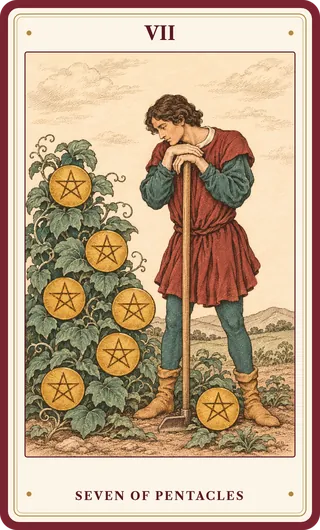
The young farmer
He is the worker who has already done the planting and tending. Reversed, his pause turns into restlessness, doubt or avoidance of what he sees.
The bush with seven pentacles
The growing plant stands for a long-term investment of time, money or care. Reversed, it asks whether the plant is thriving, overcrowded or planted in poor soil.
The pentacle on the ground
One coin lies apart from the vine, a sign of effort that has not taken root. Reversed, it points to wasted resources or a result you let slip.
The hoe or staff
He leans on his tool, resting between tasks. Reversed, the rest becomes exhaustion, laziness or a refusal to pick the tool up again.
His steady gaze
He is looking carefully at what he has grown, which is the heart of the card: honest evaluation. Reversed, he looks away, or stares so anxiously that he cannot see clearly.
The green growth
Fresh leaves show that real growth takes time and cannot be rushed. Reversed, the green warns against tugging at the plant to make it ripen faster.
The open landscape
The wide space around him suggests room to decide what comes next. Reversed, it shows the freedom to change course if the current field is not working.
Seven of Pentacles reversed and health
In health readings, the reversed card often shows frustration with slow progress. You may have been exercising, eating well or managing a condition for weeks, and the results are not showing as quickly as you hoped. The card can warn against giving up on a sound routine too soon, or against swapping plans every time the scale or the mirror does not move.
It can also point to fatigue from effort without enough rest, particularly in people who push hard and then wonder why they are drained. If you recognise that, consider whether your approach needs adjusting, not whether you need to try harder.
Tarot cannot diagnose anything or replace medical care. If a health worry is behind your question, use the card as a gentle prompt about patience and routine, and talk to a professional about anything that concerns you.
Spiritual and personal growth meaning
On a personal level, the reversed Seven of Pentacles speaks to impatience with yourself. You may feel you should be further along in your healing, your learning or your habits, and you judge every day that does not show visible change. The card gently reminds you that growth often happens below the surface for a long time before anything appears.
It can also invite you to question the goals you are chasing. If a plan has felt hollow for months, the reversal may be pointing at a mismatch with your values, not at a failure of discipline. Not every field you planted deserves a lifetime of tending.
For people who are very driven, the card can be a counterweight. Effort is not the same as progress, and being busy is not the same as being on the right path. Rest and honest reflection are part of the work.
Is the Seven of Pentacles reversed a yes or no?
For yes or no questions, the reversed card leans towards no, or at least not yet. The pull of the card is to stop and reconsider before you commit further. If your question is whether a particular investment, project or relationship is about to pay off right now, the answer is more likely “not at the moment”.
Context changes this. If you ask “should I keep waiting?”, the reversal can mean you are being too impatient, and the answer is to give it more time. If you ask “is this worth my effort?”, it can lean towards no. Our Seven of Pentacles yes or no page covers both positions in more detail.
When you want a clearer answer, pull a second card for clarification rather than leaning on one reversal. The card is more a call to review than a flat refusal.
Reversed Seven of Pentacles with other cards
Cards around the Seven shape which of the four patterns applies. Some pairings are especially telling:
- With the Knight of Wands or Eight of Wands, expect impatience and a rush to force results.
- With the Seven of Swords, look for a shortcut, a hidden cost or something you are not saying out loud.
- With the Five of Pentacles, money strain and a sense of lack are strengthened, so check your practical safety net.
- With the Four of Pentacles, you may be holding on too tightly to money or control out of fear.
- With the Ace of Pentacles, a new and better opportunity may be on offer, so the old investment can be let go.
If the reversed Seven lands in a three-card line, read the cards on either side as cause and consequence. In a simple 3 card tarot spread with past, present and future positions, the Seven in the present slot often means you are at the point of reassessment. The past card shows what you invested, and the future card shows what happens if you stay the course.
Should you quit or keep going?
Reversed Seven of Pentacles readings often come down to this decision, so it helps to have a way to test it. The point is to base the choice on evidence, not mood. Here is a simple check you can run in a few minutes.
- Define what a good result looks like, in a number, a date or a clear outcome.
- List what you have already put in, including time, money and emotional energy.
- Compare it honestly to what has come back so far.
- Ask whether the delay is normal for this kind of work, or a sign that something is wrong.
- Decide: continue with a deadline, change the approach, or stop.
The cost you have already paid is not a reason to continue. What matters is whether the next hour or the next pound is likely to be well spent. Keep in mind that some things really do take years, and impatience is easy to mistake for good judgment.
How to work with the card in a reading
When this card appears, look for the question it quietly asks and answer that, before you reach for a prediction. A good prompt is: “What am I investing in, and what am I really getting back?” The card does well with direct, practical questions, and it is less useful for vague worries.
Also check your own mood. If you drew it while frustrated, you may be reading disappointment into everything. If you drew it while calm, the card may be showing something you have not wanted to admit. Both are useful, and a reading journal helps you notice which is which over time.
Finally, remember that the Seven of Pentacles belongs to a suit about practical life, which you can explore across the Suit of Pentacles. The cards before and after it in the suit tell a story from first opportunity to long-term mastery, so reading the Seven alongside its neighbours gives context a single card cannot.
Try this: Draw one more card and ask, “What would make this effort worth continuing?” Write down the answer in one sentence and act on a small piece of it within the week.
When to take it seriously, and when to relax
Take the card seriously when it matches something you already suspect. If you have been quietly doubting a job, a deal or a relationship for months, the reversed Seven is confirming what your instincts have noticed. Do not argue yourself out of a clear signal.
Relax when the card shows up in a situation that is simply slow. A garden does not grow faster because you worry at it. If your plan is sound, your numbers are fine and you are doing the work, the reversal can be nothing more than a flicker of impatience that you can name and set aside.
In both cases, the card is giving you something useful: a reason to check in. The farmer in the picture is never doing wrong by pausing to look. What matters is that you look honestly, decide with a clear head, and then put your energy where it will actually grow.
Questions readers ask
What does the Seven of Pentacles reversed mean?
It usually means effort and reward are out of step. You may be impatient for results, avoiding an honest review, putting energy into the wrong thing, or spreading yourself too thin. It is a prompt to reassess, not a final verdict.
Is the Seven of Pentacles reversed a bad card?
Not really. It can sting because it points at frustration or wasted effort, but it also gives you a chance to change course before you invest more. Many readers see it as a useful warning.
What does the Seven of Pentacles reversed mean in love?
It often points to an imbalance in effort, impatience with how slowly a bond is growing, or a relationship that is not giving back what you put in. It can also warn you not to rush someone new.
Is the Seven of Pentacles reversed a yes or no?
Leaning no, or not yet. The card says the current plan is not paying off as hoped, so pause and adjust before you commit more. If your question is about patience, it can also mean wait.
What does the Seven of Pentacles reversed mean for money?
Poor returns, impulsive spending, weak planning or an investment that is not worth its cost. It can also mean you are tempted to sell or quit too early. Review your numbers before making a move.
How is the Seven of Pentacles reversed different from the Eight of Pentacles reversed?
The Seven is about judging results and being patient with growth. The Eight is about the daily work of building skill, so reversed it points to boredom, sloppy craft or burnout.