
Seven of Pentacles as a Yes or No Answer

- Arcana
- Minor Arcana, Suit of Pentacles
- Element
- Earth
- Yes or no
- Yes
patiencelong-term investment
setbackspoor planningfinancial worry
The Seven of Pentacles is a “yes, in time” card. Upright, it answers yes as long as you are willing to wait and the effort you have put in so far is sound. Reversed, it leans no: the plan, the pace or the investment needs to change before the result you want can arrive.
That conditional quality makes it different from cards like the Ten of Pentacles or the Sun, which give a clean yes. The Seven of Pentacles shows a gardener stopping to look at his crop. It does not say the harvest is here. It says the work is real, the growth is under way, and the next step is to assess honestly. This page shows how to read that as an answer in love, work, money and health, and how position, timing and neighbouring cards shift the result.
The short answer, upright and reversed
Here is the verdict at a glance:
- Upright: leaning yes, with patience required
- Reversed: leaning no, or “not this way”
- Timing: slow, measured in months and seasons
- Best for: questions about long-term effort, investments and steady growth
- Weakest for: questions that need an instant, clear, dramatic answer
A good rule is to read the card as a yes to the process and a maybe to the date. If your question is “Is this worth continuing?” and the card is upright, the answer is yes. If your question is “Will it happen next week?” the card is gently telling you to adjust your expectations.
Why this card gives a yes with a condition
Some cards are simple. The Sun is yes. The Tower is no. The Seven of Pentacles sits in the middle because it is the card of review. In the numbered suits, seven is where the effort of the earlier cards meets a question: has it been enough? In the suit of Pentacles, which deals with work, money, health and the physical world, that question is asked in the most practical way possible.
The Golden Dawn tradition links this card with Saturn in Taurus and gives it a title about success unfulfilled. You do not need to use that system to feel the point. Success is on the way, but it is unfinished, and Saturn is the planet of time and discipline. A yes from this card comes with an invoice for patience.
So when you pull it, you are not being told to relax and wait for luck. You are being told that the earlier work counts, and that the answer now depends on how you handle the slow middle. For a fuller picture of the card on its own terms, see the Seven of Pentacles meaning.
What the image tells you about the answer
In the Rider-Waite-Smith version, a man leans on his hoe in a green field and looks at a bush heavy with round golden coins. He is not harvesting, and he is not walking away. He is standing still and looking carefully. That posture is your answer in picture form: look at what you have grown before you decide anything.
The coins are on the bush, not in a basket. That detail matters for a yes or no reading. The reward exists, but it is not in your hands yet. A reader who gives a flat yes is skipping the fact that the crop has not been picked. A reader who gives a flat no is skipping the fact that the crop is plainly growing.
One more detail: his gaze is on the plant, not on the sky. This is a card of evidence. Before you accept the yes, ask what the evidence is. Are there real signs of growth in your situation, or are you hoping the vine will fill out on its own?
Read Seven of Pentacles for your question
Upright: A relationship that has been tended with care is growing, so stay patient and keep investing, but check honestly that the growth is mutual.
Reversed: You are forcing a connection to ripen faster than it can, or pouring effort into someone who gives little back.
Upright: They feel steady, invested and quietly proud of what has been built, though they are taking time to assess it.
Reversed: They feel restless, doubtful or tired of waiting, and may be questioning whether the effort is worth it.
Upright: Your steady work is paying off slowly, so keep going and use this pause to review what is actually working.
Reversed: Effort is being scattered or wasted, and you may need to change your method or walk away from a dead end.
Upright: Long-term savings, investments and businesses are growing, and patience will serve you better than a quick move.
Reversed: Poor returns, impatient decisions or a shaky investment need a hard look before you add more.
Upright: Pause, assess the crop honestly, then keep tending what is growing and prune what is not.
Reversed: Stop doing more of what is not working, and change the plan instead of simply trying harder.
Upright: Slow, consistent habits are working even if the change is hard to see yet, so stay with the routine.
Reversed: Burnout, inconsistency or an approach that is not suiting your body calls for a rethink.
Seven of Pentacles reversed as a yes or no
Reversed, the card leans no. The gardener has not looked properly, or the garden has been neglected, or the work has been scattered across too many plots. Typical themes are impatience, wasted effort, laziness, poor planning and bad returns. Our guide to the Seven of Pentacles reversed covers each of these in more depth.
It is rarely a hard, final no. A better reading is “not like this” or “not yet.” The reversed card often arrives when someone is about to dig up a seed to check whether it is growing, or when they have worked hard on the wrong thing. The no is aimed at the method, not at your goal.
If you tend to read reversals as blocked energy rather than a flipped meaning, the answer is the same. Something in the process is stuck, and the question has to be revisited once you have changed it. If you are unsure which approach suits you, how to read reversed tarot cards explains the options.
Try this: Pull the card and say aloud one thing you have actually done toward your question in the past three months. If you cannot name anything, treat the answer as a no until you can.
Seven of Pentacles yes or no in love
In love, the upright card is a yes to questions about growth, trust and staying power. Will this relationship deepen? Is it worth investing in? Yes, if the effort is shared and you are prepared to let it build slowly. The card likes couples who tend the relationship through ordinary weeks, not just through exciting moments.
It is a more cautious answer for questions about speed. “Will they commit this month?” “Will we get engaged soon?” The card cannot promise it. It is a long-view card, and it tends to describe love that ripens, not love that arrives in a flash.
For single people asking “Will I meet someone?”, the upright card suggests that what you are cultivating, such as friendships, self-respect and a settled life, is working, but meeting a partner is not the same as the crop being ready. Treat it as a soft yes with a reminder not to rush.
Reversed in love, it can mean you are pouring energy into a person who does not give it back, or that you keep checking on the relationship and judging it too early. Honest review is the cure, not more effort.
Getting back together, commitment and new connections
Questions about an ex are where the Seven of Pentacles needs care. Upright, it suggests that something can grow again, but only through steady, visible change over time, not a single grand gesture. The answer is “possibly, if both of you do the work and give it time,” which is a maybe leaning yes. If the card is reversed, expect no movement, or that you would be repeating the same patterns.
For marriage and long-term commitment, the card is a good one. It favours decisions made after careful assessment rather than on impulse. A yes here is a yes to a commitment you have looked at clearly, and that is a sturdy kind of yes.
For a brand-new connection, it asks you to let things develop. It does not say no, and it does not say “now.” If you need a faster, more emotional answer, the Eight of Cups yes or no shows what it looks like when a card says to walk away instead.
Career and job questions
At work, the Seven of Pentacles is a good card with a slow pulse. Will this project succeed? Will my career grow? Yes, if you keep going, and especially if you have been building skills and reputation steadily. It rarely points to a sudden promotion or an overnight offer, but it often points to the quiet reward of work that is already paying off.
The card also asks for a review. If you are wondering whether to stay in your current role, the upright card says look at what you have grown there, then decide. If the crop is healthy, stay. If the plants are thin after years of effort, the card is letting you know that assessment can lead to a change.
For job applications, interviews and quick decisions, treat the answer as a maybe leaning yes. For long projects, studies, training and building a business, it is a stronger yes. Reversed, it suggests that the strategy needs to change: you may be overworking, spreading yourself too thin or chasing results too early.
Money, savings and investing
Of all the areas, money is where the card feels most at home. Upright, it is a yes to questions about long-term savings, pensions, property and businesses that grow through compounding and patience. It is a “keep your hands steady” card, and it rewards the person who reviews their portfolio without panicking.
Quick-win questions get a cooler answer. “Will this trade pay off by Friday?” is not what the card is about. Used like that, it says that short-term thinking will not help you here, and that the better question is about the next year or two.
Reversed, the card warns against poor returns, impulsive moves and sinking more into something that has not performed. It is not a financial forecast, so treat it as a prompt to examine the numbers. For a wider look at money questions, a money tarot spread gives you more positions than one card can.
Seven of Pentacles card symbols
Choose a symbol to read what it means on the card.
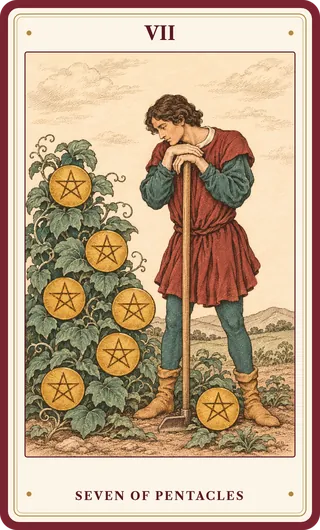
The gardener leaning on his hoe
He has stopped working for a moment, which is the whole point of the card. It shows the pause to assess before deciding whether to carry on.
The pentacle bush
A leafy bush heavy with coins represents slow, living growth rather than instant results. It reminds you that what you have planted is real, but not yet fully ripe.
Seven pentacles
Seven is the number of reflection and review in the tarot. The coins stand for the rewards of effort so far and the question of what they are worth.
The lowest pentacle
One coin sits lower than the rest, close to the ground. It hints at what has already been harvested or what may be falling away unused.
The gardener's gaze
He looks at the crop rather than at the horizon or at you. The answer is found in honest observation of your own results.
The hoe
The tool is resting, not abandoned. It shows that effort has been made and more may be needed, but not this minute.
The green, open field
Earth and cultivated ground tie the card to the suit of Pentacles and to practical, material matters. The calm setting suggests no emergency, only patience.
Health and habits
In health questions, the Seven of Pentacles supports slow, consistent routines. Will this new routine help? Yes, if you give it time, because the body responds to months of habit more than weeks of effort. The card encourages you to measure progress honestly, ignore day-to-day noise and stay with what works.
Reversed, it can point to burnout, inconsistency or a plan that does not suit you. In that case the answer is not to try harder but to adjust the routine. This card is a reflection of effort and patience, not a medical opinion, so please speak to a qualified professional about real health concerns.
Questions where this card works best and worst
The Seven of Pentacles gives its clearest answers to questions that involve effort over time. It struggles with questions that are about fate, luck or sudden events.
It works well for:
- “Is it worth continuing with this?”
- “Will my effort on this project pay off?”
- “Is my business or investment growing?”
- “Should I stay patient with this person or plan?”
It works poorly for:
- “Will I win?” or “Will they call tonight?”
- Questions about events outside your control
- Anything that needs a date
If your question falls in the second group, reword it. “Will I get the job?” is mostly about someone else’s decision. “Is the work I am putting into my applications paying off?” is a question this card can answer. Our list of questions for tarot reading has more examples of well-built questions.
Timing: how long does the yes take?
Timing is the weak point of any single card in a yes or no reading, and this one is deliberately slow. Read it as months, a season or a full growing cycle, never as days. If the question has a deadline shorter than that, the card is telling you the deadline is unrealistic.
You can use the pentacle count to anchor the idea: seven is a number you reach after steady work, not at the start. Some readers translate it loosely as seven weeks or seven months, but treat that as a loose guide and not a calendar. If timing matters a great deal, see tarot timing for ways to ask about it directly.
Try this: Ask the question twice. First: “Is this worth continuing?” Then: “How should I treat the next three months?” Compare the cards. The first gives you the yes or no, and the second shows what the waiting should look like.
Position and neighbouring cards
In a one-card draw, the card speaks for itself. In a spread, its neighbours shape the answer a lot. A strongly positive card beside it, such as the Ten of Pentacles or the Nine of Pentacles, turns the conditional yes into a more confident one. The Ten of Pentacles yes or no page shows what that fuller harvest looks like.
Some pairings to watch:
- Eight of Cups: the review ends in leaving, so a considered maybe about walking away
- Five of Pentacles: hardship or lack of support pulls the answer toward no
- Three of Pentacles: teamwork and skill confirm a yes for projects
- Wheel of Fortune: yes, and a change in timing is close
- Four of Pentacles: you are holding on too tightly, so loosen your grip on the outcome
Position matters too. As the outcome card in a 3-card tarot reading, it suggests that the final result is slow and earned. In the past position, it says the work has been done and you are now seeing its fruit. In the future position, it asks for patience.
How to ask the question properly
Because this card rewards clear thinking, the way you ask matters. Keep the question about your own actions and choices, set a time frame that matches real growth and avoid stacking several questions into one. “Should I keep investing in this business for the next year?” will give a sharper reading than “Will everything work out?”
Decide beforehand what upright and reversed will mean. Many readers use upright as yes and reversed as no, but if you want a fuller answer, treat the Seven of Pentacles as “yes, if” and ask what the “if” is. Then draw a clarifier.
If you want a quick, structured yes or no draw, the yes or no tarot reading tool gives you a simple way to practise before relying on one card for a big decision.
What to do after you draw it
The card gives a short set of instructions, and they work the same whether your answer is yes or no.
- Name what you have already planted and what proof of growth exists.
- Prune anything that is clearly not working.
- Set a realistic review date, such as three months out.
- Keep up the effort that is paying off, without adding panic.
This is why the card reads as calm and practical, not exciting. It does not hand you the result. It hands you a method.
How it compares with other Pentacles answers
Within the suit of Pentacles, each card gives a different shade of answer. The Ace of Pentacles is an opening yes, a seed in hand. The Seven is the waiting yes, after the seed is planted. The Ten is the completed yes, with the harvest in. The Eight of Pentacles yes or no comes just after, and it says yes to the work of skill and practice.
Seen that way, the Seven of Pentacles is the pause between effort and reward. If it turns up when you want an answer now, that is the card’s quiet point: the answer is forming, and you will see it more clearly if you stop pulling at the roots and keep looking after the garden.
Questions readers ask
Is the Seven of Pentacles a yes or no card?
Upright, it is a yes with a condition: yes, if you are willing to wait and the effort so far has been sound. It is not a quick yes. Think of it as a green light with a long road ahead.
Is the Seven of Pentacles reversed a no?
Usually it leans no, or at least not like this. Reversed, the card points to wasted effort, impatience or poor returns, so the answer is to change the method before expecting a result.
Does the Seven of Pentacles mean yes in love?
Yes if you are asking whether a relationship can grow with time and care. It is a weaker answer to questions about sudden reunions, instant commitment or fast chemistry.
How long does the Seven of Pentacles take to come true?
Expect months rather than days. The card is about slow growth, so the timing is long and gradual, and it often points to a season of waiting before results show.
What does the Seven of Pentacles mean for a job or business question?
It says the work you have done is building something, and the answer is yes if you keep going. It also asks you to review the results honestly and adjust, not to push ahead blindly.
Should I draw another card if I get the Seven of Pentacles?
If the answer feels too soft, yes. A clarifying card, ideally from the same suit or a strong Major Arcana card, can show whether the waiting will end in a harvest or a rethink.