
Ten of Pentacles as a Yes or No Answer

- Arcana
- Minor Arcana, Suit of Pentacles
- Element
- Earth
- Yes or no
- Yes
wealthlegacyfamily security
setbackspoor planningfinancial worry
The Ten of Pentacles is a yes. Upright, it is one of the steadiest, most reliable yeses in the whole deck, and it speaks best to questions about security, family, home and long-term plans. Reversed, the answer softens to no, or more accurately not yet, because something in the foundation needs attention first.
It is a yes with a particular flavour. It does not promise a fast result or a thrilling leap. It promises something that lasts, built slowly and shared with other people. Below you will find how that plays out for love, money, work and health, when the card leans toward no, and how to word your question so the answer means something.
The short answer: upright and reversed
Upright, the Ten of Pentacles answers yes. The question you asked is likely to lead to a stable, secure and well-supported outcome. If you asked whether a plan will hold up over time, the card says it will.
Reversed, it answers not yet. A reversed Ten of Pentacles tends to show up when the groundwork is weak: money is tangled, a family disagreement is unresolved, or the plan depends on something that is not actually secure. Treat it as a no for the moment rather than a permanent closed door. For a fuller picture of how reversals work in general, see our guide to reading reversed tarot cards.
Here is a quick way to hold both positions in mind:
- Upright: yes, and it will last
- Reversed: no for now, fix the foundations first
- Sideways or unclear: look at the cards around it
Why the Ten of Pentacles says yes
The Ten of Pentacles is the last card of the suit of Pentacles, the suit of the body, work, money and home. By the time you reach the ten, the effort of the earlier cards has paid off. The seed of the Ace has grown, been tended, and now stands as a finished structure.
In numerology, ten is completion, and it also contains a one, so it hints at a new cycle growing out of the old. This is why the card feels so confident. It is not asking whether something might work. It is showing what a finished, working thing looks like, and it is rarely a card of doubt.
The other reason it says yes is that its meaning is inclusive. The success in this card is not one person’s win. It belongs to a whole family or community, which makes it more stable than a victory that depends on a single person. If you want the complete card meaning beyond yes or no, read the full Ten of Pentacles meaning.
What the image tells you about the answer
An older man sits beneath a stone archway, watching a couple, a child and two dogs in a courtyard. Coins are arranged around the scene, and coats of arms mark the arch and his robe. Nobody looks anxious. Everyone is at ease, and that is the answer in picture form.
Notice that the patriarch is slightly apart. He is not busy anymore. His work is done, and what he built is now carrying the family without him. When the card appears in a yes or no reading, ask whether your question is about something that could eventually run on its own, outlasting a single effort. If it is, the yes is strong.
Notice too that the setting is a protected one, with walls and an archway. The card says yes to safety, belonging and continuity. It says less about adventure.
Try this: Look at the card and name one thing in your own life that is like that courtyard: a place, group or habit that supports you without constant effort. Then ask whether your question adds to it or threatens it.
Read Ten of Pentacles for your question
Upright: Yes to commitment, family and a relationship built to last, with shared values and long-term plans behind it.
Reversed: Not yet: money, family pressure or different life goals are getting in the way of a stable bond.
Upright: They feel secure, loyal and ready to build something lasting with you.
Reversed: They feel unsettled or pulled between you and family expectations, so commitment feels heavy.
Upright: Yes to a stable, well-established path with long-term security and a place in a solid organisation or family business.
Reversed: No for now: instability, office politics or a shaky foundation make this the wrong moment to rely on it.
Upright: Yes to lasting wealth, savings, property or an inheritance that supports more than one person.
Reversed: No for now: disputes over money, weak planning or unprotected assets put long-term security at risk.
Upright: Build slowly, think beyond yourself and put your effort into things that will still stand in ten years.
Reversed: Pause, repair the foundations and talk openly about money and family before you commit further.
Upright: Yes to steady, sustainable wellbeing, with good routines, support around you and long-term vitality.
Reversed: No for now: stress from family or money is wearing you down, so rebuild support before pushing on.
Ten of Pentacles reversed: no, or not yet
Reversed, the Ten of Pentacles turns the calm courtyard into a contested one. Think of a family argument over an estate, a business partnership with unclear terms, or a financial plan that looked solid until you checked the details. The answer to your question is no for now, because the security you are counting on is weaker than it appears.
What makes this a “not yet” rather than a hard no is that the card is usually pointing at something fixable. Money can be organised, difficult conversations can be had, and a shaky plan can be strengthened. The reversal is a prompt to do that work before you commit.
If you drew it reversed and want the detail, our page on the Ten of Pentacles reversed goes through love, work and life. For yes or no purposes, the practical rule is simple: do not make a big, hard-to-undo decision while this card is reversed. Shore up what is underneath first, then ask again.
Ten of Pentacles yes or no in love
For love, the Ten of Pentacles is a yes to the serious questions. Will this relationship last? Are we building something real? Could we marry, move in together or start a family? The card favours exactly these questions, because it is about commitment and shared life.
It is a quieter yes for questions about attraction, chemistry or whether someone is thinking about you. Those are matters of feeling in the moment, and this card is about structure over time. If you asked “Does he like me?” and drew it, the more honest reading is that the connection has potential for stability, rather than that he is currently swept away.
Reversed in love, it points to a relationship where the practical side is shaky. This could be money stress, pressure from relatives, or two people who want different kinds of life. The answer is no for now, and the cure is honest conversation about the foundations. For comparison, the Ten of Cups yes or no page covers the emotional counterpart, which is about happiness in the heart rather than security in the structure.
Ex, reconciliation and second chances
People often ask this card about getting back together. Upright, the Ten of Pentacles leans yes if the relationship had a real foundation: years together, shared family, a home or a history that still holds weight. In that case the card says what you built is still standing and can be repaired.
It leans less certain if the relationship was mostly intense and short. A reunion needs more than feelings. The card asks whether the practical side would work this time, such as living arrangements, finances, children and family acceptance.
If you get it reversed on this question, expect the old problems to still be live. Often it is a money, family or lifestyle issue that was never settled. A yes only becomes realistic once those things are addressed in the open.
Ten of Pentacles yes or no for money and career
Money is where this card is most at home. Upright, it says yes to long-term financial security, savings and investments you hold for years, property, a family business or an inheritance. It supports questions like “Will I be financially stable?” or “Is this a sound long-term investment?”
For career, it says yes to established, stable paths: a permanent role, a respected company, a profession with a pension and a future, or a business that supports more than just you. It is not a card for gambling, sudden pivots or get-rich-quick plans. If your question is about a risky startup, the card may still say yes, but it will mean yes to the version with strong foundations and shared stakes.
Reversed, it warns of unstable finances, disputes over money and plans without a safety net. If you are weighing a big purchase or a job change, the Four of Pentacles yes or no page is a useful contrast, since that card is about holding on to money tightly, where the Ten is about money that supports many people.
Try this: Write your money or career question, then add the words “in ten years.” Redraw or reread the card with that timeframe. If the yes still feels right, trust it. If it fades, the answer is about the short term, not the long term.
Home, family and moving
This card is the tarot’s clearest home and family card, so it answers those questions well. Will we buy this house? Will my family be supportive? Is this a good place to settle? Upright, it says yes, especially if the plan involves roots, long-term stays and shared use.
It also speaks to growing a family and to inheritance or family property. Tarot cannot confirm a pregnancy or a specific legal outcome, but the card does point to a family expanding, strengthening or being secured. Treat it as a sign of support, not a guarantee of an event.
When the question is about moving away, cutting ties or breaking from family expectations, the card becomes more cautious. It values continuity, so it may lean no, or at least ask you to be sure you are not throwing away something valuable.
Ten of Pentacles card symbols
Choose a symbol to read what it means on the card.
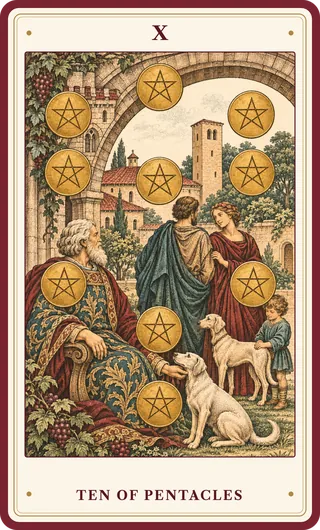
The elderly patriarch
He sits apart from the family and watches over them, calm and content. He stands for wisdom, earned success and the pleasure of seeing your work benefit others.
The stone archway
The arch frames the scene like a gateway into a settled, protected life. It shows security that has been built over time, not won overnight.
The family crests
Coats of arms decorate the arch and the robe. They point to heritage, reputation and values passed from one generation to the next.
The couple and the child
The younger couple and child show the generations living together in comfort. They answer the question of who the success is for.
The two dogs
The dogs greet the family without fear or suspicion. They signal loyalty, trust and a home where everyone is welcome.
Ten pentacles in the Tree of Life pattern
The coins are arranged like the ten points of the Kabbalistic Tree of Life. They suggest wealth that is complete, balanced and fully grounded in the material world.
Health and wellbeing questions
Tarot should not replace medical advice, and a yes or no card cannot diagnose anything. Used as a reflection tool, though, the Ten of Pentacles upright is a gentle yes to questions about sustainable wellbeing: building habits that last, having support around you, and recovering with a stable routine.
It suits questions such as “Is this a healthy long-term routine?” far better than “Will I be cured by next month?” Its strength is steadiness and slow, secure gains.
Reversed, it suggests that stress from money, family or home is affecting your health. The answer is not yet, and the advice is to rebuild your support system, ask for help and simplify before you push harder.
When the Ten of Pentacles leans no
Although it is called a very positive card, there are situations where an upright Ten of Pentacles is a gentle no. These tend to be questions where the thing you want threatens security or tradition.
- Quick wins: a rush, a gamble or a “this week” result
- Breaking away: leaving family, a stable job or a long commitment on impulse
- Pure thrill: choices made only for excitement, with no foundation
- Selfish gain: wins that come at the cost of other people
In each case the card is not refusing you out of fear. It is saying that the thing you want does not fit the lasting, shared kind of success it stands for. Ask yourself whether the answer might be “yes, but slowly and with others” rather than the fast yes you were hoping for.
How strong is the yes, and how long will it take
Among the Pentacles, this is one of the strongest yeses, but strength and speed are different things. The Ten of Pentacles is very sure, and very slow. It operates over years and sometimes generations, so a yes from this card does not mean “by Friday.”
If your question has a deadline, this card is a poor timing guide. It tells you that the outcome is solid, not when it will arrive. For questions where timing matters, our page on tarot timing shows how to read time in a spread.
A helpful rule: the Ten of Pentacles confirms the direction and the quality of the outcome. For the pace, pull a second card or read the surrounding cards.
Ten of Pentacles with other cards
In a spread, the cards around the Ten of Pentacles tune the yes. Some of them strengthen it and some of them ask for caution.
- Ten of Pentacles with the Ace of Pentacles: the yes is real, and a fresh opportunity is how it begins
- With the Four of Pentacles: yes, but watch for gripping too tightly to money or control
- With the Ten of Cups: a double yes for happiness and security in family life
- With the Tower: the foundation is being shaken, so check how stable the structure really is
For the last pairing, see The Tower yes or no to understand how sudden upheaval changes the answer. A Tower beside the Ten does not cancel the card, but it says the stability has to be tested first.
How to ask so the answer is useful
Yes or no questions work best when they are specific and concern something you can act on. The Ten of Pentacles will give you a cleaner reading if your question matches its themes: stability, family, money and the long term.
Good questions for this card include “Will this partnership last?” and “Is buying this home a sound decision?” Weak questions are vague (“Will things be okay?”) or hinge on feeling (“Does he think about me?”). If you need help shaping a question, our list of questions for tarot reading has examples you can adapt.
Draw once, read the answer, and resist the urge to redraw until you get what you hoped for. If you want a fresh draw with a clear question, use the yes or no tarot reading tool and compare the result with what you have read here.
Try this: Before you draw, write down what you hope the answer will be. After you draw the Ten of Pentacles, notice whether your hope was about the long term or the short term. That gap often explains why the card’s answer surprises you.
If you wanted a different answer
Sometimes people draw the Ten of Pentacles and feel disappointed, because they wanted excitement and the card gives them steadiness. That reaction is useful information. It can mean your question was really about thrill, change or escape, and the card is quietly pointing to what is already secure.
Other times the yes feels too good to trust, especially if money or family has been hard. The card does not ask you to ignore difficulty. It says that, on the path you are asking about, the long-term outcome is supported. Whether you believe it, and what you do next, is up to you.
If the answer matters a lot, build your reading out. A three-card line of what supports you, what to watch for and what the outcome is gives more than one card ever can, and is far more honest than asking the same yes or no question again and again.
What to do after you draw it
With an upright Ten of Pentacles, act on the yes, but in the Ten’s style: steadily, with planning, and with the people it affects in mind. Put things in writing, build savings, talk with family and commit to the long game. It is a card that rewards patience.
With a reversed Ten of Pentacles, do the repair work. Look at money, paperwork, responsibilities and family conversations that you have been putting off. Then ask the question again in a week or two, once something has changed.
Either way, the card is on your side. It is the tarot’s way of saying that lasting things are worth building properly, and that you do not have to build them alone.
Questions readers ask
Is the Ten of Pentacles a yes or no card?
Upright, the Ten of Pentacles is a yes. It is one of the most settled and lasting yeses in the deck. It says yes most clearly to questions about security, family, home and long-term plans.
What does the Ten of Pentacles reversed mean as a yes or no answer?
Reversed, it usually means no, or more kindly not yet. The foundations are not secure enough, or family and money tensions need attention first. It is a call to repair before you build.
Does the Ten of Pentacles mean yes in love?
Yes, when the question is about commitment, marriage, moving in together or building a family. It is less clear for fast, casual or purely passionate questions, because this card is about the long term.
Can the Ten of Pentacles ever mean no?
Yes. It can lean no when the question is about a quick win, a risky venture, cutting family ties or abandoning something stable. The card values security, so it resists anything that threatens it.
How long does it take for a Ten of Pentacles yes to happen?
Slowly. This card works on a timescale of years, not days, so expect steady progress rather than a quick result. For short-term timing questions it is not the right card to rely on.
Is the Ten of Pentacles a yes for money questions?
Yes. It points to lasting financial security, savings, property or inheritance. It rewards patient, long-range planning, so the yes holds best when the plan is sound and shared with the people it affects.