
Ten of Pentacles Reversed (Meaning in Love, Work & Life)

- Arcana
- Minor Arcana, Suit of Pentacles
- Element
- Earth
- Yes or no
- Yes
wealthlegacyfamily security
setbackspoor planningfinancial worry
The 10 of Pentacles reversed means the security, family bond or long-term wealth that the upright card promises is under strain. It points to money disputes, family conflict, an unstable financial base or a legacy that is not being handled well. In most readings it is a warning about foundations, not a verdict on your future.
What makes this card different from other “difficult” cards is that it concerns things built to last: homes, savings, families, businesses and traditions. When it turns upside down, the question is not “will something go wrong?” but “which part of what I rely on is weaker than I have admitted?” That is a question you can answer, and this page walks through how, from love and work to health and timing.
Why the card changes meaning upside down
The upright Ten of Pentacles is the card of completion in the material world. It shows wealth that has lasted, a family that has grown around it, and a sense of belonging to something bigger than yourself. As the tenth card of the suit, it closes the story of Pentacles: the effort, saving and patience of the earlier cards have paid off.
Reversed, that completion is interrupted. The cause might be outside you, such as a failing company, a legal dispute or an economic squeeze. It might be inside the family, such as old resentments, unequal treatment or secrets about money. Or it might be inside you, when you realise the life you have built looks stable but does not feel like yours.
If you are new to reading cards this way, the guide to reversed tarot cards explains the different ways a reversal can behave: blocked, delayed, internalised or opposite. The Ten of Pentacles uses all four, which is why the details of your question matter so much.
Key meanings at a glance
These are the themes that come up most often when this card appears reversed:
- Financial instability, debt or a weak safety net
- Family conflict, estrangement or tension over inheritance
- A business, property or plan that is not built to last
- Wealth that is for show, or success that feels empty
- Pressure to follow family tradition or expectations
- A fresh start in how you handle money, family or legacy
Not every reading will touch all of these. Usually one or two stand out, and your question decides which. A question about a partner points to family and values. A question about a job points to stability and fit. A question about savings points to the plan itself.
What the image tells you when reversed
Picture the upright scene: an old man in a rich robe sits under an archway while a couple and child talk nearby and two dogs rest around them. Everything is calm because nothing is being forced. Now flip it. The calm feels fragile. The patriarch, who stands for the person or generation holding the wealth, may be absent, controlling, or stuck in old ways. The couple and child, who stand for the next generations, may be arguing or drifting away.
The archway is worth a moment. Upright, it reads as shelter. Reversed, it can read as a gate that is closed, or as a structure with cracks. The pentacles, arranged in the pattern of the Tree of Life, no longer line up neatly. Something that should flow, whether money, affection or support, has stopped.
Notice, too, that this is one of the few cards in the deck where people of three ages share a frame. Reversed, it often asks you to look at who in your circle is carrying the weight, and who is being left out of the picture.
Try this: Look at the card for one minute and decide which figure you are most like right now: the patriarch, the adult, the child or the dog. Write one sentence about what that figure needs in order to feel secure.
Read Ten of Pentacles for your question
Upright: A relationship with shared values, family approval and a future you can both picture.
Reversed: Money, in-laws or family expectations are straining the bond, or the relationship lacks a solid base.
Upright: They feel secure, committed and proud of what you are building together.
Reversed: They feel unsettled, torn between family pressure and their own wishes, or unsure the foundation will hold.
Upright: A stable, established position with long-term prospects and a sense of belonging.
Reversed: A shaky employer, a family business in conflict, or success that feels hollow.
Upright: Lasting wealth, savings, property and an inheritance that is protected.
Reversed: Unstable income, debt, a disputed inheritance or a safety net that is thinner than it looks.
Upright: Build for the long term and enjoy what you have made.
Reversed: Check the foundations now: review the paperwork, talk honestly and repair what is weak.
Upright: Steady wellbeing supported by good routines and a reliable support network.
Reversed: Stress from family or money worries is wearing you down, and long-term habits or family history need attention.
Ten of Pentacles reversed in love
In love, this card is less about passion and more about the foundation under it. The 10 of Pentacles reversed often shows a relationship where practical things are not lined up: one partner earns much more than the other, plans for living together keep slipping, or the two of you want different futures. It can also suggest a partnership that looks perfect from outside while the private reality is more uneasy.
Family often sits in the middle. In-laws may disapprove, cultural or religious expectations may clash with your choices, or one partner may be tied to a family business or home in a way that leaves little room for the couple. Finances can be the quiet cause: a shared mortgage, unspoken debt, or disagreements about who pays for what.
If you are single, the card can point to a pattern of choosing partners based on security, status or family approval rather than real connection. It can also describe a relationship that cannot grow because there is nothing stable yet to build on. For the opposite picture, where a relationship has settled into lasting contentment, see Ten of Cups reversed, which looks at the emotional side of the same family theme.
Family and home
Family is the heart of this card, so it deserves its own space. Reversed, the Ten of Pentacles can describe a household where money or property is a source of tension: a will that has not been discussed, siblings who disagree about care for a parent, or a family member who holds all the financial power. It can also show estrangement, where distance has grown because of old hurts.
It is not always about conflict. Sometimes it points to a family that is simply not providing what you need, whether that is emotional support, financial help or a sense of belonging. In that case the card invites you to think about chosen family, the friends and mentors who actually show up for you.
It can also describe the moment when you decide not to continue a tradition. You might break a cycle of silence about money, leave a family business, or raise your own children differently from how you were raised. That can bring friction, but it is not a failure. The reversed card simply acknowledges that the old structure does not fit anymore.
Career and business
At work, this card reads as a warning about stability. The company may be struggling, the role may have no real future, or the industry may be shifting under you. If you run a business, particularly a family one, it can point to disputes between partners, a succession plan that has not been made, or growth that has outrun the foundations.
It can also describe a job that looks secure on paper but does not suit you. The pay, title and pension might be excellent, yet you feel as if you are living someone else’s idea of success. This is the reversed card’s quieter message: stability is only worth having if you can actually live inside it.
Practical steps help most here. Update your CV, build contacts outside your current employer, read your contract, and ask for clarity about the company’s plans. If you are the one with authority, the King of Pentacles reversed shows the leadership side of the same problem, such as greed, rigidity or poor stewardship of resources.
Money and finances
For money questions, the 10 of Pentacles reversed is one of the more direct cards in the deck. It can point to unstable income, debts piling up, an investment that is not performing, or a plan that depends on one source of income. It can also describe an inheritance that is delayed, disputed or smaller than expected.
Another meaning is wealth that is only for show. Think of spending on appearances, borrowing to keep up a lifestyle, or a family that looks prosperous but lives close to the edge. The card does not tell you which of these applies, but if the description fits, it is asking for honesty.
The fix is rarely dramatic. Gather your accounts in one place, list what you owe and what is owed to you, check that your will and beneficiaries are current, and build an emergency fund before chasing growth. Compare this with the Five of Pentacles reversed, which shows recovery from real hardship, whereas the Ten reversed often warns before hardship arrives. A structured reading with the money tarot spread can help you see which area needs attention first.
Try this: Spend twenty minutes today writing down the “foundations” of your finances: income, savings, debts, insurance, will. Mark the one that feels weakest and set a date this week to fix it.
Health and wellbeing
The Ten of Pentacles reversed is not a medical card, and it cannot diagnose anything. What it does show is how stability and stress affect the body. Money worry, family tension or the pressure of caring for relatives can wear down sleep, appetite and energy. The card can point to that gap between how stable your life looks and how well you actually feel.
It can also point to inherited patterns, such as family medical history or family habits around food, alcohol or rest. If you draw it with a health question, treat it as a prompt to book the check-up you have delayed and to look at what your routine is built on. Any actual symptoms belong with a doctor, not a card.
Caregiving is another reading. If you are supporting an older relative or managing a family situation, the reversed card may be saying that the support network is stretched thin. Asking for help, whether from siblings, friends or professionals, is the practical response.
As feelings: what someone thinks about you
When a person’s feelings are the question, the reversed Ten of Pentacles suggests they care about security and are not sure they have it with you. They may be hesitant because of money, family opinion or timing. Their uncertainty is often about circumstances rather than about you.
It can also show someone weighed down by family expectations. They may like you, but feel torn between what they want and what their parents, culture or community expect. In that case the card says they are not yet free to choose, rather than that they are not interested.
If the question is about an ex, it can point to unresolved issues from the past, such as shared property, children, family ties or money. Those loose ends keep the connection alive in a way neither of you may have intended. As a person, this card can describe someone from an established family who is struggling with its rules, or someone who looks successful but is quietly stressed about money.
Ten of Pentacles card symbols
Choose a symbol to read what it means on the card.
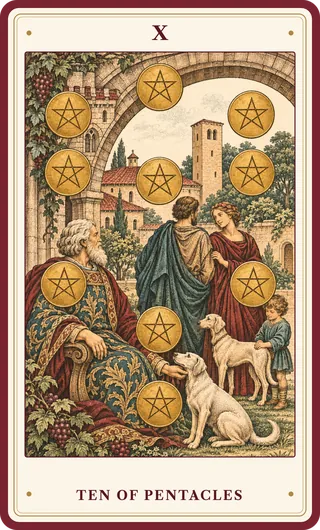
The elderly patriarch
He sits at the edge of the scene, wise and settled, representing wealth built over a lifetime. Reversed, he points to a legacy that is under strain, passed on badly or not passed on at all.
The two dogs
They are loyal, relaxed and part of the household. Reversed, they stand for the trust and ease that has gone missing at home.
The archway and the town
The stone arch frames a secure, established place with walls around it. Reversed, the walls can read as a cage or as a structure with cracks in it.
The couple and the child
Three generations share one space and look at ease. Reversed, they show family members pulling apart, or roles and expectations that no longer fit.
The ten pentacles
The coins form the shape of the Tree of Life, a complete and balanced pattern of material blessing. Reversed, the pattern is broken: something has gone out of balance or stopped flowing.
The patterned robe
His robe is covered in grapes and coins, a sign of abundance earned and enjoyed. Reversed, it hints at wealth for show, or abundance that does not feel like yours.
The coat of arms
A family crest hangs on the gate, marking the name and history carried by this house. Reversed, it raises questions about inheritance, reputation and who gets to carry the name.
Spiritual meaning
On a spiritual level, the reversed Ten of Pentacles asks what you are really building. It can point to a hunger for meaning that a comfortable life has not satisfied. You may have done everything “right” by material standards and still feel that something is missing.
It also invites you to think about ancestry and inheritance in a wider sense: the beliefs, habits and stories you have received from your family, and which of them you want to keep. Some are gifts. Others are burdens you were never asked about. Reversed, the card gives you permission to sort one from the other.
This is also a card of Earth, linked in many traditions to Mercury in Virgo, which suits the practical, detail-minded work it calls for. Spiritual growth here looks like careful, steady tending: honouring what is good in your roots and quietly changing what is not.
Yes or no
As a yes or no answer, the 10 of Pentacles reversed leans towards no, or at least “not yet”. The upright card is one of the strongest yeses in the deck, so its reversal naturally shifts the answer. If you are asking whether a purchase, partnership or family plan will work out, the card says the foundations are not ready.
The nuance is that this is a no about stability, not about everything. If you are asking “should I leave this family business?” or “should I stop trying to meet everyone’s expectations?”, the reversed card can support a yes, because the structure you are leaving is not serving you. The meaning of the answer depends on whether your question is about keeping a structure or leaving one. You can see the full reading for this card on the Ten of Pentacles yes or no page.
In past, present, future and outcome positions
The position tells you how much weight to give the card:
- Past: a family or financial instability shaped you, or a security you once had was lost. This often explains why you now feel cautious about money or trust.
- Present: the foundations are being tested right now. Look for the specific pressure point and act on it.
- Future: a warning. If you continue as you are, instability or conflict may follow, but you have time to change the course.
- Outcome: the result may fall short of lasting security, so ask what would make it sturdier before you commit.
As advice, the reversed Ten of Pentacles is a suggestion to slow down any big commitment, such as buying a home, merging finances or signing a family agreement, until the details are solid.
Is it always a bad sign?
No, and this is where many readings go wrong. The reversed Ten of Pentacles is a warning card, and warnings can be acted on. It rarely means ruin. More often it describes a gap between appearance and reality, and the gap can be closed once you see it.
It can also be a sign of healthy change. Someone leaving an inherited path, setting boundaries with relatives, or deciding to build their own wealth rather than depend on family money may draw this card. The upheaval is real, but so is the independence that follows.
Timing is another clue. The upright card describes things that take years to form, so the reversed version often points to slow-moving issues that have been building for a while rather than something that happens overnight. Treat it as a long-term review, not an emergency, unless the cards around it say otherwise.
Cards that change the reading
Neighbouring cards sharpen the message. A few combinations come up often:
- With the Tower: a sudden shock to your finances or family structure. Respond quickly and calmly.
- With the Four of Pentacles: fear of loss leading to control or hoarding. See Four of Pentacles reversed for the pattern.
- With Justice: legal matters such as wills, contracts or divorce settlements.
- With the Sun or the Star: reassurance that the problem is temporary and that recovery is possible.
Court cards tell you who is involved. A King or Queen often points to a parent or authority figure, while a Page can show a young family member or a new start. Swords cards suggest the problem is communication, and Cups cards suggest that emotion is driving the money or family issue.
What to do when you draw it
Use the card as a checklist rather than a sentence. Pick one area where it applies and take a small, concrete step within a week.
- Name the foundation that feels weak: money, family, work, home or health.
- Write down what you know and what you are guessing. Many fears about money or family shrink once facts replace assumptions.
- Have the conversation you have been putting off, whether about a will, shared costs or expectations.
- Make one structural fix, such as opening a savings account, updating a document or setting a boundary.
- Revisit the card in a month and see what has changed.
If you pulled the card in a spread, ask a follow-up question like “what would make this stable?” and draw one more card. Many readers find the answer comes from the card that follows, not the one that raised the alarm.
Try this: Draw one extra card with the question “What strengthens my foundation?” Write down one action from its meaning and do it before the day ends.
Ten of Pentacles upright versus reversed
The simplest way to remember the difference is that upright shows what has been built and is lasting, while reversed shows what is cracked, blocked or unfinished. Upright is the family dinner where everyone belongs. Reversed is the same table with an empty chair, an unpaid bill or an argument no one wants to start.
Both cards share the same subject: security over time. Upright, you can rest in it. Reversed, you have work to do before you can. That work is usually practical, and it is almost always possible, which is why a reversed Ten of Pentacles is better treated as a useful alert than as a bad omen.
Questions readers ask
What does the Ten of Pentacles reversed mean?
It means the stability, family security or long-term wealth shown by the upright card is shaky, blocked or not what it seems. Think money disputes, family friction, a weak financial plan or a legacy that needs repair. It is usually a warning to fix foundations, not a prediction of ruin.
Is the Ten of Pentacles reversed a bad card?
It is uncomfortable, but rarely disastrous. Most of the time it points to something you can still act on, such as an unclear will, a budget with no cushion, or a family pattern that needs honest talk. The surrounding cards show how serious it is.
Does the Ten of Pentacles reversed mean divorce or separation?
Not on its own. It can show strain over money, in-laws or family expectations, and in some readings that strain is serious. Look at the cards around it before reading it as an ending.
Is the Ten of Pentacles reversed a yes or no?
Usually a no, or a not yet. The upright card is a strong yes, so reversed it suggests the foundations are not ready, especially for questions about money, property or family plans.
What does the Ten of Pentacles reversed mean for money?
It points to unstable income, debt, a poorly planned investment or a family money dispute. It can also mean looking wealthy without having real security. The fix is usually practical: a budget, an emergency fund and clear paperwork.
Can the Ten of Pentacles reversed mean a positive change?
Yes. It can describe someone breaking an unhealthy family pattern, leaving a business or tradition that no longer fits, or building security on their own terms rather than inheriting it. The change may feel uncomfortable at first.