
Ten of Cups Reversed (Meaning in Love, Work & Life)

- Arcana
- Minor Arcana, Suit of Cups
- Element
- Water
- Yes or no
- Yes
harmonyfamilyhappiness
emotional blockswithdrawalimbalance
The Ten of Cups reversed means the happiness this card promises is blocked, strained or not as real as it looks. Upright, the Ten of Cups shows a loving home and lasting emotional fulfilment. Reversed, there is a crack in that picture: tension in the family, partners who want different things, or a life that seems complete from outside and feels hollow inside.
It is a card of the gap between the ideal and the real. The longing for harmony is still there, and often the love is too, but something is in the way. That might be unspoken resentment, unrealistic expectations, old family patterns or simply neglect. This guide covers what the card means in love, work, money, health and family, how to tell which version of it you are looking at, and what to do once it shows up.
What the Ten of Cups reversed means at a glance
The core idea is simple: happiness is possible but currently blocked. The upright Ten of Cups shows a family under a rainbow, with nothing left to chase. Turn it over and the rainbow is still in the sky, but you cannot quite step into it.
Common keywords for the reversed card are family discord, broken or unstable home, disconnection, misaligned values, unmet expectations, disillusionment and a lack of harmony. Some readers also see a quieter meaning: you may not be appreciating what you already have, because you are busy comparing your life with an ideal.
Notice what the reversal does not say. It does not say the love is gone, and it does not say the family is doomed. It says the picture has slipped out of alignment, and that something needs honest attention before it can slip back.
Why the rainbow cracks: reading the reversal
In the Rider-Waite-Smith image, Pamela Colman Smith painted a couple with their arms raised and two children dancing beside them. The cups arch overhead as a rainbow, which is a lovely image because a rainbow is real and temporary at once. The card has always asked for gratitude in the present moment, because this kind of joy is not guaranteed to stay.
Reversed, that gratitude is the thing that goes missing. Either life has genuinely become harder, or the reader is holding it up against a version of happiness that no real household could match. Both are worth looking at, and they call for different responses. One needs repair. The other needs a gentler, more realistic standard.
The Ten is also the final number in the suit. In tarot numerology, ten marks a cycle reaching its end, and in the Golden Dawn tradition this card is linked to Mars in Pisces, a feeling-heavy sign with a fighting planet in it. That fits the reversal: strong emotion under pressure, looking for somewhere to go. The suit itself is water, so everything here is about feeling, connection and what we do or do not say.
Blocked, performed or broken: three ways to read it
Because the card is so broad, it helps to ask which version applies to you. Most readings fall into one of three.
- Blocked: the care is real, but something is in the way. Money stress, a busy schedule, a sulk that never got repaired, an in-law who interferes.
- Performed: the life looks right (the house, the holiday photos, the family gatherings) but nobody feels close. This is the “perfect from outside, hollow inside” reading.
- Broken: the connection has actually split, through separation, estrangement, a move or a loss, and the card is mourning the picture that did not come true.
Look at the cards around it and at your own question. If the Ten of Cups reversed lands beside the Five of Cups, the blocked or broken reading gains weight, because that card is about grief over what has spilled. Beside a bright card like the Sun, the situation is more likely a temporary cloud than a lasting fracture.
Try this: Write down three sentences starting “From outside, my home life looks like…” and three starting “From inside, it feels like…”. The distance between the two lists is what the card is pointing at.
Read Ten of Cups for your question
Upright: A settled, loving partnership with shared values and a future you both want.
Reversed: A relationship that looks fine from outside but feels distant, or two people who want different futures.
Upright: Deep contentment, belonging and gratitude.
Reversed: Disappointment, loneliness inside a full life, or a sense that something essential is missing.
Upright: A workplace where you feel at home and your success supports the rest of your life.
Reversed: A job that looks good on paper but drains you, or a team that performs harmony without feeling it.
Upright: Shared security and enough to make home life comfortable.
Reversed: Tension over money at home, or a comfortable income that has not bought the peace you expected.
Upright: Notice the good you already have and let yourself enjoy it.
Reversed: Say what is true, drop the picture-perfect script and repair what can be repaired.
Upright: Emotional ease, good rest and the lift that comes from close company.
Reversed: Stress carried from home, isolation, or burnout from keeping up appearances.
Ten of Cups reversed in love
In a relationship reading, the card most often points to two people who care about each other but are not facing the same way. One wants children, the other does not. One wants to settle, the other keeps the door ajar. Or the couple is stable and polite, but real conversation stopped some time ago.
It can also show outside forces pressing on the bond: meddling relatives, a stressful move, a difficult step-family situation, or a social image the couple is trying to maintain. In some readings the reversed Ten simply describes an unconventional partnership that does not follow the usual script, which can be a strength rather than a flaw if both people are content with it.
What the card asks of you in love is honesty. The couple under the rainbow is happy because they look at the same sky. If you cannot say what you want without fear, that is the first thing to repair. The Relationship Tarot Spread is a useful way to lay out what each person needs and where the two of you meet.
Ten of Cups reversed as feelings
When you are asking how someone feels about you, the reversed Ten shows feelings that are real but complicated. They may want the closeness the upright card shows and still be held back by fear of conflict, unresolved history, or doubt that the relationship can hold. It does not usually mean they feel nothing.
It can also describe your own feelings. You may feel unfulfilled, disconnected from what once made you happy, or lonely even while surrounded by people. That loneliness inside a full life is one of the most recognisable versions of this card, and it deserves to be taken seriously rather than brushed off as ingratitude.
Reading someone else’s feelings from one card is always limited, so treat the answer as a mood rather than a verdict. A second card for “what would help?” will tell you more than a repeated search for their hidden heart.
If you are single
For singles, the Ten of Cups reversed rarely says you will never find love. It more often shows that you are carrying beliefs about family, marriage or the ideal partner that make real relationships feel disappointing before they begin. Dating can bring loneliness, poor communication or a string of near-misses that leave you doubting the picture altogether.
It can also point backwards, to the family you grew up in. If the home you knew was tense or unpredictable, you may be wary of building one, or you may be unconsciously recreating its patterns. The card invites you to notice this without blame.
A small shift helps here. Instead of aiming for the whole rainbow, look for one honest, warm connection at a time: a friend, a sibling, a neighbour. The Ten of Cups reversed often softens once belonging is rebuilt in small pieces.
Family and home
This is the card’s home territory. Reversed, it commonly describes family discord, a tense household, a split between generations or a home that does not feel safe. It can show a family that gathers for holidays and performs closeness without feeling it, or one member carrying a cost that nobody else has noticed.
Sometimes the card points to generational patterns: old arguments, silences or roles repeating in new relationships. If you recognise that, the card is not asking you to fix your family. It is asking you to stop passing the pattern forward.
For those hoping to start a family, a few readers connect the reversed card with delays or fertility worries. Treat that gently. A tarot card cannot diagnose anything, and if this is a real concern, a doctor will help far more than a spread.
Try this: Pick one relative or housemate and plan one small, specific act of warmth this week, such as a call, a shared meal or a short honest message. Watch what shifts.
Ten of Cups reversed in career
At work, the card describes a place where harmony has become strained or merely performative. The office may look polished while colleagues feel isolated, tense or unsupported. You might be in a team that smiles in meetings and says nothing real, or in a job where success has come at the cost of your home life.
It can also describe the odd disappointment of reaching a goal and feeling little. You got the title, the pay rise, the corner office, and the rainbow did not appear. The reversed Ten asks what the career was meant to earn, and whether the people you were building it for are still in the picture.
On the practical side, the card can mean work-life balance has tipped. It can also, in a few readings, just point to a career in social work, family services or care, where the subject matter is families under strain. Check the question you asked before choosing a reading.
Ten of Cups reversed in money
In financial readings, the reversed card links money and the household. Arguments over spending, a partner and you pulling in different directions, or financial insecurity making home life tense are the common meanings. The money itself may be fine, and the problem may lie in how you talk about it.
It can also mean that material comfort has not delivered the peace you hoped for. A bigger house or a better income does not repair a household that has stopped talking. In that case, the card quietly suggests that your real wealth lies in connection, and that you may be undervaluing it.
Practically, it is a good moment to sit down together and agree on shared goals before making big purchases or risky investments. If you are weighing a financial decision, compare this card with the Ten of Pentacles reversed, which covers family wealth and legacy strain from the material side.
Health and wellbeing
For health questions, the reversed Ten of Cups points to emotional rather than physical causes. Stress carried from home, isolation, poor sleep from rumination, or the exhaustion of keeping up appearances can all show up here. It is a nudge to look after your emotional health as seriously as your physical health.
If you feel lonely or low, the card suggests reconnecting with people who care about you, even if the effort feels large. If you are the family caretaker, it may be asking whether anyone is caring for you. As always, tarot is no replacement for medical or mental health advice, and a persistent low mood is worth discussing with a professional.
Ten of Cups card symbols
Choose a symbol to read what it means on the card.
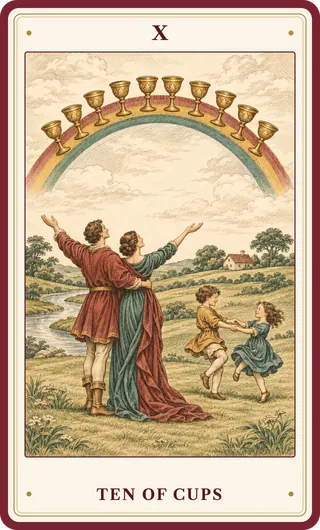
The rainbow of ten cups
Ten golden cups arc across the sky as a rainbow, a blessing that is real but fleeting. Reversed, the rainbow reads as faded or out of reach: the happiness is imagined clearly but not yet lived.
The couple with raised arms
The two adults stand close with arms lifted toward the cups, grateful and united. Reversed, they become the question of whether the pair are truly looking the same way.
The two children
The children dance freely beside their parents, showing innocence and the next generation. Reversed, they point to how family tension lands on the youngest and to patterns handed down.
The cottage
A modest home sits in the distance, a symbol of shelter and belonging. Reversed, the house can be a shell: a place you live in but do not feel at home in.
The river and green land
A calm river runs through fertile, green land, showing emotional flow and abundance. Reversed, the water slows or stagnates, and feelings go unspoken.
The cups themselves
Cups are the suit of emotion, and ten is the full measure of it. Reversed, the cups still hold something, but it is hard to drink from them.
Unrealistic expectations and the pressure to be happy
One of the most useful ways to read this card is as a check on perfectionism. The upright Ten of Cups is so idyllic that it can become a standard no real family meets. Social media, family expectations and our own stories about what a good life should look like all feed that.
The reversed card shows up when that standard has begun to hurt. You may be disappointed in a perfectly decent partner because they are not a fairytale. You may feel like a failure because your household is noisy, untidy and sometimes cross. Seen this way, the reversal is not a warning of loss but an invitation to put the script down.
This overlaps with the Six of Cups, the card of nostalgia and childhood memory. If both appear, ask whether you are measuring the present against an idealised past.
Is the Ten of Cups reversed a yes or no?
For a yes or no question, the reversed Ten of Cups leans towards no, or more accurately “not yet.” The upright card is one of the strongest yeses in the deck for questions about love, family and contentment. Reversed, it says the conditions are not right, or that a problem must be dealt with first.
Context matters. If you ask “will we get back together?” the card suggests the old harmony is not available as it was, though a different, more honest arrangement might be. If you ask “should I stay in this home?” it points to the need to look at what is actually happening there. Our Ten of Cups yes or no page covers both positions in detail.
Use the card as a signpost rather than a verdict. A reversed Ten with a clear next step attached, such as an honest talk or a boundary, often turns a “no” into a “yes, once this is done.”
What to do when you draw it
The best response to the Ten of Cups reversed is small and honest. You do not need to rebuild your whole life. You need to find the one place where the picture and the reality part ways, and say something true about it.
Here is a simple order to follow:
- Name the gap in one sentence, without blame.
- Decide whether it is blocked, performed or broken.
- Choose one person to talk to and one thing to say.
- Drop one expectation that has been making everyone feel like they are failing.
- Revisit the card in a week or two.
If the card appears as advice, take it as permission to stop performing happiness and to start building the real thing. Honest conversations are rarely comfortable, but they are the only route back to the warmth that the rainbow stands for.
Ten of Cups reversed in past, present and future positions
In a past position, the card suggests a childhood or earlier relationship where the ideal never quite arrived, and where some old hurt still shapes your choices. It can also describe a happy period that has ended, with the reversal marking the loss.
In the present, it shows where the strain is right now: the room, the relationship, the team. This is the most common position for the card to feel uncomfortably accurate.
In a future position, treat it as a caution rather than a fixed outcome. It shows what will happen if the current gap goes unaddressed, and it points to the choices that would change it. In a three-card spread, the card on either side often tells you whether the strain is easing or growing.
Cards that often sit beside it
Pairings change the tone sharply. With the Two of Cups reversed, the strain is between two people. With the Three of Cups reversed, friendship or community is part of the problem, with gossip or exclusion at work. With the Eight of Cups, walking away from a situation that no longer feeds you becomes a real possibility, and the reversed version of that card suggests staying out of fear.
Pairings with Swords usually point to words: arguments, cold silences or a painful truth finally being said. Pairings with Pentacles bring in money, property and practical arrangements. A Sun or Star nearby is a good sign that the clouds are passing.
The card’s closest cousin in the suit, the Page of Cups, can show a message or a small gesture of reconciliation, which may be exactly the first step the reversed Ten needs.
Upright versus reversed: what changes
The upright Ten of Cups is about arrival. The reversed Ten is about the distance between where you are and where you hoped to be. Upright brings gratitude, harmony and a sense of home. Reversed brings tension, disconnection and a lingering question about whether the picture was ever true.
Some readers, and some decks, handle reversals differently. If you do not read reversed cards, the Ten of Cups upright can still carry a shadow side: complacency, pretending, or clinging to an image. If you do read them, the guide to reversed tarot cards shows the main ways to interpret them, whether as blocked energy, internal energy or the opposite meaning.
Either way, the card is best understood as a mirror. It does not decide your family’s fate. It shows you where the love is waiting, and what is currently standing between you and it.
Try this: Draw one more card and ask, “What would help me close this gap?” Write the answer in one sentence and act on it within a day.
Frequently misread points
A few mistakes come up often. The first is assuming the card predicts divorce or a family breakdown. It can describe a break, but most often it describes strain that can still be mended. The second is treating it as a judgement on you. The card describes a situation, not your worth.
The third is reading it only through romance. Many people draw it about work, a friend group or their own sense of belonging, and the symbolism of the home and the shared sky applies to all of them. The fourth is overlooking the role of expectation, which is the quiet cause of many reversed Tens.
Hold the card gently. Its message is that happiness has not left. It has been misplaced, and you are being shown where to look.
Questions readers ask
What does the Ten of Cups reversed mean?
It means the happy picture of the Ten of Cups is under strain. There may be tension at home, mismatched values in a relationship, or a life that looks right but feels empty. The fulfilment is usually still possible, just blocked for now.
Is the Ten of Cups reversed a bad card?
Not in the sense of a doom prediction. It is an honest card that shows where the gap is between how things look and how they feel. Seeing that gap clearly is the first step to closing it.
Is the Ten of Cups reversed a yes or no?
Usually a not yet, or a yes only after a problem is dealt with. For questions about long-term love, family or contentment, treat it as a no for now and ask what needs to change.
What does the Ten of Cups reversed mean in love?
It points to a relationship where something has gone quiet: different dreams, unspoken resentment, outside pressure or a polished surface with little closeness underneath. If you are single, it can show old beliefs about love and family that you are still carrying.
What does the Ten of Cups reversed mean as someone's feelings?
Their feelings are usually real but complicated. They may care deeply and still feel doubt, fear of conflict, or disappointment that the relationship is not what they hoped for.
Can the Ten of Cups reversed mean a broken family?
It can describe family discord, distance or a household that has split, but it does not always predict a break. Often it shows strained harmony, old patterns repeating, or a family that performs closeness without feeling it.