
The Tower Reversed: Meaning in Love, Work & Life

- Arcana
- Major Arcana, card 16
- Element
- Fire, Mars
- Yes or no
- No
sudden changeupheavalrevelationawakening
avoiding disasterdelayed changefear of change
The Tower reversed means a collapse that is being delayed, avoided or lived through quietly on the inside. Upright, the lightning strikes and the structure falls. Reversed, the lightning is held back, or you are the one holding it back, or the strike has already happened and you are sorting through what is left.
It is not a clean reprieve. In most readings the underlying problem is still there, and the card asks whether you will take it down on purpose or wait for pressure to do it for you. This guide covers each of those readings, how they play out in love, work, money and health, and how to tell which one applies to your spread. For the full card, start with the upright Tower meaning.
The Tower reversed at a glance
The Tower is card XVI of the Major Arcana, linked to Mars and fire in many traditions. Its upright meaning is sudden upheaval, revelation and the fall of false foundations. Reversed, the same energy is blocked, slowed or turned inward.
The most common keywords for The Tower reversed are:
- Delayed or avoided collapse
- Fear of change and clinging to what is crumbling
- Inner upheaval that does not show on the surface
- Recovery and rebuilding after a crisis
- Disaster narrowly missed, at least for now
Which keyword fits depends on the question, the position in the spread and the cards around it. The sections below take them one at a time.
Why it is not simply “disaster avoided”
Many short guides give The Tower reversed one meaning: you dodged the bullet. That reading is possible, and it feels good, but it is the least common one in practice. A reversed card rarely cancels an upright card. It changes how the energy shows up.
Think of it this way. The Tower exists because something in your life was built on a false base: a story you told yourself, a role that no longer fits, a relationship held together by silence. Turning the card over does not repair the base. It changes the timing and the style of the fall.
If you do feel relief when the card comes up, check whether the relief is earned. Have you actually fixed the problem, or have you only postponed finding out how bad it is? A genuine near miss usually comes with a clear reason you can name. A postponed one usually comes with a feeling of tension that has not gone anywhere.
Four ways to read The Tower reversed
Most interpretations fall into four overlapping categories. Your job is to decide which one fits the question, and the question itself usually tells you.
The collapse is delayed
The pressure is building but has not broken. You may be putting off a conversation, a decision or an admission. This is the reading to reach for when the person asking already half knows what is wrong.
The upheaval is internal
Nothing dramatic is happening outside, but your beliefs, values or sense of direction are shifting. This is a quieter Tower, often felt as restlessness, doubt or a growing sense that your old answers no longer work. You are the one questioning the structure rather than having it knocked down for you.
You are resisting change
You see the cracks and are working hard to hold the wall up. This might mean over-managing, people-pleasing, keeping up appearances or refusing to hear bad news. It is exhausting, and the card is asking you to notice the cost.
You are in the aftermath
A Tower event has already happened, and the reversed card marks the stage after: shock, sorting through the rubble, deciding what to keep. Here the advice is to rebuild with more honesty and not try to restore the old version exactly as it was.
Read The Tower for your question
Upright: A sudden revelation, argument or break that shatters a relationship built on something untrue.
Reversed: A problem you both know about but keep postponing, or a slow unravelling after a crisis has already passed.
Upright: Shock, panic and the sense that the ground has gone from under them.
Reversed: Strong emotion held down under a calm surface, with fear of what would happen if it came out.
Upright: Redundancy, a collapsed project or an overnight change that ends the way things were done.
Reversed: Clinging to a role or plan you suspect is failing, or recovering after a shake-up at work.
Upright: A sudden financial shock such as a lost income, a big bill or a plan that falls apart.
Reversed: A money problem being ignored or patched up, or a situation less dire than you fear.
Upright: Let the false structure fall and use the clearing to build something honest.
Reversed: Take the structure down on your own terms before pressure does it for you.
Upright: A sudden scare, flare-up or diagnosis that forces you to stop and change course.
Reversed: Symptoms or stress you are putting off facing, or steady recovery after a health shock.
The Tower reversed in love
In a relationship reading, The Tower reversed most often points to the thing nobody is saying. There may be a betrayal, a deep mismatch, resentment or a truth that would end the relationship as it stands if it came out. Both people sense it and carry on around it. The relationship can look calm while the tension grows underneath.
It can also describe a slow ending: a relationship that is over in everything but name, where one or both people are delaying the actual break because of fear, guilt, money, children or the pain of starting again. If you have been through a painful breakup recently, the card may be showing that you have not yet faced what it meant.
There is a more hopeful reading too. If a couple has just come through a crisis and stayed together, The Tower reversed says the relationship is changed, not destroyed. The advice is not to try to return to how things used to be. For single people, it can mean you are holding on to a past relationship or a pattern that keeps you from letting someone new in. If you are weighing a relationship question, a relationship tarot spread gives more detail than a single card.
Try this: Write down the one thing in your relationship, or your love life, that you have not said out loud to the other person (or to yourself). Do not decide anything yet. Just notice whether writing it makes your chest tighten or loosen.
The Tower reversed as feelings
When you pull this card to describe how someone feels about you or a situation, it often shows strong emotion kept under control. The person may be anxious, overwhelmed or in turmoil, but not showing it. They may be afraid that if they admit what they feel, something will fall apart.
This is not a sign of indifference. If anything, a reversed Tower suggests too much feeling rather than too little, locked behind a composed face. It can also mean they are avoiding a confrontation with you, with themselves or with a difficult truth about the connection.
For a deeper look at how this card reads as someone’s emotions, see The Tower as feelings. Remember that a card can only reflect the energy around a situation, so use it as a prompt for a real conversation rather than a replacement for one.
The Tower reversed as a person
As a person, The Tower reversed describes someone holding a lot of suppressed tension. They may look steady, even rigid, while worrying about everything that could go wrong. They tend to avoid conflict, hold on to old ways, and keep things from falling apart through sheer effort.
It can also describe someone who has recently gone through a major upheaval and is still processing it. They may be raw, defensive or prone to sudden outbursts that seem out of proportion. If the card represents you, the kindest reading is that you are under more pressure than you let on.
In a workplace setting, this can be the manager who refuses to admit a project is failing, or the colleague who is quietly overwhelmed. In family readings, it often points to someone who keeps the peace at a high personal cost.
The Tower reversed in career
At work, the card often shows a role, plan or business model that is struggling while you keep it going. You might be holding on to a job that has stopped fitting, avoiding a hard conversation with a boss, or ignoring warning signs of layoffs or burnout. The card sometimes also confirms that you have taken sensible steps and kept your position through a rough patch.
If you feel relieved, that is a good sign. If you feel flat or trapped despite having avoided disaster, ask whether the thing you protected was worth protecting. Sometimes this card appears to shake someone out of a comfortable routine they would never leave voluntarily. Compare it with the restless pull of the Eight of Cups, which is about walking away from something that no longer feeds you.
After a restructure or a sacking, The Tower reversed can describe the recovery period: updating your CV, rebuilding confidence and deciding what you want next. Treat it as a stage of repair rather than a fresh wave of bad news.
The Tower reversed in money
In money readings, The Tower reversed often points to a financial problem that is being ignored, patched or hidden. Debt that has not been looked at, a budget that depends on an optimistic guess, or a shaky investment held on to out of pride can all fit. The card is less about a sudden loss and more about the strain of keeping things going.
It can also say that your situation is less dire than you fear. If you have been dreading a number, the reversed card can suggest that facing it will be less painful than staying in suspense. Either way, the practical advice is the same: look at the actual figures.
Avoid risky or impulsive financial moves while this card is in play, since the foundations may not be as sound as they appear. If you want a structured way to look at your finances, try the money tarot spread.
The Tower reversed in health
Health readings should always be treated as reflection, never as medical advice. With that said, The Tower reversed can show a health scare that turns out to be smaller than feared, or recovery after a sudden event. It can also point to stress, anxiety or symptoms you have been putting off dealing with.
The common thread is avoidance. If the card prompts you to book an appointment you have been delaying, that is a good use of it. For emotional health, it can signal suppressed shock or trauma that may benefit from support from a professional you trust.
The Tower card symbols
Choose a symbol to read what it means on the card.
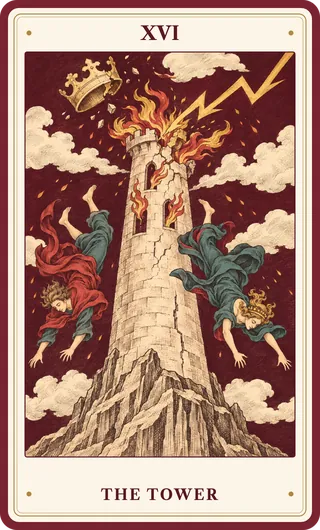
The tower on the crag
A tall stone tower sits on a narrow mountain peak, built high but on shaky ground. It stands for a structure, belief or arrangement that looks solid but rests on weak foundations.
The lightning bolt
The bolt strikes from a black sky and breaks the tower open. It is sudden truth or insight arriving whether you invite it or not, and reversed it can be the strike you are bracing against or holding back.
The crown
A large crown is knocked off the top of the tower. It points to ego, status and the belief that you are in control being broken apart.
The two falling figures
A man and a woman are thrown headfirst from the windows. They show how a collapse pulls people out of their places of comfort and into open air, where they can no longer pretend.
The flames
Fire pours from the windows and the lightning sparks flames inside the walls. This is the destruction that comes from within as well as from outside, which matters most when the card is reversed.
The falling sparks
Small flame shapes, often described as Hebrew letters called yods, drift down through the air. They suggest that energy and meaning are released when the structure breaks, not simply lost.
The dark sky and rocky ground
The background is black and grey with no horizon in sight. It reflects the disorientation of a crisis, and a reversed card can mean you are staying in that fog by refusing to look.
The Tower reversed and inner change
The reversed Tower has a spiritual side that upright readings tend to skip. Because the change is internal, it often appears when your beliefs, values or sense of purpose are being questioned. You may find you can no longer believe something you once took for granted.
This can feel unsettling because there is no outside event to blame. There is just a slow awareness that your old framework does not fit. The card encourages patience: you do not need to rebuild your worldview overnight, and you do not need to pretend you are sure.
Some readers see this as the gentler version of the Tower’s awakening, where you choose to tear down an old idea yourself. The lightning is still coming, but it arrives as an insight and not as a shock.
Try this: Complete the sentence “I keep this going because I am afraid that…” five times in a row, writing quickly. Circle the answer that surprises you most.
The Tower upright versus reversed
The simplest difference is where the force comes from. Upright, change is external, sudden and often unwelcome. Something happens to you: a revelation, a firing, a break. Reversed, change is internal, slow or resisted. You are either causing it, delaying it or recovering from it.
The speed also differs. Upright Tower events tend to be sharp and complete. Reversed Tower situations drag on, with tension that is neither released nor resolved. That is why some readers find the reversed card harder to live with than the upright one: the waiting is the difficulty.
The emotional tone also shifts. Upright, the card brings shock, then clarity. Reversed, it brings anxiety, avoidance, and sometimes numbness. If you want to understand how the position of a card changes its meaning in general, how to read reversed tarot cards explains the main approaches.
Is The Tower reversed a yes or no?
Usually a no, or a not yet. The Tower asks whether the thing you are building is on solid ground, and reversed it implies that you are not ready to look. If you ask whether a plan will work and draw this card, the likely message is that the foundation needs checking before you proceed.
That said, it is not a flat refusal. The card sometimes means the feared event will not occur, which is a yes to “will I be okay?” For a full breakdown, see The Tower as a yes or no answer. For questions about stability, a reversed Tower leans toward no. For questions about avoiding a threat, it can lean toward yes, with a warning to stay alert.
Reading it with the cards around it
Context decides which meaning of The Tower reversed is correct. A few pairings come up often:
- With Death reversed: resistance to an ending that is already overdue.
- With The Devil reversed: the first signs of breaking free from a pattern, helped by the Tower’s cracks.
- With the Nine of Swords: anxiety about the fall that may be worse than the fall itself.
- With The Sun or The Star: recovery and relief are real, and the near miss is genuine.
Position matters as well. In a past position, it describes a collapse you have not fully processed. In the present, it shows the strain of holding things together. In the future, it warns of a crisis you can still influence. If you often use spreads, the 3 card tarot layout is a clear way to see this progression.
How long does it take?
The Tower reversed does not give you a date. Because it describes delay, it often points to a situation that has dragged on for weeks or months, and it can continue until you act. The timing is usually tied to how long you are willing to wait before looking at the problem.
If you are asking when something will happen, the card suggests that the pressure is already close to a tipping point, but that you have some control over how it lands. Take a look at tarot timing for methods that do not rely on a single card.
What to do when you draw it
You do not have to wait for the fall. The most useful response is a small, deliberate step that lowers the pressure before it becomes a crisis.
- Name the structure you are propping up. Be specific: a job, a promise, a belief, a relationship.
- Ask what you would do if you knew it would fall within a year.
- Choose one honest action that tests the foundation, such as a conversation, a budget review or a medical appointment.
- Plan for support, whether friends, a counsellor or a financial adviser, before you take the action.
- Revisit the card in a week and see what has changed.
Taking the structure down yourself is almost always gentler than having it taken down for you. You decide the pace, what to keep and what to let go.
Try this: Pull one extra card from your deck (or use a random card draw) and ask, “What does the ground look like once this is cleared?” Write down the first image or word that comes to you.
Common mistakes when reading it
The first mistake is treating the card as a guarantee. Reversed Tower does not promise that nothing will happen, and it does not promise that something will. It describes a tension and invites you to deal with it.
The second is over-dramatizing. This is not the catastrophe card in reverse. Most of the time it is about ordinary avoidance, such as an unanswered email, an unspoken doubt or a budget not checked, and it comes with ordinary solutions.
The third is ignoring your own role. A reversed card puts you closer to the controls than the upright version does. You may be the one delaying the fall, which means you are also the one who can choose to change it.
Questions readers ask
What does The Tower reversed mean in tarot?
The Tower reversed usually means a collapse that is delayed, avoided or happening quietly on the inside. It can also mean you are living through the aftermath of a Tower event and rebuilding. It rarely means the underlying problem has gone away.
Is The Tower reversed a bad card?
No. It is less dramatic than the upright card and often gives you more choice. The warning is that putting off a needed change tends to make the eventual fall bigger, so it is best used as a prompt to act early.
Does The Tower reversed mean disaster avoided?
Sometimes, particularly if the surrounding cards are positive and the situation really has settled. More often it means the disaster is postponed or that you are working hard to keep it away. Ask what you are propping up and whether it is worth the effort.
What does The Tower reversed mean in love?
It often points to a relationship problem both people sense but avoid discussing, or to a slow-motion ending rather than a sudden one. It can also describe a couple rebuilding after a crisis. The relationship is rarely stable until the truth is spoken.
Is The Tower reversed a yes or no?
Usually a no, or at least a not yet. The foundation of the plan is shaky, or you are delaying an honest look at it. A reversed Tower leans toward fix the base first and ask again.
How is The Tower reversed different from The Tower upright?
Upright, the change arrives from outside, fast and without permission. Reversed, it is slower, internal, resisted or already behind you. The energy is the same: something false is coming down.