
Death Reversed (Meaning in Love, Work & Life)

- Arcana
- Major Arcana, card 13
- Element
- Water, Scorpio
- Yes or no
- No
endingstransformationtransitionrelease
resisting changestagnationfear of endings
Death reversed means resistance to a change that is already due. You may be clinging to a job, relationship, habit or version of yourself that has ended in everything but name, and that refusal is keeping you stuck. Less often, the card describes a slow, private transformation that is happening out of sight and has not yet reached the surface of your life.
The card is not a prediction of literal death, and it is not a punishment. Upright, Death says the ending is happening and you are moving with it. Reversed, the ending is still waiting for you to cooperate. Below you will find what that looks like in love, feelings, work, money and health, how to tell which version applies to you, and what to do next.
Death reversed is not a literal death
The most common fear about this card is that it predicts someone dying. It does not. In tarot, Death is the thirteenth Major Arcana card and it stands for endings, transitions and the clearing away of what is finished. Reversing the card does not make it more literal or more ominous. It changes the question from “what is ending?” to “why is it not ending?”
Waite, who guided the artwork for the Rider-Waite-Smith deck, linked the reversed card with inertia, lethargy and a kind of frozen sleep. That is still the best one-line summary: life has stopped moving because something that should have been released is still being held.
If you are asking a question about someone’s health or mortality, tarot is the wrong tool. Treat the card as a mirror for your attitude to change and let medical or legal questions go to people qualified to answer them.
The main meaning: resistance to necessary change
The core of Death reversed is resistance. You know, at some level, that a chapter is over. The job no longer fits, the relationship has stopped growing, the old story about who you are has worn thin. But the thought of the empty space afterwards feels worse than the discomfort of staying, so you stay.
This is why the reversal often feels like limbo. Nothing dramatic is going wrong, yet nothing is moving either. You may notice yourself rehearsing old arguments, keeping things you no longer use, putting off a decision for the fourth time, or telling yourself you will deal with it when conditions are better.
The card is not scolding you. Fear of endings is human, and it usually protects something real: security, belonging, a sense of identity. The reversal simply names what is going on, so the choice becomes conscious instead of automatic.
The second meaning: a slow, private transformation
Not every Death reversed is about avoidance. Sometimes the card shows change that is real but slow and internal. You may be reworking your beliefs, grieving quietly or outgrowing a role without announcing it to anyone. From the outside nothing looks different. On the inside, a great deal is shifting.
In this reading the card is gentler. It tells you the process is not yet finished and cannot be rushed. The upright card is a clean break, while the reversed card is more like a long convalescence. You are letting go in stages instead of all at once.
This meaning tends to show up when you feel tired, reflective or oddly detached, rather than anxious or panicked. If the card appears alongside restful or reflective cards such as The Hermit, the quiet-transformation reading is more likely.
Read Death for your question
Upright: Something in your love life has already ended, and you are holding on to it, whether that is an ex, an old pattern or a relationship that stopped working.
Reversed: Change is happening quietly inside you or the relationship, and it needs time and honesty before anything shows on the surface.
Upright: They know something must change but feel afraid, stuck or attached to how things used to be.
Reversed: They are processing a private shift in how they feel and may not be ready to talk about it yet.
Upright: You are staying in a role, industry or identity you have mentally outgrown because leaving feels too risky.
Reversed: A deep rethink of your goals and values is under way, even though nothing has visibly changed at work.
Upright: You are avoiding a financial reset, such as a budget overhaul, a debt plan or ending a failing venture.
Reversed: Your relationship with money is slowly restructuring, and patience will pay off more than a dramatic move.
Upright: Stop negotiating with an ending, name what is finished and choose one small step toward releasing it.
Reversed: Trust the slow work, give yourself privacy and rest, and let the change finish at its own pace.
Upright: Stress, stagnation or a refusal to adjust habits may be wearing you down, and a change in routine is overdue.
Reversed: You are in a recovery or adjustment phase that is slow but real, so rest and consistency matter more than quick fixes.
How to tell which meaning applies to you
The same card can describe two quite different situations, so context matters. A few questions help separate them.
- Do you know what needs to end? If yes and you are avoiding it, read the card as resistance. If you cannot name it, read it as a slow process still taking shape.
- How does it feel? Dread, guilt and a nagging sense of “I should” point to resistance. Calm exhaustion and a need for solitude point to quiet transformation.
- What do the neighbouring cards say? Stuck or fearful cards around it support resistance. Cards of rest, healing or insight support the inner-change reading.
If you are still unsure, draw a clarifying card and ask directly: “What am I holding on to?” or “What is changing beneath the surface?” Pull from your own deck, or use the random tarot card generator if you are reading on screen. For more on how to approach any upside-down card, see this guide to reading reversed tarot cards.
Try this: Write down the one thing you suspect has already ended in your life. Next to it, write what you are afraid will happen if you let it go. Read the second line out loud and ask whether that fear is a fact or a guess.
Death reversed in love
In love, Death reversed usually describes an attachment that has outlasted its purpose. For someone in a relationship, it can mean a partnership that has been quietly ending for a long time, with both people avoiding the conversation that would make it official. It can also describe a couple that needs to change how they relate, perhaps dropping an old dynamic or rebuilding trust, and is resisting that work.
For singles, the card often points backwards. It can mean you are still emotionally tied to an ex, a past hurt or a type of partner who keeps repeating the same pattern. Fear of being alone is a common driver. The card suggests that the empty space after letting go is temporary, and that it is the thing which makes room for something better.
It is not always about leaving. Sometimes the ending that is needed is of a habit, such as keeping score, withholding, or hiding your needs, rather than of the relationship itself. A relationship can survive a “Death” if both people are willing to let the old version end.
Death reversed as feelings and as a person
When Death reversed describes how someone feels about you, it suggests they are caught between two states. They may be struggling to move on from a past relationship, afraid of the change that being with you would bring, or unable to say what they really feel. The card often points to hesitation more than lack of interest, though it rarely signals clarity or commitment. You can compare this with how the upright card reads in Death as feelings.
As a description of your own feelings, the card shows an inner tug of war. Part of you wants to move forward and part of you is gripping tightly to what is familiar. Naming that conflict honestly is usually the first relief.
When the card stands for a person, it describes someone who resists change, avoids endings, or lives in the past. They may be loyal and steady, but they struggle when circumstances demand adaptation. It can also describe someone going through a quiet, deep personal change who is not ready to share it.
Death reversed in career
At work, Death reversed often means staying too long in a role you have already left emotionally. You may have outgrown the position, the company or the whole field, yet you keep postponing the decision to move because the next step is unclear. The result is stagnation: no promotions, no new learning and a growing sense of going through the motions.
The card can also point to an outdated professional identity. You may still define yourself by a title, a past success or a path that made sense ten years ago. The reversal asks whether that story still fits.
If your job is under pressure, such as restructuring or redundancies, Death reversed can show you resisting what is coming instead of preparing for it. Quietly updating your CV and making contacts now costs far less than being caught unprepared. Compare this with the more forceful upheaval described in The Tower, where change arrives without asking.
Death reversed in money
Financially, the card suggests avoidance. This might mean ignoring a debt, refusing to look at a failing business, holding on to a spending habit that no longer works, or clinging to an investment out of sentiment. The money is not lost yet, but the unwillingness to restructure may be costing you.
The reversal also hints at a deeper layer: your relationship with money may need to change before your circumstances will. Old beliefs about scarcity, worth or risk can keep you repeating the same patterns, whatever your income.
On a hopeful note, the card does not forecast ruin. It asks for a calm audit. List what is working, what is draining you and what you are afraid to look at. The step that feels most uncomfortable is usually the one that frees the most.
Try this: Spend ten minutes looking at your bank statements or budget with one rule: no judgement, just notes. Circle one recurring cost or commitment that belongs to a past version of your life, and decide whether to end it this month.
Death card symbols
Choose a symbol to read what it means on the card.
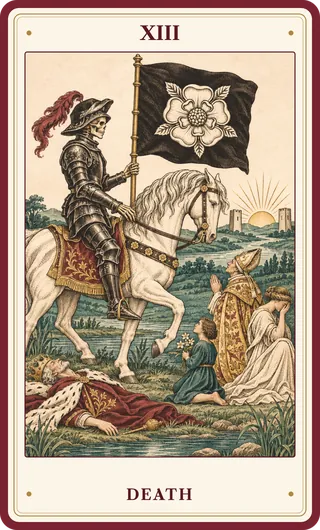
Skeleton in black armour
Death is shown as a rider in full armour, a figure that cannot be bargained with or stopped. Reversed, the same figure becomes the change you keep trying to delay.
White horse
The pale horse carries Death steadily forward at a walking pace. It stands for the unhurried, certain nature of an ending, and reversed it suggests that pace is being resisted or slowed.
Black flag with a white rose
The rose is a symbol of purity and new life set against a dark background. It shows that the card is about renewal, and reversed it reminds you that the new life is still on offer.
Fallen king
The king lies under the horse, showing that status and power do not exempt anyone from endings. Reversed, it points to pride or control that makes letting go harder.
Bishop, maiden and child
The bishop prays, the maiden turns away and the child offers flowers. Each shows a different response to loss, and reversed they ask which of those responses you are stuck in.
Rising sun between two towers
In the distance the sun rises between two towers, a sign that a new day follows the ending. Reversed, it suggests the dawn is close but you are not yet looking at it.
River and boat
A river flows through the background with a boat on it, a classic image of passage from one state to another. Reversed, it shows a crossing that is delayed, not cancelled.
Death reversed in health and spirituality
In health readings, Death reversed does not predict illness or death. It more often shows stagnation: habits that no longer serve you, stress you have been pushing through, or a recovery that is slow because you are resisting rest or a change in routine. Treat it as a prompt to adjust, not as a diagnosis, and see a professional for any real health concern.
Spiritually, the card describes a transition that is stuck. A belief, a role or a grief may need to be released, but you are not yet ready. It can also show the deeper, quieter shedding of an old self, the kind that takes seasons, not weeks.
Emotionally, expect fatigue and mixed feelings. People drawing this card often report feeling in between: no longer who they were, not yet who they are becoming. That discomfort is normal and does not mean you are doing it wrong.
Death reversed vs The Tower, The Hanged Man and Eight of Cups
Several cards are easy to confuse with Death reversed. The difference is in who is choosing and how fast things move.
The Tower is sudden, external upheaval. Death reversed is the opposite: a change you are slowing down from within. If The Tower breaks your structure, Death reversed leaves it standing long after it should have come down.
The Hanged Man is a deliberate pause. You are suspended by choice, looking for a new perspective. Death reversed is a pause by avoidance. Both feel like waiting, but only one has a purpose.
Eight of Cups is walking away on purpose. Death reversed is the version where you know you should walk away and cannot. If Death reversed appears with the Eight of Cups, you may be close to the moment of decision.
Death reversed as a yes or no
Most readers treat Death reversed as a no, or at least a “not yet.” The thing you are asking about is waiting on an ending that has not happened, so the new beginning cannot arrive. If you ask “Will this relationship move forward?” or “Will I get a new job?” the card says the old situation has to be released first.
There is one common exception. If your question is “Should I end this?” or “Am I ready to let go?”, the card may be a gentle push toward yes, since the reversal points to something already finished. Ask yourself whether the card answers the question or the question is hiding the real issue.
For a fuller breakdown of how the card behaves in simple questions, see Death as a yes or no answer. As with any one-card draw, a clarifying card gives more detail than the first card alone.
The symbols in the Death card and what they say when reversed
The Rider-Waite-Smith image shows a skeleton in black armour riding a white horse. Everyone in the scene, from the fallen king to the bishop and the child, responds to him differently, but no one stops him. The picture teaches that endings are not negotiable, only your reaction to them is.
In the background, the sun rises between two towers. This is the detail most often missed, and it is the point of the whole card. The ending is not the end of the picture. When the card appears reversed, it is as though you are standing with your back to that sunrise.
The white rose on the black banner works the same way, as a symbol of life that continues. Taken together, the symbols argue that the reversal is not about doom. It is about a delay in turning toward what comes next.
Reading Death reversed in a spread
Position changes how the card lands. In the past position, it describes a change you avoided or a loss you never fully processed. In the present position, it shows where you are stuck right now. In the future position, it warns that if you keep avoiding the ending, the same situation will repeat.
In a three-card reading, try it as the middle card with a cause on the left and a way forward on the right. In longer layouts such as the Celtic Cross, look at what sits beside Death reversed: the cards around it often show what you are holding on to and what is waiting once you let go.
Pairings help too. With cards of fear or attachment, the resistance reading gets stronger. With cards of rest or insight, the slow-transformation reading does. With cards of fresh starts, it suggests the new beginning is ready and only your willingness is missing.
What to do when you draw Death reversed
The card is useful because it gives you something to act on. A simple sequence works for most people.
- Name the ending. Write one sentence about what you already know is over.
- Name the fear. What do you think will happen if you let go?
- Find the smallest step. This is not the full goodbye, just one concrete action, like a conversation, a resignation draft or a cleared shelf.
- Mark the loss. Even welcome endings deserve a moment of acknowledgement.
- Leave room. Do not fill the gap at once. The space is where the new thing starts.
If the card feels more like quiet transformation than avoidance, skip the action steps and focus on rest, journaling and patience. You do not have to force change that is already happening on its own.
Try this: Pull one more card and ask “What becomes possible when I let go?” Place it next to Death reversed and describe the pair in one sentence, as if it were a headline for the next chapter of your life.
Death reversed in a nutshell
Death reversed is about the gap between knowing and doing. It does not take change away. It shows you the ending has not been completed, whether through fear, habit or a slow inner process that is not done yet. Read upright, Death is the clean ending. Reversed, it asks you to stop holding the door shut.
When it appears, resist the urge to read it as bad news. It is among the more honest cards in the deck. It tells you where you are stuck, why, and that the way forward is short once you stop arguing with it.
Questions readers ask
What does Death reversed mean in tarot?
Death reversed usually means you are resisting a change that is already due, or holding on to something that has ended. It can also mean a slow, private transformation is under way. It is almost never about literal death.
Is Death reversed a bad card?
No. It is uncomfortable because it points to stagnation and fear, but it is also honest and useful. It shows exactly where you are stuck and gives you the chance to move before life forces the issue.
Does Death reversed mean someone will die?
No. Death reversed is a card about endings, resistance and renewal, not about physical death. Tarot readers treat it as symbolic, and a reading should never be used to predict someone's death.
What does Death reversed mean for love?
It often points to a relationship or pattern that has run its course but has not been let go of. For singles it can mean lingering attachment to an ex or fear of changing how you date. In a couple it can mean one or both of you are avoiding a needed conversation.
Is Death reversed a yes or no?
Usually a no, or at least a not yet. The answer depends on whether something has to end before the thing you are asking about can begin, and reversed suggests that ending has not happened.
What is the difference between Death reversed and The Tower?
The Tower is sudden change that happens to you from outside. Death reversed is change you are avoiding from within. The Tower breaks the structure, while Death reversed leaves it standing past its time.