
The Hermit Reversed: Meaning in Love, Work & Life

- Arcana
- Major Arcana, card 9
- Element
- Earth, Virgo
- Yes or no
- Maybe
solitudereflectioninner guidancesearching
isolationlonelinesswithdrawal
The Hermit reversed means that solitude has stopped serving you. Either you have pulled away from people so far that you feel lonely and stuck, or you have been avoiding the quiet time and inner work you need. It can also mean the opposite of both: your period of retreat is finished and the card is nudging you back into the world with what you have learned.
Which of those applies depends on your question and the cards around it, and this guide shows you how to tell. Below you will find the reversed Hermit in love, work, money, health and spirituality, as someone’s feelings, as a yes or no answer, and as advice you can act on this week. If you want the foundation first, start with the upright Hermit meaning.
What the Hermit reversed means
The upright Hermit is card nine of the Major Arcana, a robed figure on a snowy peak holding a lantern. He has chosen to be alone because that is where he finds the truth. Reversed, that choice goes wrong somewhere. The retreat is no longer a deliberate act of wisdom, and what was restful becomes cold, heavy or avoidant.
The core keywords are isolation, loneliness, withdrawal, avoidance, losing your way and refusing guidance. None of these is a verdict on your character. They describe a pattern that has probably built up slowly: a few cancelled plans, a few unanswered messages, a habit of keeping your thoughts to yourself until it feels normal.
The reversal also carries a quieter, more hopeful meaning. A Hermit who comes down the mountain is a teacher, and a reversed card can show the moment of return. You will see this reading often when someone has finished a long stretch of study, grief, recovery or solo work and is about to rejoin their life. If the rest of your spread feels warm and forward-moving, lean toward this version.
Two ways the Hermit turns upside down
It helps to hold two separate readings in mind, because they point in nearly opposite directions. In the first, you are alone too much. In the second, you are alone too little, and you are dodging it.
The first reading is too much solitude. You have withdrawn from friends, family, colleagues or a partner. You may call it self-care or independence, but it has tipped into loneliness, rumination or a fear of being seen. The Hermit reversed asks whether you are healing or hiding.
The second reading is too little solitude. You keep every hour full, stay surrounded by noise, and never sit with a question long enough to hear your own answer. Here the card warns against using busyness, company or distraction to avoid something you already suspect. The fix is not more people. It is a deliberate, scheduled amount of quiet.
How to tell which reading you are looking at
Start with the question you asked. If it was about loneliness, a stalled project, a relationship that feels distant, or a friend who has gone quiet, the “too much solitude” reading is usually the right one. If it was about a decision you keep postponing, a restlessness you cannot explain, or a pattern you keep repeating, the “avoiding solitude” reading often fits better.
Then look at the neighbouring cards. Swords and Cups cards in difficult positions tend to confirm isolation and emotional distance. Active cards, such as Wands, or cards of arrival and completion suggest the return. If the cards beside it are mixed, trust the one that makes you feel a small, honest flinch. A reversed card that lands too neatly is worth a second look.
You can also ask a direct follow-up and pull one more card. Something like “What am I avoiding by staying alone?” or “What would help me come back?” gives you a specific next step. For more on how reversals behave in general, see our guide to reading reversed tarot cards.
Try this: Write two lines. First: “Being alone lately has felt like ___.” Second: “The thing I am keeping quiet is ___.” If the first line is filled with relief, you are probably resting. If it is filled with heaviness, the reversed Hermit is describing isolation.
Read The Hermit for your question
Upright: Upright, the Hermit asks for slow, honest self-knowledge before you let someone in.
Reversed: Reversed, it shows loneliness, emotional distance, or a person who shuts others out instead of saying what they need.
Upright: Upright, someone is quietly sorting through what they feel and needs space to do it.
Reversed: Reversed, they feel disconnected, closed off or confused, and may be hiding the feeling even from themselves.
Upright: Upright, focused solo work, research and deep specialist skill pay off.
Reversed: Reversed, you are working in a silo, avoiding feedback, or stalling a decision with endless analysis.
Upright: Upright, a careful private review of your finances brings clarity.
Reversed: Reversed, fear or shame keeps a fixable money problem hidden, and you may need an adviser instead of going it alone.
Upright: Upright, step back, turn the noise down and listen to your own judgement.
Reversed: Reversed, come back down the mountain: reach out, accept help and bring what you have learned into daily life.
Upright: Upright, rest, quiet and retreat restore your energy and settle your mind.
Reversed: Reversed, isolation is wearing on your mood, or constant busyness is stopping you from resting at all.
The Hermit reversed in love
In a love reading, the reversed Hermit most often points to emotional distance. One person has gone quiet, stopped sharing, or begun treating their feelings as private property. It can show loneliness inside a relationship, where two people share a home but not much else. It can also show the fear of intimacy that follows an old hurt, where pulling away feels safer than risking it again.
If you are single, the card often says you have been out of circulation for too long. That may have been wise after a breakup, but now the shell is thick enough that nobody can reach you. You might also be telling yourself you are “just not a dating person” when the truth is that you are afraid. The reversed Hermit does not push you into a relationship. It asks you to start small: say yes to one invitation, reply to one message, let one conversation run past comfortable.
In a partnership, the reversed Hermit asks for conversation, not distance. If you are the one withdrawing, say what you need, such as an hour alone on Sunday afternoons, in words rather than silence. If your partner is the one pulling back, resist the urge to chase. Give them a clear, low-pressure invitation to talk and a little time to answer.
The Hermit reversed as feelings
When you ask what someone feels about you and draw the Hermit reversed, the answer is rarely coldness. More often it is confusion or retreat. They may feel lonely, closed off, or unsure how to say what is going on inside. They may be avoiding you precisely because the feelings are strong and they do not trust themselves to handle them.
This card does not tell you their intentions, only their state. Someone in a reversed Hermit mood is not good at initiating or following through. If you are waiting for a grand gesture, you may wait a long time. A clear, kind message that makes it easy to reply will tell you more than any card. You can read more about how this card sits in that position in the Hermit as feelings.
About an ex: the reversed Hermit can suggest they are struggling with disconnection since the breakup, or that they have shut the door to protect themselves. It is not a reliable sign of a return. It is a sign of someone who is not yet reachable.
The Hermit reversed in career
At work, the reversed Hermit shows a person who has been working alone for too long, or in the wrong way. You may be keeping your best ideas private, refusing feedback, or overpreparing because finishing means being judged. Analysis paralysis is a classic form of this: one more spreadsheet, one more course, and the decision still does not get made.
It can also show feeling like an outsider on your team. Perhaps you have been put in a role with little contact, or you have stopped joining meetings and conversations because they drain you. The card is not telling you to become the loudest person in the room. It is telling you that a small increase in visibility would change things.
There is a positive version too. If you have spent months building, researching or studying alone, the reversed Hermit can mean the quiet phase is complete and it is time to present the work, ask for a mentor, or apply for the role. Think of the Hermit finally turning the lantern outward so other people can use its light.
The Hermit reversed in money
In a money reading, this card usually points to fear and secrecy. You may be avoiding opening a statement, or hiding a debt from a partner, or trying to solve a complicated problem entirely on your own because asking for help feels like failure. The problem is often smaller than the dread around it.
The reversal suggests getting an outside view. That might mean a free debt advice service, an accountant, a friend who is good with numbers, or a conversation with the person you share finances with. Private reflection about money is fine. Private secrecy about money is what the reversed Hermit warns against.
It can also describe a scarcity mindset that leads you to withdraw from opportunities: not applying for a raise, not attending the networking event, not asking what a project pays. If this lands, a gentle push toward one small public step will do more than another month of quiet worrying.
The Hermit reversed in health and wellbeing
For health, the Hermit reversed often reflects the mood side of isolation. Long stretches without company can flatten motivation, sleep and appetite, and the card may be a prompt to notice that. It can also point to withdrawal from medical care, such as putting off an appointment because you would rather not know the answer.
If the card shows up alongside heavy cards such as the Nine of Swords, take it seriously and talk to someone you trust or a health professional. Tarot is a reflective tool, not a diagnosis, and a reading that raises concern about your mood is a reason to reach out, not a reason to wait it out alone.
The other reading applies here as well. If you are always on and never still, the reversed Hermit is a plain request for rest. Ten minutes of silence with no phone is a modest start, and it works better than a dramatic digital detox you will not keep.
The Hermit card symbols
Choose a symbol to read what it means on the card.
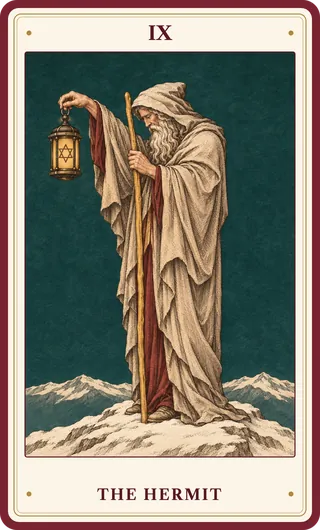
The lantern
The lantern holds the Hermit's small, steady light, the wisdom he has earned. Reversed, the light points at the ground or dims, which suggests wisdom going unshared or a person who has lost sight of their own guidance.
The six-pointed star
Inside the lantern sits a six-pointed star, a sign of balance between inner and outer worlds. Turned over, it asks whether you have kept that balance or tipped entirely into withdrawal.
The staff
The staff is the Hermit's support and authority as he climbs. Reversed, it can mean you are leaning on no one, or refusing the guidance a good teacher could offer.
The grey cloak
The long grey robe and hood show someone who has set aside status and show. Reversed, the same cloak reads as hiding, a way of staying unseen.
The snowy peak
The Hermit stands on a high, cold summit, far from crowds. Reversed, the height can feel like exile rather than clarity, a place too lonely to stay.
The bowed head
His head is lowered and his gaze turns inward and downward. Reversed, that inward gaze can become rumination, or a refusal to look up and meet other people.
The grey, empty sky
The background is bare and still, free of distraction. Reversed, the emptiness can feel like numbness or a life with too little in it.
The Hermit reversed in spirituality
Spiritually, the Hermit is the seeker, and the reversed card can show a seeker who has gone too far inside. You may have built a private practice that no longer connects to anything or anyone. A meditation group, a teacher, a retreat with other people, or even a conversation with a friend who shares your interests can restore balance.
It can also describe the reverse: avoiding spiritual practice or inner work because it brings up uncomfortable material. If you have been skipping journaling, therapy, prayer or whatever your form of quiet reflection is, the reversed Hermit nudges you back to it.
A third meaning is the end of a seeking phase. Wisdom that stays on the mountaintop is not much use. The reversed Hermit can mean you know enough now to teach, write, share or simply live differently, and that doing so is the next stage of the work.
The Hermit reversed as a person
As a person, the reversed Hermit is someone who has withdrawn so far that being alone has become part of who they are. They may be shy, guarded, private to the point of secrecy, or stubborn about taking advice. They can come across as aloof when they are actually uncomfortable.
It can also be a person who cannot be alone: the friend who always needs company, who fills every silence, and who panics when plans fall through. In both cases the common thread is a poor relationship with solitude, whether too much or too little.
If the card describes you, there is nothing to fix so much as rebalance. If it describes someone else, patience and clear, low-pressure invitations work better than demands.
The Hermit reversed as yes or no
The Hermit is a “not yet” card in its upright form, and the reversed Hermit is less a flat no than a redirect. For questions about reconnecting, sharing your work, ending a period of isolation or reaching out to someone, it leans yes. For questions about withdrawing further, going it alone or making a major decision without input, it leans no.
Where a question is about someone else’s behaviour, such as whether a person will contact you, the card suggests they are not currently open. Our dedicated page on the Hermit as a yes or no answer goes through both orientations in detail.
As with any yes or no pull, the useful part is the reason attached. If the card says “not like this,” ask what a better version would look like and draw again.
Advice when the Hermit shows up reversed
The most useful response is small and specific. The aim is to rebalance solitude and company, not to swing from one extreme to the other.
- Contact one person today with a simple message, even just “I’ve been quiet lately, how are you?”
- Decide what you are avoiding and name it in a sentence on paper.
- Schedule real alone time, with a start and finish, so quiet becomes a choice and not an escape.
- Ask for one piece of help or feedback you would normally try to manage alone.
- Share one thing you have been working on or thinking about with someone who is likely to be kind.
None of these needs a large change of lifestyle. The Hermit reversed is about breaking an old pattern, and patterns shift through repeated small acts.
Try this: Put a lantern on your calendar. Pick two evenings this week: one for solitude, with a phone-free hour of reading, walking or journaling, and one for company, with a call, coffee or meal. Notice which one you resist more.
Cards that often appear with the Hermit reversed
Some pairings sharpen the meaning. The Hermit reversed beside the Four of Swords reversed suggests rest that was never fully taken, and a return to activity that may be too early or too forced. Next to the Three of Cups reversed, it points to a social life that has frayed, with friendships that have drifted or a group you have stepped away from.
Alongside the Eight of Cups, you may be looking at a walk away that was meant to bring clarity but has turned into drifting. With the High Priestess, the question is whether your silence is wisdom or secrecy. With the Sun, the Star or the World, the reversed Hermit usually shows the end of a hard stretch and the arrival of company and light.
Context matters more than any fixed formula. A single card can mean opposite things depending on its neighbours, so read the whole spread as one story.
Common misreadings of the Hermit reversed
The first mistake is assuming the card means you should never be alone. Healthy solitude is not the problem. The question is whether being alone restores you or shrinks you.
The second is treating it as a prediction of permanent loneliness. It describes a current pattern and, almost always, a way out. The third is reading it as only negative. A reversed Hermit that shows a return to the world is often one of the more encouraging cards in a spread about recovery or change.
The last common mistake is ignoring the avoidance version altogether. If a reversed Hermit keeps appearing and you are surrounded by people, ask honestly what you have been outrunning. That kind of recurring card usually has a specific answer.
Try this: Pull the Hermit reversed again tomorrow with the question “What is the next small step out?” Use a 3 card tarot spread with past, present and next step, and write down one action you can do within a day.
Hermit upright versus reversed at a glance
Upright, the Hermit finds the mountain peaceful, and reversed, he finds it cold. That one contrast explains most of the differences. Upright solitude is chosen, purposeful and temporary. Reversed solitude is unchosen, aimless or open-ended.
Upright, the lantern lights the way. Reversed, it either dims from neglect, points at the ground, or sits unlit because the person is afraid of what it will show them. Upright, the Hermit seeks answers. Reversed, he is either stuck in the question or running from it.
Upright, the card says: “Go inward, you will find what you need.” Reversed, it says: “You have been inside long enough, or not long enough. Look honestly at which.” Either way, the lesson is the same: use your solitude well, then bring what it gives you back to the people around you.
Questions readers ask
What does the Hermit reversed mean in tarot?
The Hermit reversed means solitude has stopped helping you. Either you have withdrawn so far that you feel lonely and cut off, or you have been avoiding the quiet reflection you need. It can also mean the time for retreat is over and it is time to rejoin people.
Is the Hermit reversed a bad card?
No, it is a corrective card, not a doom card. It points at a pattern, usually isolation or avoidance, that you can change. Many readers also see it as a welcome sign that your retreat is complete.
What does the Hermit reversed mean in love?
It often shows loneliness, emotional distance or someone who withdraws instead of communicating. For singles it can mean you have been hiding from dating for too long. In a couple it asks for honest conversation about what each person needs.
What does the Hermit reversed mean as someone's feelings?
The person may feel disconnected, confused or closed off, and they may be pulling away rather than reaching out. It does not automatically mean they have stopped caring. It often means they are struggling to say what they feel.
Is the Hermit reversed a yes or no?
It leans toward yes when the question is about coming out of retreat, reconnecting or sharing your work. It leans toward no when the question is about staying isolated or rushing ahead without reflection. Read it as a yes to connection and a no to hiding.
What is the difference between the Hermit upright and reversed?
Upright, the Hermit chooses solitude on purpose to find clarity. Reversed, solitude is unwanted, overdone or being dodged altogether. The upright card finds the mountain peaceful, and the reversed card finds it cold.