
The Hermit as a Yes or No Answer

- Arcana
- Major Arcana, card 9
- Element
- Earth, Virgo
- Yes or no
- Maybe
solitudereflectioninner guidancesearching
isolationlonelinesswithdrawal
The Hermit is a “no” in most yes or no readings, but a gentle one: it means “not yet, look first” rather than “never”. Upright, it asks you to step back, stop collecting other people’s opinions and think the matter through alone. The answer turns to yes when your question is about study, rest, solitude or inner work. Reversed, it usually flips toward yes, because the quiet time is over and it is time to act or rejoin people.
That makes the Hermit a card of timing as much as outcome. It does not say your plan is bad. It says you do not have all the information yet, and the person who most needs to find the answer is you. Below you will find how to read it upright and reversed, how the answer shifts across love, work, money and health, and how to ask a question the Hermit can actually answer.
Why the Hermit leans toward no
The Hermit is the ninth card of the Major Arcana. Nine sits at the end of a single-digit cycle, so the card carries a feeling of completion, review and taking stock before something new begins. A figure standing alone on a mountain at that stage is not about to sign a contract or send a text. He is looking at what he has learned so far.
In the Rider-Waite-Smith image, an old man in a grey cloak holds a lantern with a six-pointed star in one hand and a staff in the other. The lantern lights only a small circle around his feet. That detail matters for yes or no readings: you are being shown enough to take the next step, not enough to promise a result. When a question needs a confident “go”, a card that only lights the next step reads as “wait”.
For a fuller picture of the card outside of yes or no questions, see the Hermit tarot card meaning. The yes or no reading simply compresses that meaning into a direction: inward first, outward later.
The Hermit upright: a “not yet” more than a hard no
A hard no in tarot comes from cards of loss, collapse or blockage. The Hermit is nothing like those. Nothing is being taken from you. What the card removes is the pressure to decide now. Think of it as “no to this speed” instead of “no to this goal”.
In practice, a Hermit answer often sounds like this: you need more information, you need more time, or you need to be honest about what you actually want before you ask anyone else. If your question was “Should I tell them how I feel this week?”, the Hermit says hold off. If it was “Will this still matter to me in six months?”, the Hermit says spend time finding out.
This is why the card pairs so well with a second, clarifying draw. Pulling one more card to ask “what do I need to understand first?” turns the Hermit’s pause into something you can use.
Try this: Write your yes or no question on paper, then write one sentence beginning “Before I can answer this, I need to know…” Draw the Hermit’s lesson from whatever you wrote, and set a date within two weeks to revisit the question.
When the Hermit is a yes
The Hermit is a yes whenever the thing you are asking about looks like the Hermit himself. Solitude, study, research, writing, mentoring, meditation, a quiet retreat, a sabbatical, a spiritual practice, or simply some time alone to recover: all of these get a green light from this card.
Ask “Should I take a few days off by myself?” and the Hermit is an easy yes. Ask “Should I learn this skill properly before launching?” and it is a yes again. Ask “Should I go to the party and meet everyone?” and the answer is probably no, or at least “only if you want to”.
So before you read the card as no, check what your question is really about. If the action involves going inward, it is a yes. If it involves pushing outward fast, public, loud or competitive, it is a no. This one check clears up most of the confusion about why different readers give different answers for this card.
Read The Hermit for your question
Upright: Upright, the answer is usually no for now: the other person or you need time alone before a relationship can move forward.
Reversed: Reversed, the answer leans yes once you stop isolating yourself and let someone see you.
Upright: Upright, they are thoughtful and private, still working out what they feel, so you get a quiet maybe rather than a clear yes.
Reversed: Reversed, they have been shutting you out or feeling lonely, and the feelings come out only if someone makes the first move.
Upright: Upright, it is a no to rushing or networking and a yes to study, research, solo work and careful planning.
Reversed: Reversed, the answer is yes to leaving a stalled, isolated routine, but no to a hasty leap made without a plan.
Upright: Upright, hold off on the purchase or investment and review your numbers alone before you commit.
Reversed: Reversed, you have thought about it long enough, so a small, sensible step is fine, but ignore panic or pressure.
Upright: Upright, step back from other people's opinions and sit with the question until your own answer is clear.
Reversed: Reversed, come out of hiding, ask for help and act on what you already know.
Upright: Upright, rest, quiet and time away from stimulation are the yes, while pushing on is the no.
Reversed: Reversed, too much withdrawal is hurting you, so seek company, support or a professional.
The Hermit reversed as yes or no
Reversed, the Hermit shows a retreat that has run its course or gone wrong. Sometimes the person has been alone long enough and it is time to come down from the mountain. Sometimes they have been hiding, not reflecting. In both cases, the energy moves from “wait” to “stop waiting”.
That is why reversed usually leans yes: yes to reaching out, yes to asking for help, yes to making the decision you have been circling. The answer works best when you have already done the thinking and are using the delay as an excuse. Our page on the Hermit reversed goes deeper into isolation, loneliness and avoidance.
Reversed does carry a warning. In some readings it points to rash choices made because you could not stand the quiet, or to ignoring good advice. If your question is “Should I cut everyone off?” or “Should I jump in without checking?”, reversed is a clear no. Reading position and reading question together matters here, and the guide to reversed tarot cards explains how to tell a meaningful reversal from a simple flip.
The Hermit yes or no in love
For new romance, the Hermit is generally no for now. Someone is not ready, either you or them, and the card is asking for time alone first. It rarely means the person is unattractive or the connection is hopeless. It means the energy is turned inward.
In an existing relationship, the Hermit is closer to an unclear yes. The relationship can continue, but one or both of you need space, quiet and honest self-reflection. A question like “Are we going to be okay?” gets a “yes, if you give each other room to think”. A question like “Should we move in together next month?” gets a “slow down”.
For singles asking “Will I meet someone soon?”, the card suggests the answer is not what is coming in from outside but what is happening in you. It often says: not yet, and use the time to know yourself better. This is not punishment. Many readers see the Hermit as a sign that a person is becoming the kind of partner they hope to attract.
The Hermit as an answer about an ex or a crush
Two of the most common questions drawn with this card are “Will my ex come back?” and “Is he thinking about me?”. The Hermit gives a mixed but consistent response.
On reconciliation, the Hermit is usually a no for now. Your ex is withdrawn, processing, or uninterested in contact, and pushing will not help. Giving space is the right move, and the card suggests the story has not finished in either direction. On thoughts, the answer is often yes, but privately: they may be thinking about you quietly without acting on it. The card describes thinking, not texting.
If you want to understand what the card says about someone’s inner state, read about the Hermit as feelings. It covers shyness, emotional distance and the difference between someone who is reflective and someone who is simply avoiding you.
The Hermit yes or no for career
At work, the Hermit is a yes to anything that rewards depth: studying for a qualification, specialising, writing a proposal, working independently, mentoring or being mentored. It also supports taking time to decide before accepting an offer, and that last one is where the card can read as “no”: not “no, never take it”, but “no, not today”.
Questions about promotions, interviews and networking events tend to get a no or a “not yet”, since these are public and outward. Questions about changing course, going freelance or returning to school tend to get a yes, as long as you prepare first.
Reversed, the answer to a career question often flips. A stalled job, a workplace where you have been invisible, or a project you have kept to yourself too long all need to see daylight. Reversed Hermit is a yes to speaking up, showing your work and asking for what you need.
The Hermit yes or no for money
Financial questions that need research or restraint are well served by this card. Should you make that large purchase? The Hermit says wait and run the numbers alone. Should you invest on a tip from a friend? The Hermit says no: you have not done your own checking. Should you save quietly for a year? Yes.
The card is not about being cheap or fearful. It is about making money decisions in your own light, not under the glare of sales pressure or a crowd’s excitement. If you feel hurried, the Hermit would like you to slow down.
Reversed, it can mean you have over-analysed. If you have already researched a decision for weeks and keep stalling, the reversed Hermit nudges you to take a small, sensible step. For a different tone on money questions, compare it with how a card of action such as the Eight of Cups reads when you have already decided to leave something behind.
The Hermit card symbols
Choose a symbol to read what it means on the card.
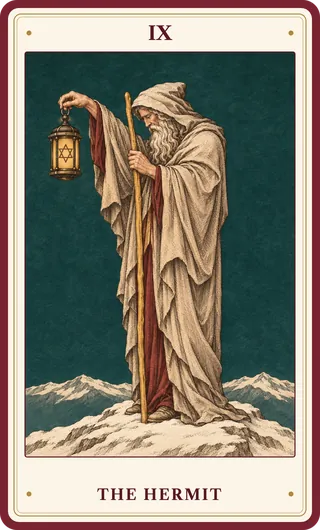
The lantern
The Hermit's light shows only the next few steps, not the whole road. It stands for wisdom you carry inside you, and it is why this card rarely gives a loud, instant answer.
The six-pointed star
Inside the lantern sits a six-pointed star, a symbol of joined opposites such as spirit and matter. It suggests that the real answer comes when your thinking and your instincts agree.
The staff
The Hermit leans on a long staff for support and balance. It points to experience and discipline, and to the fact that this is a slow, steady card, not a fast one.
The grey cloak and hood
The plain grey robe shows a person who has dropped status, noise and performance. It is the visual reason this card answers 'no' to flashy, public or rushed decisions.
The snowy summit
He stands alone on a high, cold peak above everything below. The height gives perspective, but it is also a reminder that this is a stage to pass through, not a place to live.
The empty grey sky
The background is bare and still, with no crowd, no distraction and no other card figures. It tells you the question is asking for silence before it asks for action.
The Hermit yes or no for health and wellbeing
When the question is about rest, recovery, therapy, sleep or a quiet reset, the Hermit is a yes. It supports a digital break, a day without people, or the kind of slow recovery that cannot be hurried. It is a no to overstimulation and to pushing through exhaustion.
Reversed, the question to ask is whether solitude has become isolation. Long withdrawal, loneliness or low mood can hide inside “I just need space”. If the reversed Hermit appears around a health question, read it as a prompt to reach out to a friend, doctor or counsellor. Tarot cannot diagnose anything, and the card is not a substitute for professional care.
How the Hermit reads with other cards
In a spread, the cards around the Hermit decide whether his answer is gentle or firm. A bright, forward card next to him softens the “no” into “soon”. A heavy or blocking card makes the pause longer.
- With the Sun or the Star: the wait is short, and clarity is on its way.
- With the Tower or a Swords card of conflict: stay away from the situation until things calm down.
- With the Eight of Cups or Death: the quiet is part of a bigger ending, and you are right to leave.
- With the High Priestess: intuition is the answer, and you will know when you stop asking. See the High Priestess as a yes or no answer for a similar card of stillness.
Pairs and trios often settle a yes or no question better than a single card. A simple 3 card tarot spread with “situation, what to reflect on, outcome” gives the Hermit room to speak without forcing it to be a verdict.
Asking a question the Hermit can answer
A Hermit draw is sometimes the card’s way of saying the question was framed badly. Questions that ask “Will X happen?” or “Does he love me?” are hard to answer with a card about inner discovery. The card does better with questions about your own choices and timing.
Good questions for a yes or no draw are short, specific and about something you can influence:
- Should I take time alone to decide this?
- Is it wise to commit to this right now?
- Am I ready to move forward with this plan?
- Should I wait before bringing this up?
If you draw the Hermit on a question you really need answered, rephrase it. Try “What do I need to understand before I decide?” and draw again. You can find more phrasing ideas on the yes or no tarot reading page, which also lets you pull a card online.
Try this: Shuffle while holding your question, then say it out loud once. Pull the card and, before you look up its meaning, note your gut reaction in a single word. Compare that word with the Hermit’s “wait and look inward”.
What to do after you draw the Hermit
Treat the card as a short instruction, not a verdict. A few steps make the answer concrete:
- Pause the decision for a set time, such as a few days or a week.
- Spend at least one stretch of that time truly alone, with no feed or chat to fill the silence.
- Write down what you know, what you do not know and what you fear.
- Ask one trusted person for a single piece of information, not a full opinion.
- Return to the question and see whether the answer has changed.
The point is not to wait forever. The Hermit is a card about a limited stage with a purpose, and he comes down the mountain once he has found what he went up for. Setting a date to return keeps the pause useful.
Common mistakes when reading the Hermit as yes or no
The most common mistake is reading “no” as “this will never work”. The Hermit is about patience and timing, and plenty of good outcomes begin with one. Another is treating solitude as always good: if you have been alone too long, the upright Hermit may confirm what you already know, but the reversed one is the better description of your situation.
A third mistake is ignoring your own question. Because the card changes depending on whether the action is inward or outward, it is easy to give a flat “no” to something that suits the Hermit well, such as “Should I take this course on my own?” Always match the card to what the action actually looks like.
Finally, do not draw again and again until you get a yes. If the Hermit keeps appearing, the repetition is the message. It usually means you have been avoiding some quiet, honest thinking, and the answer will not come until you have done it.
Hermit yes or no quick reference
Here is a short summary of how the card tends to land, so you can check it against your own reading.
- Upright, general question: no for now, or “not yet”.
- Upright, study, rest, solo work, spiritual practice: yes.
- Upright, new love or an ex: no for now, give space.
- Upright, existing relationship: unclear yes, with reflection.
- Reversed, general question: yes, time to act or rejoin people.
- Reversed, isolating or rash plans: no.
Remember that tarot is a tool for reflection and not a promise. If you want to see how this card sits among the rest of the deck, the full list of tarot card meanings is a useful next stop. The Hermit’s main message in any yes or no question is that you hold more of the answer than you think, and that the quiet is where you will find it.
Questions readers ask
Is the Hermit a yes or no card?
Upright, the Hermit leans toward no, or more exactly 'not yet'. It asks you to stop, reflect and gather information before deciding. It becomes a yes when your question is about study, solitude, rest or spiritual growth.
Is the Hermit reversed a yes or no?
Reversed, the Hermit usually turns toward yes, because the retreat is over and it is time to come back out. It is a no when the question is about isolating yourself further or acting recklessly without thought.
Is the Hermit a yes or no for love?
For new romance or getting back with an ex, the Hermit is usually a no for now, because someone needs space. In an established relationship it is an unclear yes that depends on honest conversation and time to reflect.
Is the Hermit a yes or no for a job or career question?
It is a yes for careful, independent work such as study, research, writing or planning a change. It is a no for rushed applications, loud networking or decisions made under pressure.
Does the Hermit mean someone is ignoring me?
Not necessarily. The Hermit shows a person who is withdrawn and thinking, which can look like silence from the outside. It points to private reflection, not always to rejection.
How should I read the Hermit if I want a firm answer?
Treat it as no for now, then ask a follow-up question or draw a second card that names what you need to understand first. A card that asks you to reflect is rarely meant to be the final word.