
The Hanged Man as a Yes or No Answer

- Arcana
- Major Arcana, card 12
- Element
- Water, Neptune
- Yes or no
- Maybe
pausesurrendernew perspectiveletting go
stallingresistanceindecision
The Hanged Man is a “not yet” in a yes or no reading. It is neither a clean yes nor a final no. If you want to act today, it works as a soft no. If you can wait and look at the question from a new angle, the answer may turn into a yes. Reversed, it leans to a firm no, because the pause has turned into stalling.
That makes it one of the trickiest cards to draw for a quick answer, and also one of the most useful. The Hanged Man is telling you something about timing and perspective, not about whether the outcome is possible. Below you will find how to read it upright and reversed, how it changes for love, work, money and health, how long the wait tends to last, and what to do while you wait.
Why the Hanged Man does not give a clean answer
Most yes or no cards describe movement. The Ace of Wands pushes forward, the Tower breaks something open, the Chariot drives on. The Hanged Man describes the opposite: a man suspended from a living tree, calm, upside down, going nowhere on purpose. A card about stopping cannot really say “go,” and it does not say “never” either.
The number helps. The Hanged Man is Major Arcana XII, which comes after the strength and justice of the earlier cards and before Death. It is the pause that sits right before a major change, the moment when you hand over control and something shifts inside before anything shifts outside. If you want the full picture of the card, the Hanged Man tarot card meaning page covers its symbolism and every position.
So when you ask a question that wants a verdict, the card answers the question underneath: “Are you seeing this clearly yet?” Often the honest reply is no, and that is the source of the “not yet.”
Upright Hanged Man: the answer is not yet
Upright, read the Hanged Man as “not yet” and treat it as a temporary state, not a ruling. The outcome you asked about is not ruled out. The conditions for it simply have not formed, or you have not yet seen what you need to see.
In practice this works out as a lean:
- If your question is “should I do this right now?”, the answer leans no.
- If your question is “will this happen eventually?”, the answer is open, and often a patient yes.
- If your question is “is this person or plan worth waiting for?”, the answer depends on whether the wait feels productive or empty.
The word that matters is “productive.” The man in the image is not suffering. His face is peaceful and a halo surrounds his head. An upright Hanged Man asks for a wait with a purpose: gather information, rest, reconsider, let someone else make their move. A wait with no purpose is the reversed card.
Reversed Hanged Man: the answer is no, or the wait is ending
Reversed, the Hanged Man leans to no. The pause that was useful has become stalling, resistance or martyrdom. You may be sacrificing time, energy or self-respect for something that is not returning it, or avoiding a decision and calling it patience.
There is a second reading worth checking. When the card shows up reversed after a long, genuine pause, and especially beside action cards such as the Eight of Wands or any Ace, it can mark the end of the wait. In that case the message is “you have seen enough, now move.” The surrounding cards decide which reading applies: stuck cards around it mean stalled, action cards around it mean released.
For more on how to read upside-down cards in general, see our guide to reversed tarot cards. The full picture of this card turned over is on the Hanged Man reversed page.
Read The Hanged Man for your question
Upright: Not yet: the connection needs time, patience or a change in how you see it before it can move forward.
Reversed: No for now: the waiting has turned into stalling, and someone is avoiding a decision or sacrificing too much.
Upright: They are undecided or reflecting, not rejecting you, and they need space to sort out what they want.
Reversed: They feel stuck, resistant or resentful about waiting, and may be unwilling to commit.
Upright: Hold off on the big move: a pause, a pending decision or a new angle on the problem comes first.
Reversed: No: you are stuck in a role or project out of fear, and more waiting will not change it.
Upright: Delay the purchase or investment and look at it from another side before you commit.
Reversed: No: avoiding a financial decision is costing you, and sacrifice without return needs to stop.
Upright: Stop pushing, pause on purpose and let a new perspective show you what you could not see while busy.
Reversed: Stop playing the martyr and stalling: decide, act or let go.
Upright: Rest and observe before choosing a treatment or plan, and let your body set the pace.
Reversed: No: passive waiting is no longer enough, so get proper advice and take a step.
Should I or will it: two questions, two answers
The same card answers differently depending on how the question is built. Questions that begin with “should I” ask for advice, and the Hanged Man says wait before deciding. Questions that begin with “will” ask for a prediction, and the Hanged Man says the energy has not lined up yet, which leaves room for a later yes.
This is why a tidy “yes” or “no” often feels wrong for this card. If you asked “Should I quit my job this week?” and drew the Hanged Man, the answer is a no for this week. If you asked “Will I eventually leave this job?” the same card is not a refusal. It is a signal that the decision is still ripening.
If you want to practise phrasing, the yes or no tarot reading tool on this site shows how simple, specific questions get cleaner results, and the Hanged Man is a good card to notice there.
Try this: Write your question twice, once starting with “Should I” and once starting with “Will”. Look at the Hanged Man against each version. Note which one the card actually answers, and use that one.
The Hanged Man yes or no in love
In love, the upright Hanged Man says the situation is not ready. The relationship may be in a pause, a person may be undecided, or you may be seeing the other person from only one angle. It is not a rejection. It asks you to stop forcing the pace and let the picture clear.
For singles, it suggests a “yes” to new love may come, but after you have changed something about how you think or what you are willing to accept. For couples, it often points to a pause, a break or a long wait for a decision such as moving in or committing. If you are asking whether an ex will come back, the card says nothing is moving yet, and your best step is to stop chasing.
Reversed, the answer to a love question is usually no. Someone is stuck, someone is giving too much and getting little, or the wait has gone on so long it has become the problem. If you want to know what another person feels, the Hanged Man as feelings page explains the uncertainty and hesitation this card shows in someone’s heart.
The Hanged Man yes or no for career
At work, the Hanged Man upright says hold the big move. A promotion may be pending, a project on hold, an offer not yet confirmed. Do not hand in your notice, sign a contract or launch based on this reading alone. Use the pause to look at the situation differently: what would this job look like if you wanted nothing from it?
It can also describe a deliberate sacrifice that pays off later, such as taking a lower role to retrain. In that case the card is closer to a conditional yes, as long as the sacrifice has an end point you can name.
Reversed, it answers no. You may be staying in a role from fear, waiting for permission that is not coming, or carrying a team’s load without credit. The card asks you to stop waiting for someone else to rescue the situation and make your own decision.
The Hanged Man yes or no for money and health
With money, the upright card advises delay. Do not buy, invest or lend yet. Look at the numbers from the opposite side: what would you advise a friend to do? A short-term sacrifice, such as paying down debt before a purchase, may buy a stronger position later.
Reversed, the card says no to continued avoidance. If you have been putting off a financial decision, the delay is now the expensive option. Sort out what you have been dodging, whether that is a budget, a debt or an overdue conversation.
For health questions, treat the card as a prompt to rest and observe, not as a medical answer. Upright, it supports pausing before choosing a treatment and listening to what your body is saying. Reversed, it warns that passive waiting is no longer enough. Tarot cannot diagnose or replace medical advice, so use the card as a nudge to get proper help and not as a verdict.
How long does the Hanged Man wait last?
The card does not give a date. It gives a condition: the wait lasts until your view changes. That might be a conversation, a piece of news, a decision someone else makes, or simply the day you notice you feel differently about the problem.
Because there is no built-in timeframe, set one yourself. A practical rule is to pick a check-in point that fits the question: a few days for a message or reply, a few weeks for a work decision, a couple of months for a relationship pause. At that point, look at what has changed. If something has, you probably have your next step. If nothing has, ask whether this is a productive wait or a stale one.
For general guidance on reading timing in a spread, see our page on tarot timing. Treat any number you get as a guide, not a promise.
The Hanged Man card symbols
Choose a symbol to read what it means on the card.
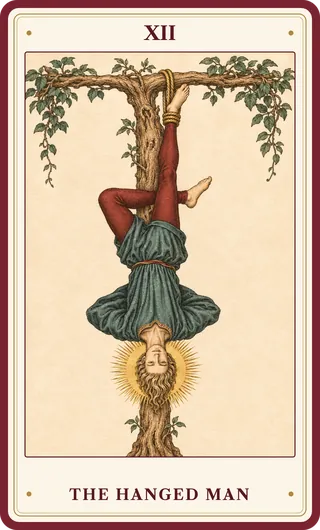
Upside-down posture
The figure hangs head down, which turns the ordinary view of the world over. It is the card's picture of seeing a problem from the opposite side.
Living T-shaped tree
The cross is made of living wood with leaves, not a dead gallows. It shows that this pause is part of growth, not punishment.
Halo around the head
A glowing nimbus surrounds the man's head. It marks insight that comes through stillness and surrender.
Calm face
His expression is serene, with no sign of struggle or pain. He is waiting by choice, which is why the card reads as a pause and not a disaster.
Bent leg forming a four
One leg is tied to the tree while the other crosses behind it, making a shape like a number four. It points to a stable, grounded pause with a purpose.
Hands behind the back
His arms are folded behind him, forming a triangle with his body. He is not grasping or fighting, which is the heart of surrender.
Bound ankle
A single rope holds his foot. It shows he is held in place but not harmed, and that the limit is real even if it is gentle.
What to do while the card says wait
“Wait” can sound like doing nothing, but the figure in the image is quite active inside. He is observing. Waiting well means doing the inner work that makes the later yes possible.
- Name what you are waiting for, in one sentence.
- List what you have been assuming about the situation, then flip each assumption and see what changes.
- Stop any action that is forcing the outcome, such as repeated messages, pressure or ultimatums.
- Set a check-in date and write down what would count as a sign to move.
The point is to stay in the pause long enough to learn something, not so long that you drift. If a week goes by and you have learned nothing, you are likely not pausing but avoiding.
Try this: Sit for ten minutes with your question. Then physically look at the room from a different position, such as lying on the floor or standing on a chair, and write down one thing about your situation you notice differently.
How the cards around it change the answer
A single Hanged Man tells you to wait. The neighbouring cards tell you what kind of wait it is and how it ends. Read them as modifiers.
- With action cards such as the Chariot, the Eight of Wands or an Ace, the wait is short and a yes is close.
- With stuck or blocked cards such as the Two of Swords, Four of Swords or Eight of Swords, the pause is real but heavy: you are stalled by fear or indecision, not guided by wisdom.
- With Death, the pause is ending and real change is on the way, which often turns the answer toward a transformed yes.
- With cups, the wait is emotional and tied to feelings that need time. With pentacles, it is practical, usually about money, paperwork or work.
In a 3 card tarot spread, the Hanged Man in the middle position describes the pause you are in, while the card after it shows what the wait produces. That is often the clearest way to turn a “not yet” into something usable.
How to ask a question the Hanged Man can answer
Yes or no spreads work best with a specific question asked once. The Hanged Man exposes weak questions quickly, because it will not rubber stamp a vague one. Questions like “Will it work out?” give it nothing to hold.
Better questions have a clear subject and a time frame, for example “Should I accept this offer by Friday?” or “Is it a good idea to message them this week?” Avoid asking the same question three times in a row. If you do not like the first answer, the card was probably right, and the reshuffle only reflects your wish for a different one.
If you want a bank of well-built questions for any topic, use these principles: one subject, one decision, one time frame, no “why” and no “what if” stacked together. Then accept the answer as a snapshot of the situation today, not a sentence passed on your future.
When the Hanged Man turns into a yes
The Hanged Man does not usually stay a no forever. The answer shifts to yes when something real changes. That might be new information, a person making their choice, or you finally letting go of how you thought it should happen.
A useful test is whether you can now describe the situation in a way you could not before. If your view has turned over, the pause has done its job. Often at that point, drawing a follow-up card gives a very different answer, such as a Page, an Ace or the Sun, because the energy has moved.
Another sign is relief. The pause often ends with a quiet sense that you no longer need to force anything. When the question stops feeling urgent, the answer often becomes clear on its own. That is the strange logic of this card: surrendering the demand for an answer is frequently how the answer arrives.
Should you pull again?
Usually no. Drawing again immediately to escape a “not yet” is the opposite of what the card asks. It turns the reading into a bargaining exercise and gives you a result that is easier to misread.
If you really need more detail, change the question and not the card. Ask what you need to understand during the wait, or what action would help in the next week. Draw once and work with it.
The one case for a redraw is when you asked a question that was too vague to answer, such as “Is my life going well?” Rephrase it into something specific and start fresh. Otherwise, take the Hanged Man at its word.
Quick answers at a glance
If you need the short version, here is how the card usually reads in a yes or no spread:
- Upright, general: not yet, with a lean to no if you want to act now.
- Upright, love: wait and watch, no pressure, no chasing.
- Upright, work and money: hold the decision and look at it from another side.
- Reversed, general: no, until you stop stalling.
- Reversed after a long pause, beside action cards: the wait is over, so move.
Remember that a yes or no answer from tarot is a lean, not a law. The Hanged Man is especially clear that the useful part of the card is the advice, and the advice is to pause with attention instead of forcing a result.
A short example reading
Say you ask, “Should I send my business proposal this week?” and you draw the Hanged Man upright. The answer is not yet. It does not say the proposal is bad. It says you are missing a view, perhaps the client’s point of view, a weak section in the plan or a number you have not checked.
You spend two days rereading it from the client’s side and spot an unclear price. You fix it, and the next day you feel calm about sending it. The pause did its work, and the “no for now” became a yes.
Now imagine the same card reversed. You have been “about to send” this proposal for six weeks. Here the card is saying the delay is the problem: send it or drop it. The two readings use the same image and give opposite advice, which is exactly why position and context matter so much with this card.
Try this: Next time you draw the Hanged Man for a yes or no, write down the date and your question. Check back after the wait you set yourself and note what changed. After a few readings you will see how your own “not yet” answers tend to resolve.
Questions readers ask
Is the Hanged Man a yes or no card?
Neither, strictly. Upright it reads as not yet, which behaves like a soft no if you want to act today and a possible yes if you can wait. Reversed it leans to a no.
Is the Hanged Man a yes or no for love?
Upright, it says the relationship or answer you want is not ready, so wait and watch instead of pushing. Reversed, it says the waiting has gone stale and the answer is no unless someone makes a decision.
What does the Hanged Man reversed mean as a yes or no?
It leans to no. The pause has become stalling, martyrdom or resistance. In a few readings it marks the end of a long wait, so check the cards beside it.
Does the Hanged Man mean something bad will happen?
No. The figure is calm, haloed and hanging by choice. It describes a necessary delay and a change of view, not misfortune.
How long does the Hanged Man wait last?
The card gives no date. A common rule is that the wait lasts until you have a new piece of information or a new way of seeing the problem, so set your own check-in date and look again then.
Should I draw again if I get the Hanged Man?
Usually not. A repeat draw to dodge a not-yet answer tends to muddy the reading. Rephrase the question to ask what you need to see or do during the wait, then draw once.