
Page of Pentacles as a Yes or No Answer

- Arcana
- Minor Arcana, Suit of Pentacles
- Element
- Earth
- Yes or no
- Yes
ambitionstudya new skill
setbackspoor planningfinancial worry
The Page of Pentacles is a yes when it appears upright, but a patient, conditional yes. It means the opportunity you are asking about is real and worth starting, as long as you are willing to learn, practise and keep going for weeks or months. Reversed, it becomes a “not yet” and sometimes a plain no, usually because of procrastination, poor preparation or unrealistic hopes.
That makes this a slower answer than the Ace of Pentacles or a card like the Six of Wands. The Page does not promise quick results. It tells you that a good start is available and that the outcome depends on what you do with it. If you want the full card profile first, read the Page of Pentacles meaning, then come back here for the verdict in specific situations.
Why the Page of Pentacles leans yes
Three things push this card toward yes. It belongs to the Pentacles suit, which is tied to earth, work, money, the body and anything you can build and measure. It is a Page, the court card of beginnings, messages and learning. And in the Rider-Waite-Smith image the Page is calm, focused and standing in a field that has already been plowed. Nothing in the picture is blocked, threatened or lost.
Compare that with cards that lean no. Swords cards like the Ten of Swords show endings and pain, and the Eight of Cups shows someone walking away. The Page shows someone arriving, curious and willing to start. That forward direction is why almost every reader treats the card as a favourable answer.
The yes is not loud, though. It comes from a student, not a master. Think of it as a green light with a note attached: yes, begin, and expect to put in effort.
Upright: a yes with conditions
When the card lands upright, the answer to “Should I?” or “Will it work?” is yes. The strongest version of that yes applies to things you can start now with small, practical steps: enrolling, applying, saving, practising, testing an idea on a small scale. The card likes action that is modest and repeatable.
The condition is commitment. The Page looks at the coin because the coin is something to be understood and developed. If you treat the opportunity casually, the yes weakens. If you treat it as a skill to build, the yes holds.
So when you get this card upright, read the answer as “yes, if you do the work.” That is more useful than a flat yes, because it tells you what the outcome depends on: your effort and consistency, not luck.
Reversed: not yet, or no
Reversed, the Page of Pentacles rarely means a hard, permanent no. It means the situation is not ready, or you are not ready for it. The classic causes are procrastination, daydreaming without a plan, quitting at the first difficulty, or chasing a result without doing the groundwork.
In a yes or no reading, treat it as “not yet” if the question is about something sound that needs better preparation. Treat it as “no” if the question is about a shortcut, a get-rich-quick idea, or a plan with no real substance behind it. The reversed Page of Pentacles page goes deeper into how this plays out in love, work and daily life.
If you aren’t sure how to handle reversed cards in general, the guide to reading reversed tarot cards explains the main approaches. Whichever method you use, the Page reversed points to a gap between intention and action.
Read Page of Pentacles for your question
Upright: A sincere, slow-building yes: someone is curious and serious about you, and the bond grows through steady effort rather than big gestures.
Reversed: Not yet: interest is there but it is distracted, inconsistent or too immature to commit, so don't build plans on it.
Upright: They feel careful, hopeful interest and want to do right by you, even if they show it quietly.
Reversed: Their feelings are unformed or put on hold, and they may be avoiding the effort that real closeness needs.
Upright: Yes to the course, the entry-level role, the apprenticeship or the first practical step toward a bigger goal.
Reversed: Hold off: the plan lacks preparation, focus or follow-through, and rushing it will waste effort.
Upright: Yes to small, regular saving, learning a money skill and starting a modest plan that can grow.
Reversed: No to shortcuts and impulse spending: the plan is vague, neglected or built on wishful thinking.
Upright: Start small, study the basics and commit to a routine you can keep for months.
Reversed: Stop daydreaming and procrastinating: pick one concrete task and finish it before asking again.
Upright: Yes to starting a gentle, realistic habit such as a walk, a sleep routine or a check-up you have been putting off.
Reversed: A habit has slipped or never started, so scale it down to something so small it can't fail.
How strong is this yes?
It helps to give the answer a strength rather than a flat label. Here is a simple scale for the Page of Pentacles:
- Upright with supportive cards around it: a solid yes, with a realistic timeline.
- Upright on its own: a steady, conditional yes.
- Reversed with supportive cards around it: not yet, but close once you fix one thing.
- Reversed with difficult cards around it: no for now, and probably a poor plan.
This graded approach fits the card’s character. The Page is the beginner of the suit, so even its best answer is a beginning, not a guarantee. If you want a firmer yes or a firmer no, ask a more specific question or add a second card for the condition.
Questions where it says yes
The Page of Pentacles is at its strongest when the question is practical and early-stage. Good examples include:
- Should I sign up for this course or training?
- Is this a good time to start saving or paying down a debt?
- Will studying for this exam pay off?
- Should I apply for this entry-level role or internship?
- Is it worth starting a small project or side business on a modest budget?
In all of these, the card is saying the effort is worth making. It supports learning, apprenticeship, careful planning and anything that grows by repetition.
It also works for questions about starting a new habit or beginning something you have wanted to try. The yes is about the first step being worthwhile, not about the end result being guaranteed.
Questions where it says no or slow down
The card is less friendly to questions that assume speed. “Will I get rich this year?” “Will they commit tomorrow?” “Can I skip the training and still get the job?” For these, even an upright Page tends to answer with a gentle no, because the card’s whole message is that the result comes through steady work.
It is also a poor fit for high-drama questions: sudden reunions, dramatic confessions, quick fixes or anything that depends on luck. In those cases the Page of Pentacles is telling you the situation is more ordinary and slower than you hope.
Where the question involves large risk, such as a big investment, a major legal step or a medical decision, treat the card as a prompt to learn more first. The Page is a student. Its advice is to study the situation before betting on it. Tarot is no substitute for professional advice on money, health or law.
Try this: Write your question in one plain sentence, then underline any word that assumes speed (“soon”, “quickly”, “finally”). Rewrite it without that word, for example “Is it worth starting this course?” Pull the card again for the reworded question only if you haven’t drawn yet. Otherwise, use the new wording for your next reading.
Page of Pentacles yes or no in love
In love, the upright Page of Pentacles is a yes for sincere, gradual connection. It describes a person who is interested, curious and serious, who shows care through practical acts: replying reliably, making plans and turning up. There may be no grand declarations, but the interest is real. If you ask “Do they like me?” or “Is this going somewhere?”, the answer leans yes, with the understanding that it will take time.
For a new relationship the card suggests a warm, steady start. You are still learning each other, so avoid forcing labels or timelines. It is a particularly good sign for anyone who wants a stable partner rather than a whirlwind.
Reversed, the answer in love becomes not yet or no. The person may be flaky, immature, distracted by other priorities, or not putting in the effort that closeness requires. If you want to see how a Pentacles court card plays out in a relationship in another form, the Knight of Pentacles yes or no page covers the more committed, slower-moving next stage of this suit.
Reconciliation, exes and “will they text?”
Questions about getting back together are tricky for this card. Upright, the Page can mean yes if the relationship is being rebuilt with small, reliable steps: honest conversation, changed habits, consistent contact. It does not support a dramatic return based on feeling alone.
Reversed, it usually says no for now. The basics are not in place, and one or both people are not ready to put in sustained effort. Repeating the same pattern and hoping for a different result is exactly what the reversed Page warns against.
For “Will they message me?” the card is a quiet maybe leaning yes when upright: a thoughtful, practical contact such as a question, a link or a short check-in is more likely than a grand gesture. Do not read it as a promise of a specific day.
Career and study
Work and education are home ground for the Page of Pentacles. Upright, it is a clear yes to training, certificates, entry-level roles, internships, apprenticeships and any position where you learn on the job. It also supports starting a new project with a small, testable first version.
If you are asking about a promotion or a leadership role, the card says the next step is learning, not seniority. That can mean yes if you are willing to take on more responsibility and build skills, and not yet if you are hoping to be handed the role.
Reversed, the Page questions whether you are really committed. Maybe the course is half-finished, the application is half-written or the plan has no schedule. Fix that and the answer improves. Compare it with the Eight of Pentacles, which is the same message at a later stage: yes, as long as you keep practising.
Money
On money questions, the upright Page is a yes to small, regular steps. Open the savings account, set up the automatic transfer, learn how to budget, take the finance course, start investing a modest amount. The card values habit over size.
It is a no, or at best a slow maybe, for any plan that depends on quick returns. If your question is “Will I win?” or “Will this speculative bet pay off?”, the Page’s answer is that no shortcut is on offer. The reward comes from doing the basics well for a long time.
Reversed, the card points to neglect: unopened bills, a budget that never gets used, or financial plans that stay in the daydream stage. It is a not-yet, with the instruction to take one concrete action this week. For a fuller reading on this subject, a money tarot spread can give you more than one card to work with.
Page of Pentacles card symbols
Choose a symbol to read what it means on the card.
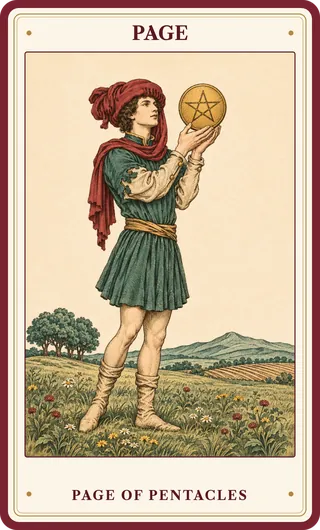
The single pentacle
The Page holds one coin up in both hands and studies it closely. It shows focused attention on one goal, a seed of opportunity rather than a finished result.
The plowed field
The ground around the Page is turned earth with green grass and small flowers. It points to preparation, patient work and a future harvest that has not arrived yet.
Distant mountains
Mountains sit far behind the Page, well beyond the field. They show that the goal is real but a long way off, which is why the answer is steady rather than instant.
Green trees
Trees stand in full leaf at the edge of the scene. They suggest growth that is already underway and the stability the Pentacles suit promises.
The cap and tunic
The Page wears a simple cap and a practical tunic suited to a student or apprentice. It signals humility, willingness to learn and no need to show off.
The calm sky
The sky is open and bright, with no storm in view. Conditions are good for starting, as long as you act on them.
The standing pose
The Page stands still while looking at the coin rather than walking or running. It is a reminder to study the opportunity properly before moving.
Health and habits
For health questions, the Page of Pentacles is a modest yes to starting a realistic, gentle routine: a daily walk, a regular sleep time, a medical check-up you have delayed, a change in meals you can actually keep. The suit is connected to the body, and the Page is about small actions that build.
It is not a diagnosis card and it cannot tell you whether a medical problem will resolve. If your question is about a symptom or treatment, use the card as encouragement to seek proper advice and to take the first practical step.
Reversed, the card often points to a habit that has lapsed or never begun. The advice is to shrink the goal until it is too easy to skip: five minutes, one glass of water, one early night.
Try this: Take whatever you asked about and write down the smallest possible first action, one that takes ten minutes or less. Do it today, then notice whether the situation feels clearer. The Page’s yes is only proven by action.
Timing: how long until it works?
The Page of Pentacles is a slow card. If you are asking when something will happen, think in weeks to months, and often in terms of a term, a season or a training period. The first result is likely to be progress, a skill gained or a door opened, rather than the finished outcome.
Because it is an earth card, it ties to concrete schedules: the next enrolment date, the next pay cycle, the end of a course. If your question has a deadline within days, this card suggests the plan is unlikely to be completed in that window, though you can still make a good start.
Reversed, timing stretches further or becomes unclear, because the delay is coming from you or from missing groundwork. Set a small deadline for the first task and the timeline will firm up. For more ways to approach timing questions, see the guide to tarot timing.
Cards that change the answer
The Page rarely reads alone. If you draw more than one card, the neighbours shape how strong the yes is. Some useful patterns:
- Page of Pentacles with the Ace of Pentacles: a strong yes, since a new opportunity is being offered and the Page is ready to use it.
- With the Eight of Pentacles: yes, and the work will be skilled and worthwhile.
- With the Seven of Cups: a softer maybe, because there are too many options and not enough focus.
- With the Four of Swords or the Hanged Man: not yet, there is a pause before things move.
- With the Page of Swords: a lively yes, but check the facts before committing.
You can use the Ace of Pentacles yes or no page to compare the two beginnings: the Ace is the offer, the Page is the person who learns to use it.
How to ask so the answer is useful
Yes or no tarot works best when the question is specific, practical and about your own actions. “Should I enrol in this course?” gives the Page of Pentacles something to say. “Will my life be perfect?” does not. Questions that start with “Should I” or “Is it worth” tend to produce the most helpful readings, and you can browse questions for tarot reading if you want more examples of wording that works.
Decide before you draw how you will read the card. A simple rule is: upright is yes, reversed is not yet or no. If you commit to that rule first, you won’t bend the meaning afterward to fit what you hoped to see. The yes or no tarot reading tool on this site can help you practise this with a single draw.
Keep the timeframe in mind too. A yes for “this month” and a yes for “this year” are different answers, and the Page is much more comfortable with the longer one.
What if you don’t like the answer?
If you draw the Page reversed and feel disappointed, resist the urge to redraw until you get an upright card. A better move is to ask a follow-up that uses the information you have just been given: “What is the first thing I need to prepare?” or “What is getting in the way of this plan?”
If you drew it upright but don’t feel ready, the card is not forcing you. It is describing an opportunity and the effort it will take. You can reasonably decide that now is not the time, and the card does not contradict that, since a patient yes is still compatible with starting later.
Also pay attention to your reaction. If an upright Page feels like a burden, ask yourself whether you want the outcome or only the idea of the outcome. If a reversed Page brings relief, that is information too.
What the image tells you
The Rider-Waite-Smith picture is the best guide to this card’s answer. A young person stands in a plowed field, holding a single pentacle and looking at it with total attention. The earth is prepared, the grass is green, trees are in leaf and the sky is open. In the far distance are mountains.
Each element supports the “steady yes” reading. The prepared field says conditions are good for starting. The mountains say the goal is far away, so patience is required. The Page’s stillness says to study before you move. And the lone coin says to focus on one thing at a time.
Notice, too, that the Page is not looking at the mountains. He looks at what is in his hands. This is the card’s practical advice for any question: attend to the next step rather than the faraway result.
Page of Pentacles compared with other yes or no cards
It helps to place this card among its neighbours. The Ace of Pentacles is a stronger, faster yes because it is a pure offer. The Knight of Pentacles is a yes with a slow, reliable pace, and it can tip into stubbornness or delay when reversed. The Queen of Pentacles and King of Pentacles are yes cards that suggest the matter is already stable and mature.
Outside the suit, the Page is gentler than the Knight of Wands or the Six of Wands, which promise energy and visible wins. It is more positive than the Five of Pentacles, which points to hardship and lack. If you want to learn how all the suits compare, the Pentacles suit overview lays out the whole family.
The simplest way to remember it: the Page is a yes you earn. If you are willing to earn it, the answer is on your side. If you aren’t, the card will say so reversed.
If you want to practise, draw a random card for a small, practical question and see how the answer feels in real life. Over time you will find the Page of Pentacles one of the most dependable cards in the deck for matters of learning, effort and quiet progress.
Questions readers ask
Is the Page of Pentacles a yes or no card?
Upright, it is a yes, but a patient and conditional one. It says the opportunity is real and worth starting, provided you do the practical work. Reversed, it leans to not yet or no.
What does the Page of Pentacles mean reversed in a yes or no reading?
Reversed, it usually means not yet rather than never. The idea may be sound, but there is procrastination, poor preparation or lack of focus in the way. Fix that and the answer can change.
Is the Page of Pentacles a yes for love?
It is a yes for slow, sincere love that grows through consistency. It is not a yes for fast passion, dramatic reunions or instant commitment. Expect real interest that needs time.
Is the Page of Pentacles a yes for money questions?
Yes if you are asking about saving, studying, budgeting or starting small. No if you are hoping for a quick windfall or a get-rich-quick plan. This card rewards steady effort, not shortcuts.
How long does the Page of Pentacles take to bring results?
Think weeks to months, and in some cases a full term or season. The Page is a learner, so the first result is usually progress and skill rather than a finished outcome.
Should I pull another card if the Page of Pentacles isn't the answer I wanted?
It is better to ask a more specific follow-up question than to redraw the same one. Try asking what step you should take first, or what is holding the plan back.