
Page of Pentacles Reversed (Meaning in Love, Work & Life)

- Arcana
- Minor Arcana, Suit of Pentacles
- Element
- Earth
- Yes or no
- Yes
ambitionstudya new skill
setbackspoor planningfinancial worry
The Page of Pentacles reversed means procrastination, lost focus and good ideas that never become action. The Page is the student of the Pentacles suit, someone who learns by doing. When the card falls upside down, the learning stalls: plans stay on the shelf, practice slips, and the thing you wanted to build stays a daydream.
It is not a harsh card. It rarely predicts a disaster. It points at a gap between what you say you want and what you are currently doing about it, and that gap can usually be closed. This guide covers what the reversal means in love, work, money, health and as a person, how to tell burnout from laziness, and what to do next. For the upright version, see the Page of Pentacles meaning.
Page of Pentacles reversed at a glance
The core idea is potential that is not being used. Upright, the Page is curious, careful and committed to a long project. Reversed, the same energy is blocked, scattered or avoided. The card belongs to Earth, so the problem always shows up in practical form: unfinished tasks, a messy budget, a skipped class, a routine that has fallen apart.
Common keywords for the reversed card:
- Procrastination and avoidance
- Lack of focus or direction
- Unrealistic or unprepared plans
- Missed opportunities
- Immaturity and unreliability
- Careless money habits
- Burnout or loss of interest
Not every keyword will apply to your reading. The question and the cards around it decide which one fits. A student asking about exams gets a very different message from someone asking about a relationship, even though both come from the same root.
What the reversed image tells you
In the Rider-Waite-Smith image, the Page stands in a field and gazes at a single gold coin held in both hands. Behind him are ploughed furrows, trees in leaf and distant mountains. Everything in the picture is about patient cultivation: you look closely, prepare the ground, and wait for seasons to do their work.
Turn the card over and each of those details becomes a question. Is the soil prepared but unplanted? Is the coin admired but never used? Are the mountains so far away that you have stopped walking toward them? The Page does not lack ability. He lacks the steady daily attention that turns a promising start into a result.
This is why the card often shows up for people with plenty of good intentions. You may have bought the course, drafted the plan and opened the spreadsheet. The reversed Page asks what happened after that.
Procrastination or burnout: telling them apart
Most sources lean on procrastination, and that is often right. But the reversed Page can also describe someone who has worked hard at something and run out of fuel. The two feel similar from the inside (you are not doing the thing), yet they need opposite responses.
Procrastination usually comes with guilt, a sense of “I should” and a pile of vague, oversized goals. You still care about the outcome, but starting feels heavy. The fix is smaller steps, clearer deadlines and removing friction.
Burnout comes with flatness. The subject that once fascinated you now feels dull, and forcing yourself harder only makes it worse. The fix is rest, a change of approach, or a return to what drew you to the work in the first place. If a hobby you turned into a career suddenly feels like a chore, this reading is worth taking seriously.
Try this: Write down the task you have been avoiding. Beside it, note whether the feeling is “I dread starting” (procrastination) or “I no longer care” (burnout). Then choose either a ten-minute first step or a proper day off, and stick to that choice.
Read Page of Pentacles for your question
Upright: A slow, sincere connection grows through steady effort, loyalty and small acts of care.
Reversed: Someone idealises love but avoids the practical work of commitment, so the relationship stalls or never really starts.
Upright: Careful, genuine interest from someone who wants to learn who you really are.
Reversed: Interest is real but undeveloped: they are unsure, distracted, or not ready to act on what they feel.
Upright: A new role, course or project begins, and you approach it with discipline and curiosity.
Reversed: You underperform your real ability through procrastination, poor preparation or a loss of interest in the work.
Upright: Good habits, a first budget or a small, sensible investment start building lasting security.
Reversed: Careless spending, unread contracts or money plans that never get past the idea stage.
Upright: Learn the skill, take the first step and keep going.
Reversed: Stop planning in circles: choose one small task, finish it, and rebuild the habit of follow-through.
Upright: A new routine takes hold and your body responds to consistent, practical care.
Reversed: Routines slip, rest is neglected or you are burnt out, so the basics need attention before any big plan.
Page of Pentacles reversed in love
In a love reading, the reversed Page points to immaturity or reluctance to commit to what a relationship requires. Someone may approach love with idealism but avoid the practical work of communication, compromise, honesty and repair. The feeling can be sincere, yet the effort behind it is thin.
In an established relationship, the card often shows stagnation. Routines have set in, neither of you is learning anything new about the other, and small chores of care (listening, planning time together, following through on promises) have slipped. It does not mean the relationship is over. It means it is being left to run on autopilot, and that rarely holds forever.
For singles, the reversed Page can say you are not ready for something serious, or that you are keeping people at a distance while telling yourself you are busy. That is fine as long as you are honest with yourself and with anyone you date. If you want a partner, it asks you to put in the same patient effort you would put into any skill. For more on how this card behaves with partners, see the Knight of Pentacles reversed, which carries a similar theme in a more driven form.
Page of Pentacles reversed as feelings
When the reversed Page describes what someone feels about you, the reading is usually “interested but not acting on it.” There is curiosity or affection, yet it is undeveloped, distracted or held back by uncertainty. This person may like you and still not text back, make plans or say what they want.
It can also point to someone who is more focused on money, studies or their own projects than on romance right now. They are not necessarily pretending. They may have little energy left over. Look at what they do consistently over several weeks, not at a single warm moment.
If the card describes your own feelings, ask whether you are avoiding a decision. The reversed Page often appears when someone knows what the next step is and is quietly stalling.
Page of Pentacles reversed in a career
At work, the reversed Page shows up when you are underperforming relative to your real ability. You may be missing deadlines, skipping preparation, drifting through meetings or treating a job as a placeholder. Opportunities can slip by because you were not ready when they arrived.
It can also describe the opposite problem: a heavy workload that has left you scattered and unable to focus on anything properly. Check which one applies. If you are overwhelmed, the answer is to cut and prioritise. If you are coasting, the answer is to set one clear target and do it.
For anyone thinking about starting a business or changing fields, this card says the groundwork is not finished. Research the market, build the skills, test the idea cheaply. Rushing in unprepared is the usual way this card turns into a costly lesson. Compare it with the Eight of Pentacles reversed, which describes the same issue at a later stage, where craft has become routine and quality has slipped.
Money and finances
Financially, the reversed Page points to careless habits: impulse spending, no budget, contracts signed without reading, loans taken without understanding the terms. You may know better, and still not act on what you know. The card is blunt about this.
It can also show money anxiety that has become avoidance. Not opening statements, not checking balances, not making the phone call about a debt. The fear feels protective, but it lets small problems grow. Facing the numbers is usually less painful than imagining them.
Some readers treat this card as a message of disappointing financial news. That can happen, but in most readings the more useful interpretation is that the issue is in your own planning. The good news is that this is fixable, and often fast. Compare it with the Ace of Pentacles reversed, where a financial opportunity is missed or poorly timed.
Try this: Spend twenty minutes today listing every recurring payment you make. Cancel one you do not use, and set a single weekly date to check your balance. Small, boring and effective is the Page’s whole style.
Studies and learning
The Page is the student of the tarot, so a reversed Page in a reading about education is easy to read. Lessons are being skipped, revision is being put off, and attention is going elsewhere. It may also show a subject you are struggling with and have been avoiding because it makes you feel slow.
It can describe a student who chose the wrong course, or the right one at the wrong time. If the subject no longer excites you, this is a good moment to ask why. Sometimes the answer is that you need a different method. Sometimes it is that you have grown out of the path.
For adult learners, the card often appears around self-taught skills, certifications and creative practice. Consistency beats intensity. Twenty minutes a day outperforms a weekend binge followed by a month of nothing.
Health
In health readings, the reversed Page points to routines that have slipped. Sleep, meals, movement, medication, check-ups: the basics are the focus. It may suggest a lifestyle that is not supporting you, or a new habit you started with enthusiasm and dropped after two weeks.
The card can also warn of carelessness, being so distracted or rushed that you overlook small physical signals. It is not a diagnosis and cannot replace a doctor. If something has been worrying you, book the appointment you have been putting off.
For burnout, the reversed Page is a gentle prompt to rest properly. A real break, even a long weekend, often does more than another week of pushing through.
Page of Pentacles card symbols
Choose a symbol to read what it means on the card.
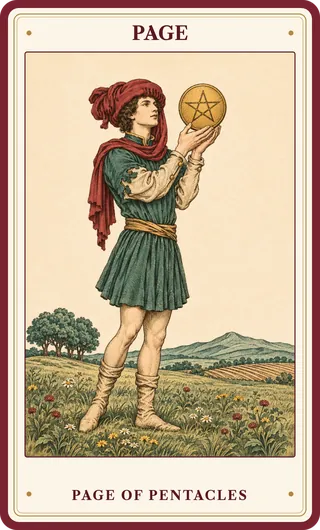
The golden pentacle
The Page holds one coin up and studies it closely. Reversed, that attention drifts, and the opportunity is admired but not used.
The ploughed field
Fresh furrows mean groundwork and patient cultivation. Reversed, the soil is prepared but nothing gets planted.
The green meadow
Grass and flowers at the Page's feet show growth that comes from steady care. Reversed, they suggest potential that goes untended.
The blooming trees
Trees in leaf stand for slow, natural development over seasons. Reversed, they ask whether you are rushing the process or ignoring it.
The distant mountains
The peaks mark the long-term goal the Page is still far from. Reversed, the goal feels remote and the path unclear.
The red hat and earthy tunic
The outfit shows a young, practical person dressed for work in the field. Reversed, it points to immaturity or a student who has stopped showing up.
Spirituality and personal growth
Spiritually, the reversed Page can show boredom or a loss of connection with practices that once felt alive. You may have stopped meditating, journaling or reading because it started to feel like another obligation. The card asks you to return to curiosity rather than discipline for its own sake.
It can also describe a student who collects ideas without applying them: ten books on a subject, no daily practice. Grounded, practical spirituality is the Page’s way. Pick one small ritual you can actually repeat.
If you read tarot yourself, this card may appear when you have been drawing cards without reflecting on them. Writing down what a reading means to you, and what you will do about it, is the Page’s kind of practice.
The reversed Page as a person
As a person, the reversed Page is often a young or inexperienced individual (in age or in attitude) who is distracted, unreliable or unsure of their direction. They may start things and not finish, seem less prepared than they should be, or lean on others to carry the practical load. Some interpretations also describe a person overly fixated on money and fussy about what is theirs.
This can be a student, an apprentice, a junior colleague, a partner in a stalled phase, or you. If it is you, the card is kind rather than accusing: it shows a person with real promise who needs structure and encouragement. Mentorship helps a great deal here.
In the wider court card family, Pages are messengers and learners. You can read more about how they work in court cards tarot.
Is Page of Pentacles reversed a yes or no?
For a yes or no question, the reversed Page leans toward no, or more accurately “not yet.” The idea may be sound, but the preparation, focus or commitment is not in place. If you ask whether a new business will succeed next month and draw this card, the answer is probably that it is too early.
It becomes more positive if you treat it as a conditional answer. Do the groundwork, finish what is already open, and ask again once you have taken real steps. The card responds to effort. You can compare it with the upright Page of Pentacles yes or no reading, which is much more encouraging.
For timing, expect delays of weeks to months rather than days. The Page works on seasonal time, so this card suggests slow progress unless you change your habits.
How the card changes with its neighbours
The reversed Page often reads differently depending on what sits beside it. Some pairings give a clearer picture:
- With the Eight of Pentacles: the work needs consistent practice, not more planning.
- With the Seven of Pentacles: you are questioning whether your effort is paying off.
- With the Two of Pentacles: you are juggling too much to focus on one thing.
- With the Four of Pentacles: money worries may be causing the stall.
- With the Magician: you have the tools but have not used them.
Position matters too. In the past, it describes a lost opportunity or a habit that started things off badly. In the present, it names what is stalling you now. In the future, it warns that things will stay stuck unless you act. In a Celtic Cross or any larger spread, look at what the cards around it say about the cause.
How to respond when you draw it
The reversed Page asks for small, concrete action. Big plans are the very thing that stalled. Try this sequence:
- Name the one goal that matters most right now.
- Break it into a first step that takes under thirty minutes.
- Do that step today, before checking anything else.
- Repeat it at the same time tomorrow.
- After a week, adjust the plan based on what you learned.
If the goal feels too big, make it smaller still. If you cannot find the motivation, go back to the reason you started. This card is often about reconnecting to the original spark, not forcing willpower.
Try this: Pull one more card and ask, “What is one practical step I can take this week?” Write the answer on a sticky note and put it where you will see it daily.
Page of Pentacles reversed versus upright
The upright Page is a learner at the beginning of something good: focused, loyal, and willing to start small. The reversed Page is the same learner with the focus gone. The difference is rarely talent. It is attention, timing and follow-through.
Reversals can also be read as a softer or internal version of the upright card, depending on your style. Some readers see a reversed Page as a slow start rather than a blocked one. If you are unsure how to read upside-down cards in general, see our guide to reversed tarot cards. The meaning here should always fit your question and the rest of the spread.
If you pull this card and it stings, take that as useful information. The card is pointing at the exact place where a little effort will make the biggest difference.
When the reversed Page keeps appearing
If the card keeps turning up, the same question is probably still unresolved. Look at what you have repeatedly postponed: a course, a conversation, a budget, a creative project. The reversed Page tends to return until something is acted on, however small.
It may also be showing a pattern in how you start things. Many repeat pullers love beginnings and struggle with the middle. If that sounds familiar, build structure around your plans before you start: a schedule, an accountability partner, a visible tracker.
And if you are drawing it daily with no specific problem in mind, treat it as a nudge to check your habits. Pick the thing you most want to be doing a month from now, and take one small step toward it today.
Questions readers ask
What does the Page of Pentacles reversed mean?
It usually means procrastination, lost focus and ideas that are not turned into action. The ambition is there, but the follow-through is missing. It can also point to burnout with a subject or routine you once enjoyed.
Is the Page of Pentacles reversed a bad card?
No. It is a warning about effort and habits, not a sign of fate. It tells you exactly where things are slipping, which means you can change course, usually quite quickly.
What does the Page of Pentacles reversed mean in love?
It points to emotional immaturity, reluctance to commit or a relationship that has stopped growing. Someone may love the idea of a partner without doing the practical work of being one. For singles, it often means you are not ready yet, and that is fine if you are honest about it.
What does the Page of Pentacles reversed mean for money?
It points to careless spending, poor budgeting or financial plans that never get started. It can also show worry about money that is making you avoid your finances. Reading the small print and setting up one simple system usually helps.
Is the Page of Pentacles reversed a yes or no?
Usually a no, or more accurately a not yet. The idea may be sound, but the preparation, focus or commitment is not in place. Do the groundwork and ask again.
Can the Page of Pentacles reversed mean good news?
Rarely. Some readers see the reversed Page as a message about delays or disappointing news around money, work or study. More often it points to something within your control, like your habits and follow-through.