
Knight of Pentacles Reversed: Meaning in Love, Work & Life

- Arcana
- Minor Arcana, Suit of Pentacles
- Element
- Earth
- Yes or no
- Yes
hard workroutinereliability
setbackspoor planningfinancial worry
The Knight of Pentacles reversed means steady progress has stalled. The patience and discipline that make the upright card so dependable turn into stagnation, boredom, procrastination, perfectionism or overwork. Most often a routine has stopped serving its purpose and you are still following it out of habit.
It is not a verdict on your character, and it does not mean you are lazy. The card works on a scale: one end is a refusal to move, the other is a refusal to rest. This guide covers both, along with what the card says about love, feelings, work, money, health and what to do next.
What the Knight of Pentacles reversed means
In the upright position, the Knight of Pentacles is the most methodical of the four knights. He does not rush. He shows up, does the next task, and trusts that results will come. Reversed, that trust gets tested. The process is still running, but it has lost direction, energy or flexibility.
The core meanings are stagnation, feeling stuck, perfectionism, boredom, stubbornness, a fear of change, and burnout from pushing too long without a break. Some readings lean toward too little action (delay, avoidance, laziness) and some toward too much (obsession, rigid control, workaholism). The surrounding cards and your question will usually show which side you are on.
If you want the full picture of the card first, the upright Knight of Pentacles meaning covers his strengths and symbolism in detail.
Why the Knight is stuck
Look at the Rider-Waite-Smith image and you can see the problem before you read a word. The Knight sits on a heavy black horse that is standing completely still in a ploughed field. The other three knights are mid-gallop or on the move. This one holds a single coin and looks at it, and the horse does not step forward.
Upright, that stillness reads as patience and control. Reversed, the same stillness feels like a standoff. He may be staring at the coin so long that nothing else happens, or waiting for conditions that will never be perfect. The strength of the card is also its trap: a person who is good at being steady can be slow to notice that steadiness is no longer enough.
Try this: Write down your current routine or plan in five lines. Next to each line, mark whether you still choose it or whether you just keep doing it. Change one marked line this week.
Stalled or overdriven: the two faces of the reversal
The reversed Knight of Pentacles has two common shapes, and it helps to name which one you are dealing with.
The first is the stalled Knight. You are putting things off, avoiding the next step, or doing busywork that feels productive but moves nothing. Fear of failure often sits underneath it, dressed up as caution or “waiting for the right time.”
The second is the overdriven Knight. You are grinding away, polishing the same piece of work, saying yes to everything and ignoring your tiredness. Perfectionism keeps you from calling anything finished. Here the card is warning about burnout, not idleness.
- Stalled signs: delay, avoidance, boredom, lack of ambition, fear of change
- Overdriven signs: perfectionism, rigidity, overwork, control, no rest
Read Knight of Pentacles for your question
Upright: Steady, loyal commitment that shows up in small, dependable ways and builds slowly.
Reversed: A relationship that has slid into routine, with duty replacing warmth, or one partner who is too stubborn, busy or guarded to engage.
Upright: Serious, patient interest shown through consistency and follow-through rather than grand gestures.
Reversed: Steadiness without warmth: the person may care but feels stuck, unsure, or unable to express it, so you get delay and mixed signals.
Upright: Hard, methodical work and reliable progress toward a long-term goal.
Reversed: A stalled career, procrastination, perfectionism that stops you finishing, or overwork that is heading toward burnout.
Upright: Careful budgeting, slow and sensible growth, and decisions made with a long view.
Reversed: Stagnant finances, over-cautious saving that blocks growth, or poor planning and impatient risks that cost money.
Upright: Keep going, trust the process and stay consistent.
Reversed: Stop and check the plan: break the rut, loosen your grip, set a finish line and let some things be good enough.
Upright: A steady routine of sleep, food and movement that you can keep up.
Reversed: A stale or rigid routine, exhaustion from pushing too hard, or healthy habits you keep dropping and need to rebuild gently.
Knight of Pentacles reversed in love
In a relationship reading, the card often describes a connection that has become more routine than romance. Everything functions: bills are paid, plans are kept, nobody is doing anything wrong. But warmth, play and curiosity have thinned out. One or both of you may be present in body and absent in attention.
It can also point to stubbornness. Someone digs in on how things “should” be done and will not bend, even when it costs closeness. Or work and practical responsibilities take so much energy that nothing is left for intimacy. Reliability without tenderness is the central theme.
The answer is rarely a dramatic one. Small changes in pattern do more than grand gestures: a different evening, an honest conversation about what has gone flat, a promise to put work away at a fixed time. For more on the card’s romantic side, see Knight of Pentacles in love.
Try this: This week, break one relationship routine on purpose. Cook something new, take a different route, or ask your partner a question you have never asked before. Notice how it feels.
Knight of Pentacles reversed as feelings
When you ask what someone feels about you and this card turns up reversed, the usual reading is steadiness without warmth. The person may care, but they are stuck, unsure or reluctant to move things forward. What you get from them is delay, vagueness or a flat sort of reliability that does not tell you where you stand.
There can be several reasons: fear of commitment, caution after a past hurt, too much on their plate, or a belief that everything must be perfect before they act. The card does not tell you which. It also cannot prove what is in their heart, so treat it as a description of how the feelings are showing up rather than a final answer.
The practical advice is to watch behavior over time. Do they follow through? Do they make room for you? If the pattern stays flat for weeks, the card is probably telling you the truth about pace and priority.
Single, dating and exes
If you are single, this card suggests low momentum. You may be avoiding dating, expecting a perfect match, or waiting for someone else to start things. It can also mean you are not ready for stability, or that you have been so occupied with work that romance sits at the bottom of the list.
In a new relationship, it warns against settling into routine too quickly, or against going so slowly that interest fades. In a reading about an ex, the card usually points to limited movement. The old pattern is stuck, and returning to it without change would repeat the rut. Reconciliation is possible only if both people do something different from before.
If you want to see how the surrounding cards in a love spread interact, the relationship tarot spread gives you a clearer frame than a single draw.
Knight of Pentacles reversed in career
At work, this card often shows up when you feel boxed in. The job has become repetitive, promotions have stopped coming, or your plan is taking far longer than you expected. You may be delaying an application, a pitch or a launch because it is not “ready,” which is its own kind of avoidance.
The other side is burnout. If you are working long hours, rechecking every detail and carrying everything alone, the reversed Knight tells you the method is breaking down. Output slows and quality suffers when rest is ignored. In a job search, it can describe applying in the same way over and over and getting the same result.
The useful move is to define done. Pick a deadline, decide what “good enough” looks like, and ship it. Then change one part of your approach rather than repeating the old one harder.
Try this: Choose one task you have been polishing or avoiding. Set a 45 minute timer, finish a rough version, and send or submit it before the day ends.
Knight of Pentacles reversed in money
Financially, the card shows slow or stuck growth. That might mean savings that are not building, a budget you keep abandoning, or income that has plateaued. It can also mean the opposite problem: saving so fearfully that you never invest in your own skills or business, or reaching for fast risks because the slow route has become frustrating.
Poor planning is the main warning. Impulsive spending, get-rich-quick schemes or ignoring practical details like fees and deadlines can undo years of careful work. A reversed Knight does not predict loss by itself, but it does say the current plan has gaps.
Go back to basics. Look at where your money goes, set one realistic target, and automate whatever you can so that discipline does not depend on motivation. If you want a structure for it, the money tarot spread is a good place to start.
Health and wellbeing
For health, the reversed Knight points to routines that have gone stale or extreme. You might have dropped a healthy habit and struggle to restart it, or you might be training and dieting so rigidly that your body is paying for it. Sleep, rest and recovery are likely to be the neglected parts.
It can also describe a stuck feeling that is more emotional than physical: low energy, dull motivation, a sense of going through the motions. If that lasts, talk to a doctor or a counselor. Tarot can help you reflect, but it is not a substitute for medical care.
A gentle rebuild works better than a hard reset. Pick one small habit you can keep on your worst day, and add from there.
Spirituality and personal growth
On a spiritual level, the card suggests a practice that has become automatic. You still meditate, journal or do your readings, but without feeling or curiosity. It may also show rigidity: clinging to one method or belief system because it is familiar, not because it still helps.
For personal growth, the reversed Knight asks whether your goals are realistic. Some people set targets so big they never start. Others set none at all and drift. Both can create anxiety. A better plan usually sits in the middle: a clear goal, broken into steps you can actually take.
This is also a good moment to look at what is missing, such as play, rest, learning something new or time with other people. Routine is a tool, not the point.
Knight of Pentacles card symbols
Choose a symbol to read what it means on the card.
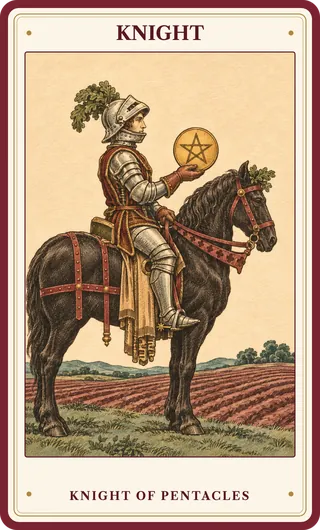
The single pentacle
The Knight holds one coin and studies it closely. Reversed, that careful attention can turn into fixation, perfectionism or refusing to let a task be finished.
The standing horse
Unlike the other three knights, his horse is still, built for strength and endurance rather than speed. Reversed, the stillness is the problem: patience has hardened into being stuck.
The ploughed field
Neat furrows show work that rewards time and repetition. Reversed, it points to effort that is repeated without checking whether anything is growing.
Black armor
The dark, heavy armor shows protection, seriousness and a guarded attitude. Reversed, it can mean you are too defended or weighed down to move.
Oak leaves on helm and bridle
Oak stands for endurance and slow, lasting growth. Reversed, it asks whether you are enduring something worth enduring.
The yellow sky
A flat, bright yellow sky gives the scene a calm, motionless feeling. Reversed, it can read as dullness or a lack of fresh air and new input.
The distant hills
The far horizon is the long-term goal he is working toward. Reversed, it can feel too far away to reach or too vague to steer by.
The Knight of Pentacles reversed as a person
When the card describes a person, it shows someone dependable on the surface who has become stubborn, cautious or hard to move. They may avoid risks, resist advice, procrastinate, or hold themselves and others to impossible standards. Some are workaholics who rarely make time for people.
In a relationship, they can be loyal but emotionally closed. At work, they might be a colleague who insists on doing things the old way, or a boss who cannot delegate. Sometimes the person is yourself, and the card is a mirror.
Remember that court cards describe a style of behavior, not a fixed identity. Someone who appears as the reversed Knight today may be going through a tired or pressured season. For a wider view of how court cards work as people, see court cards in tarot.
Yes or no
In a yes or no reading, the reversed Knight of Pentacles usually leans toward no, or at least “not yet.” The card is about delays and blocks, so it fits poorly with questions about quick results. If you are asking whether something will happen soon, expect slower going than you hoped.
It softens when the question is about doing something properly. If you ask whether you should take more time to prepare, the card can support a yes. Read it as advice about pace, not as a hard prediction.
For a fuller breakdown, see Knight of Pentacles as a yes or no answer.
Upright versus reversed at a glance
Comparing the two positions shows that the reversal is mostly about balance. The same qualities are present, but they have tipped too far or lost their purpose.
- Patience becomes stagnation.
- Discipline becomes rigidity.
- Carefulness becomes perfectionism.
- Hard work becomes burnout.
- Reliability becomes predictability without warmth.
Seen this way, the reversed Knight is the upright Knight without a check on himself. He does not need to become someone else. He needs to loosen his grip and lift his head from the coin.
When the reversal is not a warning
Not every reversed Knight of Pentacles is a problem. Sometimes it is a necessary pause. If you have been rushing or overcommitting, the card can tell you to stop and let things settle before you spend more energy. A delay that feels frustrating may be protecting you from a hasty decision.
It can also show a slow start that is still building. Some projects, such as a new relationship, a degree or a business, simply take longer than we want. The card may be asking for tolerance rather than change.
How you read it depends on context. If you want a refresher on how reversals work in general, the guide to reversed tarot cards explains the main approaches. A reversal can mean blocked, excessive, internal or simply less intense, and your question tells you which fits.
Reading it with other cards
Neighboring cards sharpen the meaning. Beside the Page of Pentacles reversed, it can show a plan that never got off the ground or one that has lost its spark. With the Four of Pentacles, it points to holding on too tightly. Next to the Eight of Pentacles, it can mean craft that has turned into grind.
If the Knight of Wands appears nearby, the contrast is useful: that knight is fast and impulsive, this one is slow and fixed. The Knight of Wands reversed shows the opposite problem of scattered energy, so the two together often describe a push and pull between rushing and freezing.
In a past position, the card describes a routine or effort that has already played out. In a future position, it warns that a rut may deepen unless you act. As an outcome, it suggests you will need patience or a change of method.
How to work with this card
When the reversed Knight shows up, a few steps help more than any big overhaul.
- Name the rut. Write down what feels stuck and how long it has been that way.
- Decide whether you are under-doing or over-doing. The fix is opposite for each.
- Change one variable. A new schedule, a new tool, a conversation you have been avoiding.
- Set a finish line. Define what “done” or “good enough” means before you start.
- Build in rest, and tell someone what you are doing so you are not carrying it alone.
Questions that help in a journal or reading include: What am I still doing out of habit? What am I afraid will happen if I stop polishing this? Where have I stopped asking for what I need? What would be different if I let this be imperfect?
If you want a quick prompt to start with, you can draw from the random tarot card generator alongside the Knight and see what it adds.
Final thoughts
The reversed Knight of Pentacles is a reminder that consistency needs direction. Steady effort is a strength only when it is going somewhere you still want to go. When the horse stops, it does not mean the field is lost. It means the rider needs to look up, check the horizon and decide on the next step.
Pace yourself, change one thing, and keep the parts of your routine that still work. The card does not ask you to become faster or looser overnight. It asks you to notice where steady has turned into stuck, and to do something small and real about it.
Questions readers ask
What does the Knight of Pentacles reversed mean?
It means steady, reliable effort has stalled or tipped into an extreme. That can look like stagnation, boredom, procrastination, perfectionism, stubbornness or overwork. The card asks you to look at your routine and ask whether it is still taking you somewhere.
Is the Knight of Pentacles reversed a bad card?
It is uncomfortable rather than disastrous. It points out a rut or an imbalance that you can fix with practical changes. Many readers also see it as a useful pause card, telling you to slow down and reassess before pushing on.
What does the Knight of Pentacles reversed mean in love?
It usually describes a relationship or a person stuck in routine, with reliability but little warmth or spontaneity. It can also mean stubbornness, commitment issues, or a partner who is too busy with work to be present. The fix is attention and small changes, not dramatic ones.
What does the Knight of Pentacles reversed mean as someone's feelings?
It suggests the person has feelings but is stuck, hesitant or emotionally guarded, so their care comes out as delay or flat consistency. Watch what they actually do over several weeks, because the card alone cannot prove their intentions.
Is the Knight of Pentacles reversed a yes or no?
Usually a no, or a not yet. The card points to delays, blocks and a plan that needs rework. It is a stronger no when the question is about speed or quick results, and a softer one when the question is about doing the work properly.
How is the Knight of Pentacles reversed different from the Page of Pentacles reversed?
The Page reversed is about a learner who has lost focus, interest or follow-through at the start of a goal. The Knight reversed is about someone who has been working for a long time and has gone stale, rigid or exhausted.