
Two of Wands as a Yes or No Answer

- Arcana
- Minor Arcana, Suit of Wands
- Element
- Fire
- Yes or no
- Yes
planningdecisionsfuture vision
delayslost motivationscattered energy
The Two of Wands is a yes card, with a condition. Upright, it says yes to plans, growth and choosing the bigger option, as long as you move from looking at the horizon to taking a real step. Reversed, it leans towards no, but in the sense of not yet rather than never.
That condition is what makes this card different from a flat yes like the Ten of Cups or a flat no like the Ten of Swords. The figure on the card has already had the idea and already has the power, and what he has not done is leave the wall. The sections below cover how to read that yes in love, work, money and health, how to read the reversed card, how much weight to give it, and what to do next.
Why the Two of Wands leans yes
The Two of Wands follows the Ace of Wands, the pure spark of an idea. By the second card, the spark has become a plan. The man on the battlements holds a globe, he has resources, and he can see where he might go. In a yes or no reading, a situation with that much potential already in hand tends towards a positive answer.
Fire is the suit’s element, and the Two of Wands is traditionally linked to Aries, a sign of initiative and starting things. Both point in the same direction: forward motion. The card is not asking whether the opportunity is real. It assumes it is, and asks what you will do with it.
For the full picture of the card beyond a yes or no verdict, see the Two of Wands meaning page, which covers its upright symbolism in more depth.
The condition attached to the yes
Every yes from this card comes with the same small print: the answer is yes if you act. The Two of Wands does not deliver outcomes while you stand still. It shows a person who has everything needed to start and has not started. If your question is about something that will happen to you without effort on your part, the card is a poor fit and its yes is weaker.
A useful way to hold this is yes, with a plan. If you already have a plan, the card confirms it. If you do not, the card is telling you that planning is the next task, and that the yes is waiting on it. In both cases it is encouraging, but only the first is a green light to go right now.
Try this: Before you draw, finish the sentence “If the answer is yes, my first step would be…” and write it down. If you can complete it in one line, a Two of Wands yes is ready to use. If you cannot, the card is pointing at that missing step.
Two of Wands reversed as yes or no
Reversed, the Two of Wands leans no, but the reason matters. The usual causes are fear of the unknown, a plan with holes in it, or someone staying safe on the wall because the world looks too big. That is a no to this attempt in its current form, not a verdict on the whole idea.
You can often tell which version you have from the question. If you were asking about a leap you are already nervous about, the reversed card is likely naming the fear. If you were asking about something you have not researched, it is likely naming the gap in the plan. If you were asking about another person, it may describe their hesitation instead of yours.
Read more about the reversed Two of Wands for its meaning outside yes or no questions. For general technique on turning cards upside down in a reading, the guide to reversed tarot cards explains the options, including reading them as a weaker or blocked version of the upright card.
Read Two of Wands for your question
Upright: A relationship or romantic goal has room to grow, and the answer is yes if both people are willing to make real plans together.
Reversed: Fear of change or a half-hearted commitment stalls things, so the answer is not yet until someone chooses a direction.
Upright: They are thinking about a future with you and weighing how far they want to take it, which is interest, not indifference.
Reversed: They are hesitating, playing it safe or keeping their options open, and the feelings may not be turning into action.
Upright: A move, promotion, new venture or expansion is favoured, provided you have done your homework and have a clear next step.
Reversed: A rushed or poorly planned move is risky, and the safer answer is to wait, research or rework the plan.
Upright: Investing in growth or planning for the longer term gets a yes, as long as you have a budget and a defined goal.
Reversed: Avoid big commitments until the numbers are clearer, because the plan has gaps or you are afraid to act on a good one.
Upright: Stop surveying and choose a direction, then take the first concrete step towards it.
Reversed: Name the fear or the missing information that is holding you back, and deal with that before deciding.
Upright: Setting a longer-term wellbeing goal and building a routine around it is supported, with steady planning over quick fixes.
Reversed: Avoidance or poor planning is getting in the way of a change you know would help, so start smaller and be specific.
How strong is the yes?
Not every yes is equal, and the Two of Wands sits in the middle to upper range. It is more cautious than the Sun or the Ten of Cups, which are yes in almost any context, and more positive than cards that need clarification such as the Two of Swords. Think of it as a yes you can lean on, with a short list of things to do first.
A practical scale for the card:
- Upright, plan in place and question about growth: strong yes.
- Upright, no plan yet: yes, once you make one.
- Upright, question about something passive or immediate: weak yes or unclear.
- Reversed, fear or hesitation involved: not yet.
- Reversed, poor planning involved: no for now, rework and ask again.
If you want a quick draw to compare against, the yes or no tarot reading tool lets you pull a single card and apply the same logic.
Two of Wands yes or no in love
In love, the Two of Wands is yes for questions about growth. Will this relationship deepen, will we build something together, should I take the next step in this? The card suggests two people, or one person on the edge of a decision, looking at a shared future and weighing how far to go. It supports commitment that is chosen deliberately.
It is less reliable for questions about the present moment, such as whether someone is thinking about you right now or will message tonight. The card looks out over the water, not at the person standing next to you. It speaks to direction and intention, not to a quick reply. For those questions you may get more from a card that speaks about emotion or action, such as the Knight of Wands.
As a feelings card, the Two of Wands describes someone who is considering you seriously but has not fully decided how far to go. That is real interest, though not yet a firm commitment. If you are the one asking, the card often says the same thing about you.
Reconciliation and asking about an ex
Questions about getting back together are tricky for any card, and the Two of Wands answers them with more nuance than a plain yes. Upright, it says the future is open and a reunion is possible if both people actually decide to rebuild with a plan, rather than drifting back to old patterns. It is a yes to possibility, not a promise.
Reversed, it often says one person is stuck in indecision or fear, unwilling to commit to a different future. In that case the honest reading is not yet, and probably not until someone changes what they are doing.
If you ask about an ex and get this card, the most useful follow-up is a question about you: what would I need to decide in order to move forward, with or without them? The card tends to answer that more clearly than it answers questions about another person’s choices.
Career and work questions
Career is where the Two of Wands is most confident. A new job, a promotion, a relocation, a business launch, an expansion, a plan to go freelance: all of these suit the card’s energy of looking at the wider world and choosing to enter it. Upright, the answer is yes, with the usual condition of preparation.
The card also favours partnerships and collaborations. Two wands, two paths, two people planning together. If you are asking whether to join forces with someone, it leans yes, particularly if the plan is clear and each person’s role is defined.
Reversed, it warns against rushing. A move made out of impatience or fear, without research, is the typical case. It can also describe staying in a safe job out of habit when you have already outgrown it. The reversed card asks which of those two is true for you, and the answer tells you whether the “no” means wait or means stop avoiding.
Money questions
For money, upright means yes to planned growth. Investing in training, setting savings targets, expanding a business, and making a considered purchase tied to a longer-term goal all fit. The card does not favour gambling or impulse spending, because its whole message is about looking ahead with a clear plan.
If you ask whether you will come into money, the card is more cautious. It describes the planning stage, not the payoff, so expect it to point to what you will need to do rather than promise a windfall. The Ace of Pentacles is a better fit for that kind of question.
Reversed, it says wait on large commitments until the numbers are clearer. That might mean a budget with gaps, a risk you have not examined, or a plan you are too nervous to act on. In that case the “no” is a pause until the plan improves.
Health and personal wellbeing
For health, the card is best used for habits and goals, not diagnosis. Upright, it supports setting a longer-term plan, such as a new exercise routine, a sleep schedule or a lifestyle change, and then committing to it. A yes here means the intention is well placed and has a good chance of working if you follow through.
Reversed, it tends to describe avoidance: you know what would help and have not started. The advice is to shrink the first step until it is easy, and be specific about it. Tarot cannot replace medical advice, so if your question is about symptoms or treatment, speak to a doctor and use the cards only to reflect on how you feel about the plan.
Try this: Ask the card a “how” question instead of a “whether” question: “What is the first small step towards this goal?” Draw one more card, and treat the Two of Wands as the confirmation that planning is the right focus.
Two of Wands card symbols
Choose a symbol to read what it means on the card.
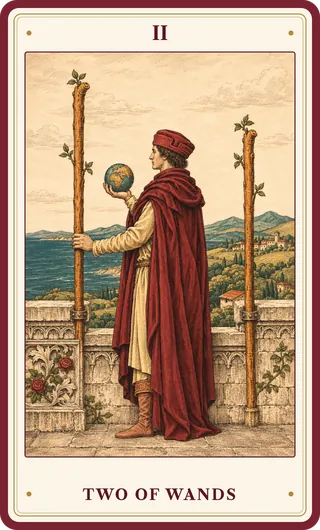
The globe
The man holds a small world in his hand. It shows that the whole field of possibility is already within reach and that the choice of where to go is yours.
The two wands
He holds one wand while the other is fixed to the wall beside him. They stand for the choice between staying with what is secure and setting out for something larger.
The battlements
He stands on a castle wall, safe and comfortable. The image asks whether you will keep looking out from safety or step down and act.
The sea and distant land
The wide water and far shore show a future that is visible but not yet reached. Success here depends on actually making the crossing.
Red cap and robe
Red carries fire, drive and ambition, the energy of the Wands suit. It marks someone who has the will to act and is deciding how to use it.
Lily and rose emblem
The crossed lilies and roses on the card join purity of purpose with passion. They suggest the best plans combine clear thinking with real desire.
The turned back
He faces away from us and toward the horizon. His attention is on what lies ahead, which is why this card speaks about the future rather than the present moment.
When the Two of Wands is not a good answer
Because the card is about planning and direction, some questions do not suit it. Questions about something happening this minute, about another person’s exact actions, or about a fixed external outcome like a result you cannot influence tend to get a vague or off-topic response. If a Two of Wands feels strangely unrelated to what you asked, the question may be the problem.
The card also does not say much about whether something is a good idea in an ethical or practical sense. It describes ambition and options, and it is happy about both. If you are choosing between a sensible plan and a reckless one, look to cards that carry judgment, such as Justice or the Swords suit, to balance it.
If you pull it and the “yes” feels unconvincing, it may mean that the decision is yours to make rather than the cards’. That is a legitimate answer in itself, and often the most honest one.
Timing a Two of Wands yes
The Two of Wands sits early in the Wands story, so the yes it offers is not usually instant. Expect a planning phase first, often a matter of weeks. Wands tend to move faster than Cups or Pentacles once things start, so the pace picks up after your first step.
A rough reading is “soon, after preparation,” and it tends to compress when you act and stretch when you wait. If you want to explore timing more carefully, the guide to tarot timing explains how suits, numbers and spreads can be used to estimate when something may happen.
Reversed, timing stretches. The delay is usually self-created, through fear or missing information, so the clock restarts when you deal with that.
Reading it with neighbouring cards
In a one-card draw the Two of Wands stands alone, but in a larger spread its neighbours can strengthen or soften the yes. A few common pairings:
- With the Ace of Wands: a strong yes, the idea and the plan lining up.
- With the Three of Wands: a yes that is already moving, with results on the way.
- With the Two of Pentacles: a yes that needs juggling several priorities at once.
- With the Eight of Cups: a yes to leaving something behind in order to go further.
- With the Four of Swords: a yes, but rest or reflection must come first.
Look at your next card as well. The Three of Wands as a yes or no is the natural follow-up, since it shows plans already in motion. Seeing the Two of Wands followed by cards of delay, such as the Hanged Man or the Four of Swords, suggests the plan is sound but the timing is not.
How to ask the question
Clear questions get clear yes or no answers. The Two of Wands responds best to questions that are open to your own action and tied to a defined choice. Vague or double-barrelled questions give vague cards. The guide to questions for a tarot reading has more examples of how to phrase them.
Compare these:
- Weak: “Will things work out for me?”
- Better: “Should I apply for the role in the new city?”
- Better still: “Is accepting this offer a good next step for my career this year?”
Ask one question at a time and set a timeframe if it matters. If you do not like the answer, resist asking again immediately. Rephrase only if you realise the first question was unclear, not because you want a different card.
Two of Wands compared with similar cards
The Two of Wands is easy to confuse with other “two” cards that involve choice. The Two of Pentacles is about juggling and keeping balance in the present, while the Two of Wands is about looking ahead and committing. The Two of Pentacles often means “maybe, if you can keep up”, whereas the Two of Wands leans yes if you plan.
The Two of Swords as a yes or no is the card of a blocked decision, with the choice avoided on purpose. The Two of Wands has the opposite problem: the choice is visible and attractive, and the missing piece is action. If you drew the Two of Swords, you need clarity. If you drew the Two of Wands, you need a first step.
Numerologically, all twos are about duality and choice, which is why the Two of Wands is a card of options rather than certainty. The difference in suit changes the flavour: fire, will and ambition.
What to do after you draw it
A yes from the Two of Wands is only useful if it leads somewhere. Use the card as a short checklist:
- Name the specific decision the card is answering.
- Write down the first concrete step, and a date for taking it.
- Identify one thing you still need to find out.
- Choose one person who can support or challenge the plan.
- Take the first step within a week, however small.
If you drew it reversed, swap step three for the question “What am I afraid of here?” and answer it honestly. Many reversed Two of Wands draws resolve once the fear has a name.
Try this: Put the card in front of you and say aloud what “leaving the wall” would look like for this question. Then do the smallest version of it today, such as sending the email, booking the call or opening the document.
A note on using the card as one answer among many
A single card is a useful signal, not a ruling. The Two of Wands gives a strong lean, and the position, wording and context of your question all affect how much weight to give it. If a Two of Wands yes contradicts a strong gut feeling, take that seriously and look at what the card might be failing to cover.
For decisions that matter, build the answer out. A 3 card tarot draw, such as situation, obstacle and advice, gives the yes some context and shows what might stand in the way. The cards help most when you use them to ask better questions of yourself, and the Two of Wands is especially good at that: it hands you the map, and you decide where to go.
Questions readers ask
Is the Two of Wands a yes or no card?
Upright, the Two of Wands leans yes, especially for questions about plans, expansion and choosing a bigger option. The yes is conditional on you having a plan and taking a first step. Reversed, it usually means not yet.
Is the Two of Wands reversed a no?
It leans no, but it is better read as not yet or not like this. The reversed card points to fear, indecision or a plan with gaps rather than a closed door. Fix the gap and the answer can change.
Does the Two of Wands mean yes in love?
Often yes, when the question is about the relationship growing or a shared future. It is weaker for questions about instant contact or a fast reply, because the card is about planning, not immediate action.
Is the Two of Wands a yes for a job change or business move?
Yes, this is where the card is strongest. It supports moving toward a bigger opportunity, as long as you have researched it and know your next concrete step.
How soon will a Two of Wands yes happen?
The Two of Wands sits at the planning stage, so expect the yes to come after a decision and preparation, often over weeks rather than days. The timing speeds up the moment you take your first action.
Should I trust one Two of Wands draw as a final answer?
Treat it as strong guidance rather than a ruling. Check the position in your spread, the cards beside it, and whether your question was clear and specific enough to answer.