
Three of Wands as a Yes or No Answer

- Arcana
- Minor Arcana, Suit of Wands
- Element
- Fire
- Yes or no
- Yes
expansionforesightprogress
delayslost motivationscattered energy
The Three of Wands is a yes. Upright, it answers yes to questions about growth, progress and plans you have already set in motion, with the understanding that the result is still on its way. Reversed, it means not yet, and in a strict yes or no pull you can count it as a no.
What makes this card different from a plain “yes” like the Sun is the wait. The figure on the cliff has already sent his ships out and cannot hurry them. So the Three of Wands says: go ahead, you are on the right track, and be patient while it arrives. This page explains how to read that answer for love, work, money and timing, and what to do when the card does not quite fit your question. For the full card meaning beyond yes or no, see the Three of Wands page.
The short answer
Upright Three of Wands: yes. Reversed Three of Wands: not yet, which leans no. That is the verdict most readers use, and it holds for the large majority of questions.
Think of three levels of confidence. A fully upright card in a clear one-card pull is a confident yes with a delay. An upright card surrounded by cautionary cards is a yes that needs adjusting. A reversed card is a pause: the plan may be sound, but something about the timing, preparation or follow-through is not ready.
If you only want a fast answer, you can use the yes or no tarot reading tool and come back here for what the card says about your specific situation.
Why the Three of Wands says yes
The card sits in the suit of Wands, which is fire: action, ambition and drive. By the number three, you are past the idea (Ace) and past the decision (Two). Now something is taking shape in the real world. The Three is where the early results of your effort become visible.
That is why this card leans so firmly towards yes. It does not describe a wish or a hope. It describes effort that has already been made and a plan that has already been launched. A yes from this card is earned, not granted.
In the Golden Dawn tradition the card is linked with the Sun in Aries, which adds a note of confident, forward-moving fire. You do not need astrology to read the card, but it fits the picture: this is a card of visible momentum and good conditions.
What the image tells you about the answer
Look at the Rider-Waite-Smith picture as if it were a short story. A man in a rich robe stands on a high cliff with his back to us. He holds one wand, and two more are planted beside him. Below him lies a calm sea with ships on it, and beyond that, distant mountains under a warm sky.
He is not building, arguing or hesitating. He has already done the work and is now watching. That is the reason the answer is yes: the hardest decision is behind him. It is also the reason for the wait: the ships are not in the harbour, and no amount of staring at the horizon will bring them in faster.
When you pull this card, ask yourself whether your question matches that picture. If you have already started, applied, invested, reached out or planted something, the card fits and the yes is strong. If you have not, the picture does not describe your situation, which matters for the section on when the card is a poor fit.
Read Three of Wands for your question
Upright: A yes to a connection that has already started to grow, especially one with distance, travel or a long view built into it.
Reversed: Not yet: plans for the future are out of step, someone is hesitating, or the relationship is being asked to grow faster than it can.
Upright: Hopeful, confident and looking ahead, with real interest that has been thought through rather than rushed.
Reversed: Uncertain and holding back, with enthusiasm that cools when things stop moving quickly.
Upright: A strong yes to expansion, a bigger role, work with distant clients or a project you have already launched.
Reversed: Not yet: delays, weak planning or an opportunity that needs more groundwork before it pays off.
Upright: A yes to patient, long-range plans such as investments, exports or a business that has begun to earn.
Reversed: No for now: returns are slower or smaller than forecast, so avoid stretching your budget on hope.
Upright: Keep going, lift your eyes to the horizon and trust that the effort you sent out is on its way back.
Reversed: Rework the plan, check the details you skipped and give the timeline more honest room.
Upright: A yes to steady progress: recovery or a new routine is working, though results take time to show.
Reversed: A slow or stalled recovery, so review the plan with a professional rather than pushing harder.
Three of Wands reversed: yes or no
Reversed, the Three of Wands does not usually mean “never.” It means the ships are delayed, they never sailed, or the plan needs more thought before it can succeed. Common themes are poor planning, obstacles you did not foresee, frustration at slow progress and expansion that has outrun its foundations.
For a strict yes or no answer, treat it as a no for now. For a more flexible reading, treat it as a maybe that depends on what you change. The reversed card is practical: it asks you to check the route, the budget, the people involved and the timeline before you expect results.
Context decides how hard to lean. A reversed card in a question about a rushed decision is a firm warning to wait. In a question about a long-running project that has simply been slow, it is a sign to adjust and keep going. Our Three of Wands reversed page covers the reversed meaning in more depth, and the guide to reading reversed tarot cards explains how to decide when a reversal is a block, a delay or a softer energy.
Try this: Draw the Three of Wands reversed in a practice reading and write down three things in your plan that you have assumed rather than checked. Fix the weakest one before asking again.
Love and relationships
For love questions, the upright Three of Wands is a yes when the relationship is already moving and you are looking at its future: planning a trip together, building a long-distance connection, moving toward a shared home or deciding where this is going. It rewards people who think ahead and communicate their plans.
It is a weaker answer to questions about attraction, such as “does she like me?” The Three of Wands is about progress and outlook, not chemistry. In that case, the yes means the connection has room to grow if you keep investing, not that the other person is already certain. For feelings, a card like the Knight of Cups or the Two of Cups speaks more directly.
Reversed in love, the card suggests mismatched timelines. One person is looking at the horizon while the other is not ready to leave the harbour. The answer is not yet, and honest conversation about expectations is the next step.
Getting back together and waiting to hear
Many people ask this card about an ex or about someone who has gone quiet. Upright, it leans yes to the idea that contact or movement is coming, particularly if there is distance involved or the person is travelling, studying or building something elsewhere. The wait is part of the answer, so do not chase.
The card does not promise a reunion by itself. It says that what you have put into the situation has gone out and a response is on its way. If you have not actually reached out or made your position clear, the ships have not sailed, and the sensible reading is to take the first step before expecting a reply.
Reversed, the card advises against forcing a reconciliation. Communication has stalled, or the plan for how you would get back together is not realistic yet. Wait, rebuild your own footing and see whether the connection resumes on better terms.
Career and job questions
Work is where the Three of Wands is most reliably positive. Use it as a yes for applications, promotions, expansion of a business, launching a project, moving abroad, taking on international clients or any role with a wider reach. The card loves foresight, so planning a few steps ahead makes the yes stronger.
Be specific about what the yes covers. It confirms that you are on the right path and that your groundwork is paying off. It does not guarantee the exact job or the exact date. If you asked “will I get this particular offer?”, read the yes as a good chance with news still to come.
Reversed, it points to a plan that hit a wall: a stalled application, a project that lacked groundwork, or a venture that grew faster than its structure. The answer is not yet. Review your preparation and return to it, perhaps after drawing something like the Eight of Pentacles to see whether the skill and effort are in place.
Money and investment
For finance, the upright Three of Wands says yes to long-range, steady plans: investments held over time, a business with early revenue, trade and export, freelance work with clients in other places, or savings built toward a clear goal. The key word is patience. Returns arrive with time, not at once.
It is not a card for quick wins or get-rich schemes. If your question is “will this pay off by next week?”, the answer leans not yet, even upright, because the card’s timeline is longer than that.
Reversed, it warns against stretching your budget on projections. Costs may be higher than planned, or returns slower than forecast. Hold off on any commitment that depends on money you do not yet have.
Health questions
Use the Three of Wands carefully for health. Upright, it is a yes for steady progress: a recovery plan that is working, a treatment you have begun, a new routine that is starting to show results. It speaks to the early stage of a change that will keep improving.
Reversed, it suggests slow recovery, a plan that lacks support or a goal set too high too quickly. The card advises review and professional guidance rather than more force.
Tarot cannot diagnose or replace medical advice. For any real health concern, treat a card as a prompt for reflection and speak to a qualified professional.
Three of Wands card symbols
Choose a symbol to read what it means on the card.
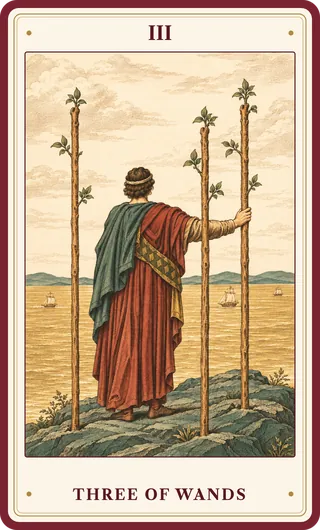
The figure seen from behind
We never see his face, which invites us to share his view instead of judging him. He has done the hard part and is now watching and waiting.
Three wands
One wand is held in his hand and two are planted in the ground, showing foundations already laid. Three is the number of first results taking shape.
Ships on the sea
The ships are the plans you have sent out, and they are still travelling. This is why the answer is a yes that comes with a wait.
The cliff edge
He stands high above the water, which gives him perspective and a wide view. It also shows he is at a threshold, with the next stage still ahead.
Distant mountains
The far shore and mountains stand for goals that are visible but not yet reached. They say the future is larger than your current location.
Warm yellow sky
The glowing sky belongs to the fire suit of Wands and signals energy, optimism and daylight ahead. It tells you conditions are favourable.
Rich robe
His clothing suggests someone with standing and experience, perhaps a merchant or leader. Success here comes from preparation, not luck.
When the Three of Wands is a poor fit for the question
The Three of Wands answers best when something is already in motion. Some questions simply do not match the card, and recognising that saves you from reading a false yes.
These are the situations where the card can mislead:
- You have not yet started and are asking whether you should. The card’s yes is about results of past action, so the better reading is “begin, then wait.”
- You are asking about a specific person’s private feelings. The card does not read minds.
- You need an answer this week. The card points to a longer wait.
- Your question is about ending something, resting or letting go. The card’s energy is outward and expanding.
In those cases, redraw with a clearer question or choose a method suited to the situation. The questions for tarot reading guide has examples of wording that gets clearer answers.
How long until the yes arrives
Because the ships are at sea, the Three of Wands is a mid-range timing card. It usually points to weeks or months rather than days. In practice, the more distance, paperwork, travel or other people involved, the longer the wait.
Fire cards often move faster than water or earth cards, so the surrounding cards matter. A quick card such as the Eight of Wands next to it shortens the estimate. A slow card such as the Four of Swords or the Hanged Man stretches it. Our tarot timing guide shows how to turn a card into a realistic window.
Try this: After you draw a yes, write down one date a month ahead and one sign you would expect to see by then. Check back and see how the wait compared to the card’s estimate.
Cards that strengthen or soften the yes
Because the card is about momentum, the cards around it change the weight of the answer. Next to the Two of Wands, a decision already made becomes visible progress, which strengthens the yes. Next to the Six of Wands or Ace of Wands, the yes becomes bigger and faster.
Cards of waiting or caution soften it. The Four of Swords tells you rest or delay is needed before the result. The Two of Pentacles suggests you are juggling too much to follow through. Swords in general bring doubt or conflict, which can turn the yes into a maybe.
If the Three of Wands appears among several cards in a larger spread, treat the yes as true for the matter it sits beside, not for the entire reading. Position and neighbours always count.
How to ask the question
A good yes or no question for this card is specific, has a clear timeframe and relates to something you have actually started. “Will my application to the overseas program go through?” is better than “Will my life get better?” The more your question describes a launched plan, the more reliable the card becomes.
Avoid asking the same question again and again until you get the answer you want. Draw once, note the answer, and wait until something has changed before you ask it again. A card that shows up on repeat is usually telling you the same thing: be patient.
Also avoid questions that contain two things at once, such as “Should I move and take the new job?” Split them into separate questions so that each card answers one thing.
A simple three-card method for yes or no
If one card feels too thin, a three-card method gives a fuller answer. Draw one card for the situation, one for the obstacle and one for the outcome. A Three of Wands in the outcome position is a yes. In the obstacle position it suggests the issue is impatience or planning. In the situation position it confirms that you are already on the way.
Another option is to treat the first card as your answer and the next two as the explanation of why and what to do. If you want a more structured approach, the 3 card tarot page explains several layouts you can adapt.
When the answer is yes, the other cards tell you what the wait will be like. When it is no, they tell you what to change.
What to do after a yes
A Three of Wands yes is a call to keep your plan alive without forcing it. Check the details, follow up on messages or applications, and prepare for the stage that comes next. The figure on the cliff is not idle: he is observing and ready.
Use the waiting period well. Build on what you have, widen your network, and prepare for a larger version of your plan than you currently have. The card often arrives right before things expand, and people who have prepared for that are ready when the ships come in.
Finally, trust the effort you have already put in. The card rewards those who have started. If you are still deciding whether to begin, make that step now and return to the card later.
Try this: Write down the one action you can take this week that would help your “ships” arrive: a follow-up, a proposal, a call. Do it before you draw again.
Frequently asked follow-ups
People often ask whether the Three of Wands is “more yes” than other Wands cards. It is a solid yes, but not the strongest. The Ace of Wands is a yes for a new beginning, and the Six of Wands is a yes for public success. The Three of Wands is the yes for ongoing progress with a pause built in.
Others ask if the answer changes in a spread where it appears in the past position. In that case it reflects earlier effort or a plan already launched, and the yes belongs to the present result. For a wider view of the suit, read about the Wands as a whole, which shows how this card fits between the Two and the Four.
If you are unsure after reading, pull one more card for clarity and read it as advice, not as a replacement answer. Calm, specific follow-up questions work better than repeating the same one.
Questions readers ask
Is the Three of Wands a yes or no card?
Upright, the Three of Wands is a yes. It is a yes with a wait built in, because the ships are still at sea and the results have not arrived yet.
What does the Three of Wands reversed mean for a yes or no question?
Reversed, it means not yet, and in a strict yes or no pull it counts as a no. The usual reasons are delays, weak planning or timing that is off.
Is the Three of Wands a yes for love?
Yes, if the connection is already moving and you are looking at the longer term. It is a weaker answer to "does he like me?" because the card is about progress and planning, not attraction.
Does the Three of Wands mean yes to a job offer or promotion?
Yes, particularly for growth, relocation, international work or a project you have already started. Expect the result to take time rather than arrive overnight.
How long until the Three of Wands answer comes true?
The card points to weeks or months, not days, since the ships still have to cross the water. Treat it as a mid-range timeframe and check for fast cards in the surrounding reading.
Can the Three of Wands be a no?
Only when reversed, or when the question is about something you have not yet begun. If nothing has been launched, the card tells you to start the work first, so the honest answer is not yet.