
Six of Cups as a Yes or No Answer

- Arcana
- Minor Arcana, Suit of Cups
- Element
- Water
- Yes or no
- Yes
nostalgiamemoriesinnocence
emotional blockswithdrawalimbalance
The Six of Cups is a gentle yes when it appears upright in a yes or no reading. It says yes to reconnecting, forgiving, returning to something familiar and accepting kindness. Reversed, it leans no, because the pull of the past is stronger than what is actually good for you now.
That answer comes with a shape, and the shape matters more than the word. This card is about memory, comfort and old bonds, so it answers some questions very clearly and others hardly at all. Below you will find when the yes is solid, when it weakens, and how to read it in love, work, money and health. For the full card, see the Six of Cups meaning.
Why the Six of Cups leans yes
Cups is the suit of emotion, and the number six in tarot points to harmony, exchange and balance after the turbulence of the earlier cards. In the Six of Cups, that harmony is simple: two children in a sunny garden, one handing the other a cup of flowers. Nothing is being fought over, hidden or earned. That is why almost every reader treats it as a yes card.
The yes is not about success, speed or money. It is about warmth. The card says the situation you are asking about has a kind, familiar and emotionally safe quality, and that moving toward it is likely to feel good. If your question is “Will this feel right?” the card is generous. If your question is “Will this make me rich by spring?” it has very little to say.
Think of the answer as “yes, and it will be gentle.” That small qualifier stops you from over-reading the card as a guarantee.
Six of Cups upright as a yes or no answer
Upright, the Six of Cups answers yes to questions that run along its grain. It leans yes for reunions, apologies, reconciliations, reconnecting with friends, going home, revisiting a place that mattered, and accepting help from people who love you. It also leans yes for anything that involves teaching, caring for others or sharing what you know.
The card is at its warmest when the question already contains a person or a past. “Should I reach out to my old friend?” is a clean yes. “Should I visit my hometown this summer?” is a clean yes. “Will my sister forgive me?” is a hopeful yes, with the understanding that forgiveness arrives as softness rather than a grand scene.
It is less convincing for questions that have nothing familiar in them. If you are asking about a stranger, a new city or an untested business, the card is not saying no. It is just looking the wrong way. That is worth knowing before you act on it.
Six of Cups reversed as a yes or no answer
Reversed, the Six of Cups leans no, and hardest on go-back questions. The innocence of the upright card turns into rose-tinted memory: the past is being polished until nothing in the present can compete with it. The answer to “Should I return to what I had?” is usually that the memory is better than the reality, or that the person you remember no longer exists.
A reversed Six of Cups is also a no for decisions made from habit or loyalty. Staying in a job because it is comfortable, keeping a friendship out of obligation, or repeating a family pattern because it is how things have always been done all fall under this card. Some readers prefer “not yet” or “conditional” for the reversal, and that is fair: the energy is still present, but it is blocked by an unresolved attachment. See the reversed Six of Cups for the full explanation.
One reversal that deserves care: a reversed Six of Cups can also mean leaving home, growing up or moving on. If your question is “Should I leave?” the card may be a yes to the leaving, not a no to the question. Read the question before you read the card.
Read Six of Cups for your question
Upright: A warm yes to reconnecting, reconciling and softening, especially with someone you already share history with.
Reversed: A no to going back for the sake of going back, because nostalgia is hiding what the relationship is really like now.
Upright: Fondness, tenderness and a protective, uncomplicated affection that feels safe and familiar.
Reversed: Longing for how things used to be, or feelings that are still tied to an old version of the person or the relationship.
Upright: A yes to familiar workplaces, former colleagues, mentoring, teaching or work that feels meaningful and kind.
Reversed: A no to staying in a role purely because it is comfortable, or to chasing a past success instead of building the next one.
Upright: A modest yes: generosity, family help, inheritance or old resources coming back, rather than a big windfall.
Reversed: A no to financial decisions made out of habit, sentiment or loyalty to how things were done before.
Upright: Lean on what is familiar and kind, and let a good memory or an old friend help you decide.
Reversed: Stop revisiting the past for answers, and bring one lesson from it into today instead of the whole story.
Upright: A yes to rest, gentle routines, time with loved ones and healing that comes from feeling safe and cared for.
Reversed: A no to old habits and old patterns that no longer serve you, and a reminder to deal with unresolved emotional strain.
How strong is the yes?
The Six of Cups is a soft yes. It is not the confident, forward-moving yes of the Ace of Wands or the full celebration of the Ten of Cups. It is closer to a nod. The outcome it describes tends to be quiet, personal and relationship-based, with very little drama.
That makes it useful for emotionally honest questions and less useful for urgent ones. If you need a firm answer about a deadline, a legal matter or a competitive situation, a soft yes is not enough, and you should draw a second card or reframe the question. If you want to know whether a gentle, human approach will work, the soft yes is exactly what you need.
Try this: Before you draw, write your question as a plain sentence and underline the person or place in it. If there is a person from your past in the sentence, the Six of Cups is speaking directly to you. If the sentence is only about the future, treat the answer as softer.
Questions where the Six of Cups gives a clear yes
The card is most reliable when the question matches its themes. These are the types of questions where you can trust a yes:
- Should I contact someone I have lost touch with?
- Will an apology or a fresh conversation help?
- Is it a good idea to visit family or go home?
- Will working with a former colleague or mentor go well?
- Should I take time to rest and do something that comforts me?
All of these ask whether a familiar, warm path is worth taking. The Six of Cups says it is. If your question sounds like any of them, the yes is strong enough to act on, provided you are realistic about what the other person wants.
A good test is to ask whether the question could be answered by “yes, because there is already something good to build on.” If it can, the Six of Cups fits.
Questions where the Six of Cups does not answer cleanly
Some questions pull the card out of its comfort zone. New ventures, major risks, and questions about someone’s secret motives all sit outside what it does well. In those cases, the card may be telling you something about your attachment to the past or your wish for safety rather than answering the yes or no itself.
The same applies to timing questions. The Six of Cups carries no calendar. It can describe something that happened long ago, something returning now or something you carry. If you need a “when,” you will do better with a method built for that, and tarot timing covers it.
If you get this card for a future question and cannot see the link, ask what in your situation is old, familiar or unfinished. The answer to that is often the real answer to your question.
Six of Cups yes or no in love
In love, the Six of Cups is a warm yes for relationships built on shared history, friendship or long familiarity. It supports reconciliation, a first date with someone you have known for years, or a childhood friend becoming something more. It is also a card of tenderness, so it fits questions about whether someone cares: the answer is that the feeling is sincere, protective and uncomplicated.
For new relationships with strangers, it is a quiet yes with a note of caution: the connection may feel familiar because the person reminds you of someone, not because the match is right. Take your time and see the person as they are.
Reversed, the card is a no for relationships that are held together by memory. It asks whether you love the person or the story you tell about them. If you have been replaying the early days of a relationship that has changed, the card is asking you to look at the present version honestly.
Does the Six of Cups mean an ex is coming back?
This is the most common question attached to this card, and the honest answer is: it can, but it does not promise it. The Six of Cups is a yes to contact, closure, forgiveness and warmth between two people who share a past. It is a softer yes to a full reunion, because it does not tell you what has changed since you parted.
To find out whether a reunion is wise, look at the cards around it. The Two of Cups or the Ten of Cups beside the Six makes a real return far more likely. The Five of Cups or Three of Swords suggests that old pain is still active. The Eight of Cups suggests one of you has already left emotionally, and the Eight of Cups as a yes or no explains why that card reads so differently.
If the Six of Cups appears reversed on an ex question, the answer is usually no for now. It does not mean never. It means the memory is doing the work that the relationship should be doing.
Six of Cups card symbols
Choose a symbol to read what it means on the card.
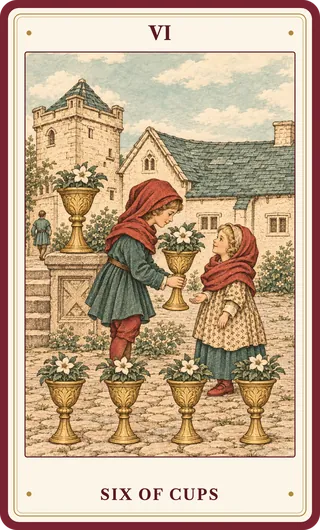
Two children
The pair stand for innocence and the simple pleasure of sharing. Their closeness is why the card is so warm toward reconnection and kindness.
The cup being handed over
One child offers a cup to the other, which makes this a card of giving without a price tag. It points to a gift, a gesture or a kindness freely offered.
Six cups filled with white flowers
Flowers instead of water show emotion that has bloomed and become something you can hold. White blossoms suggest purity, sincerity and a happy memory kept intact.
The garden courtyard and cottages
The enclosed, sunlit setting is home ground: safe, familiar and walled off from the wider world. It explains the card's pull toward comfort, and its risk of staying too long.
The guard in the background
A watchman walks away behind the children, which hints that someone is looking over this scene. It reads as protection, and as a sign that this peaceful moment has watchful edges.
The stone plinth with a cross
The cup on the stone base carries a carved cross, a quiet echo of tradition, inheritance and values handed down. It ties the card to family, roots and what lasts.
Six of Cups yes or no for career and money
At work, the Six of Cups is a mild yes for jobs that involve people you trust, such as returning to a former employer, joining a family business, working in education or care, or taking on a mentoring role. It also supports staying in a role that is emotionally rewarding even if it is not ambitious. The yes is about fit, not advancement.
For money, the card points to generosity: a gift, help from family, an inheritance, or a debt that is forgiven. It does not favour speculation or large investments. A good question for this card is “Will my family help me with this?”, not “Will this stock go up?”
Reversed, it is a no to nostalgia-based decisions. That includes refusing to sell something with sentimental value that you cannot afford, staying in a role you have outgrown, or relying on a financial approach that worked ten years ago. The card asks you to separate what feels familiar from what is actually working.
Six of Cups yes or no in health
The Six of Cups is not a diagnostic card, and no tarot card should replace medical advice. As a general mood, upright, it is a yes to rest, comfort, being cared for and routines that make you feel safe. It supports questions such as “Will taking time with my family help me recover emotionally?”
Reversed, it points to old patterns: habits you picked up in childhood, grief that has not been processed, or a reluctance to ask for help. It suggests that the stress you are feeling may have an older source than you think. That is a prompt for reflection and, where needed, professional support.
How the cards around it change the answer
A single Six of Cups gives a lean, but a spread gives a verdict. When it sits beside positive, forward-moving cards such as the Sun, the Ace of Cups or the Four of Wands, the yes becomes confident. When it sits beside cards of loss, delay or deception, the yes is still there, but it carries a condition you need to name.
A few patterns come up often:
- With the Ten of Cups or Three of Cups: a happy reunion, family gathering or shared celebration.
- With the Seven of Swords or the Moon: the past is not being told honestly, so wait.
- With the Eight of Cups: someone is leaving the old situation behind, and the yes does not hold.
- With the Ace of Pentacles or the Six of Pentacles: practical help or generosity reaches you.
If you pull the card as part of a 3 card tarot reading, check its position. In the past slot it is simply a memory, in the present slot it is the answer, and in the future slot it suggests that something familiar will return.
What the image tells you about the answer
The Rider-Waite-Smith card shows a sunlit courtyard where an older child hands a cup of white flowers to a smaller one. The flowers fill the cups, which means that feelings here have already blossomed and become something you can give. The stone buildings and the walking guard add a note of safety and protection.
Read as a yes or no, the image says that the answer is generous and sheltered, but it is also enclosed. The children are inside walls, and nothing in the picture looks outward. That is the card’s strength and its limit: it is wonderful for what is already close to you and quiet about what lies beyond the garden.
Try this: Look at the card for one minute and decide which child you are in your question: the one giving or the one receiving. If you are giving, the yes is about your own generosity. If you are receiving, the yes depends on someone else’s goodwill.
How to ask a question the Six of Cups can answer well
The clearest questions for this card are specific, bounded and emotionally honest. “Should I call her this week?” will produce a better answer than “Will we ever be okay?” The second question is too large and invites the card to speak about your longing rather than the situation. If you need help phrasing yours, the list of questions for tarot reading gives plenty of working examples.
It also helps to ask one question at a time. If you ask whether to reconnect, whether it will last and whether it will be easy, a single yes cannot cover all three. Draw once for each, or move to a spread. If you want a fast, structured pull, the yes or no tarot card reading tool lets you draw a card for each version of your question.
Be honest about which answer you are hoping for. The Six of Cups is a comforting card, and it is easy to hear a yes that is really your own wish. Say your hope out loud before you turn the card, and then see how the answer feels against it.
Should you draw again?
If you drew the Six of Cups and the answer fits your question, there is no need to pull more cards. A soft yes does not become stronger by repeating it. Drawing again until you get the answer you want is a habit that weakens every reading you do afterwards.
Draw again only when the question was unclear or when the card does not address what you asked. In that case, rephrase the question, wait a while, and then draw. If the Six of Cups returns, take that as emphasis: the matter is about the past, and the answer will not change until you deal with it.
It is also worth noticing which way the card falls. If you read reversals, the guide to reversed tarot cards explains how to decide your approach before you shuffle, so you are not choosing the reading afterwards to match your preference.
Quick reference for the Six of Cups yes or no
Upright: a gentle yes, strongest for reunions, kindness, family, forgiveness and familiar people. Reversed: leans no, strongest for going back, nostalgia, old habits and comfort that has stopped helping. In a love question, it supports contact and warmth, and cautions against assuming a full reunion. In a career question, it favours trusted people and meaningful work over ambition. In a money question, it points to help and generosity rather than profit.
Whatever the answer, the card carries one consistent message: bring the best of what you remember into the present, and leave the rest where it is. That is the useful part of both the yes and the no.
Questions readers ask
Is the Six of Cups a yes or no card?
Upright, the Six of Cups is a gentle yes. It supports questions about reconnecting, forgiving, reuniting and choosing what feels familiar and kind. Reversed, it leans no or conditional.
Is the Six of Cups reversed a yes or no?
Reversed, it leans no, particularly for questions about going back to an ex, a past job or an old pattern. It does not say the situation is bad. It says nostalgia is stronger than the facts.
Does the Six of Cups mean yes to getting back with an ex?
It is a yes to contact, reconciliation and closure, and a softer yes to a real reunion. It cannot promise the relationship will work now, so check the cards beside it and what has changed since you split.
Why did I get a past card for a question about the future?
Because your question may be tied to something that began earlier, or the answer depends on an old pattern, person or lesson. Treat it as a yes only if the question is about reconnecting or building on what you already have.
Is the Six of Cups a yes for money and career questions?
It is a mild yes when the choice involves familiar people, a trusted employer, family support or teaching. It is less reliable for bold new ventures, where it tends to say stay close to what you know.
How strong is the Six of Cups as a yes?
It is a soft yes rather than a loud one. Think of it as a yes with warmth and low pressure, where the outcome is gentle and relationship-based and rarely dramatic or fast.