
Four of Cups as a Yes or No Answer

- Arcana
- Minor Arcana, Suit of Cups
- Element
- Water
- Yes or no
- No
apathycontemplationmissed offers
emotional blockswithdrawalimbalance
The Four of Cups is a no in a yes or no reading, or more precisely “not yet”. Upright, it points to apathy, boredom and a closed mind, so the honest answer is that you are not in a place to say yes. Reversed, the card leans yes, because the fog is lifting and you are ready to accept something you nearly ignored.
The reason is in the picture. A young man sits under a tree with three cups in front of him and a fourth being offered from a cloud, and he does not see it. The card rarely says “this will never happen”. It says “something is available, and you are not receiving it right now”. The rest of this page explains how to read that for love, money, work and timing questions, and what to do when the answer is not what you hoped.
Why the Four of Cups leans no
Tarot yes or no readings work by the energy of the card, not by a fixed rule. Cards of movement, openness and success lean yes. Cards of blockage, delay and refusal lean no. The Four of Cups is a card of refusal: the figure has his arms crossed and his attention turned inward, so nothing is moving forward.
The fourth cup is key. In most cards, the offer is the good news. Here the good news is already on the table, and it is being ignored. So the card cannot give a clean yes, because the thing you are asking about has not been accepted by anyone, including you.
This is also why many readers soften the no into “not yet” or “not like this”. The card describes a mood, and moods change. If you want the full picture of the card beyond a quick answer, the Four of Cups tarot card meaning covers it in depth.
Four of Cups upright as a yes or no answer
Upright, treat the answer as no, or not yet. That fits questions such as “Should I say yes to this?”, “Will this work out?” and “Is now the time?” The card is telling you that you are disengaged, unconvinced or distracted, and any decision made from that state is likely to be poor.
Read the no as being about the questioner, not the outcome. If you ask “Will I enjoy this new role?” and draw the Four of Cups, the card is not predicting that the role is bad. It is noticing that you feel flat about it, and asking you to find out why before you commit.
There is a harder reading too. If you keep drawing the Four of Cups on the same question, the no may be about boredom with the whole situation. That is worth being honest about.
Four of Cups reversed as a yes or no answer
Reversed, the card leans yes. The figure finally sees the cup, or at least turns toward it. Motivation returns, curiosity comes back, and you may find yourself able to take up an offer that felt grey a week ago. For a question like “Should I accept?”, the reversed Four of Cups is one of the more encouraging answers in the suit.
Some readers call the reversed card a maybe, and that is reasonable. The awakening is real, but it has to be acted on. A yes from this card means “you are ready”, not “it will happen without effort”. Reach out, reply, sign, ask. The detail on this position is in the Four of Cups reversed page, and the general method for reversed cards is covered in how to read reversed tarot cards.
If you do not read reversals, you can still use this card well. Upright only, treat it as a pause. Ask the question again in a week or two and see whether the answer has moved.
Read Four of Cups for your question
Upright: Someone is bored, distant or taking love for granted, so the answer to a love question leans no or not yet.
Reversed: Interest returns and a missed chance at connection can be picked up again, so the answer leans yes.
Upright: They feel flat, withdrawn or unsure what they want, and their feelings are on hold rather than gone.
Reversed: They are waking up to what they feel and are far more willing to engage.
Upright: You are restless and may be overlooking a decent offer, so hold off on big moves and look again at what is on the table.
Reversed: Motivation returns and you are ready to accept the opportunity you nearly ignored.
Upright: Hold off on new financial commitments, because you are not seeing the full picture while you feel this flat.
Reversed: You can reconsider an offer or plan you dismissed, and a cautious yes is reasonable once you have checked the numbers.
Upright: Pause, rest and look at what you already have before you decide anything.
Reversed: Say yes to the thing you have been ignoring, once you have checked that it is real.
Upright: Low mood, burnout or fatigue is asking for rest, and ignoring it will not help.
Reversed: Energy and appetite for life are coming back, and small steps toward recovery will land well.
What the “no” is actually about
The most common mistake is to read the Four of Cups as a verdict on the thing you asked about. It is almost always a verdict on your state of mind. Three cups are in front of the figure, which means he has plenty. His problem is not supply, it is attention.
That changes how you act on the answer. A no from the Five of Cups or the Ten of Swords tells you something has ended or gone wrong. A no from the Four of Cups tells you to look again before deciding, because you are probably not seeing the situation clearly.
Think of it as a request for a second look, not a closed door. Ask yourself what you are ignoring, what you assumed without checking, and whether you are tired, burned out or simply disappointed by something unrelated.
Try this: Write your question, then draw the Four of Cups in your mind and finish this sentence three times: “The thing I am not looking at is…” Use the most honest answer as your real reply.
Four of Cups yes or no in love
In love, the upright Four of Cups is a soft no. Questions like “Will they text me?” or “Should we get back together?” get an answer of not now. One or both of you is disengaged, bored, distracted or taking the connection for granted. The feeling may still exist, but it is not active.
For a single person, the card often shows being tired of dating, or ignoring a person who is genuinely interested. If your question is “Is there someone for me?”, the card does not say no. It says the offer may already be there, and you are looking past it.
Reversed, the card leans yes. Interest comes back, a conversation restarts, or you notice someone who was there all along. The Ace of Cups yes or no answer is a clearer, more emotionally open yes if you want to compare.
Four of Cups yes or no for career and money
At work, the upright card leans no to a big move made out of restlessness. Questions such as “Should I quit?” or “Should I take this offer?” get a pause. Before you decide, work out whether the problem is the job or your energy. Burnout makes every option look grey.
For money, it is a cautious no to new commitments. You are not seeing the full picture while you feel this flat. Delay investments, large purchases and contracts until your mood has shifted, and check the numbers with a clear head.
Reversed, both turn more positive. A job offer or opportunity you wrote off deserves another look, and a money plan you dismissed can be reconsidered. The answer is yes, once the details check out. If you want a structured way to ask about finances, the money tarot spread can add detail.
When the Four of Cups means not yet
Timing is where this card is most useful. It rarely says “never”. It says the moment is wrong, and that moment is defined by your mood and attention, not by a calendar date.
If you want a rough guide, the upright Four of Cups suggests waiting until you feel more engaged, which could be days or weeks. Reversed, the shift is already under way. Pair it with a timing question and look at the surrounding cards. A Wands card nearby suggests a quicker change, while a Swords card suggests the delay comes from overthinking.
Be careful not to use “not yet” as a way to avoid a decision. If you have been waiting for months and nothing has changed, the card may be showing a pattern: you keep saying maybe and nothing happens. In that case the real answer is to decide, one way or the other.
How to ask a question the Four of Cups can answer
The card works best when the question involves an offer, an option or a choice you are lukewarm about. It works poorly for questions about other people’s secret feelings or fixed outcomes. A clear question gets a clear answer.
Good questions have a few things in common:
- They ask about a decision you control (“Should I accept this?”).
- They are about the present or near future, not far away.
- They are specific enough that yes and no mean something.
- They do not ask the same thing twice in one sitting.
Weak questions, such as “Does he love me?” or “What will happen this year?”, are better answered with a spread. The yes or no tarot card reading page walks through how to phrase and draw for a clean answer.
Four of Cups card symbols
Choose a symbol to read what it means on the card.
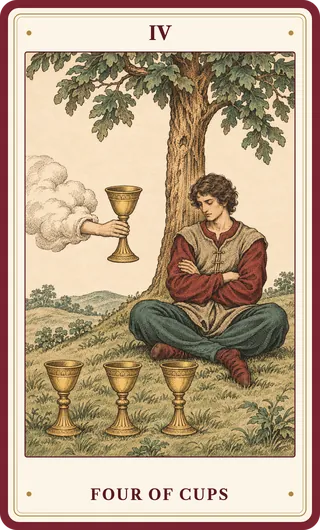
The seated figure
A young man sits with crossed arms and a closed posture. He is turned inward, which shows withdrawal, boredom and a mind that is elsewhere.
The three cups on the grass
Three cups sit in front of him, untouched. They stand for what he already has: past experiences, existing options and gifts he has stopped valuing.
The cup from the cloud
A hand reaches out of a cloud holding a fourth cup. It is a new offer or insight, and it is the reason this card is about attention, not luck.
The tree
He leans against a tree trunk, which gives a sense of stillness and being rooted in one spot. It suggests stagnation, but also a safe place to rest.
The crossed arms and legs
His closed body language is a refusal to receive. It shows self-protection and a decision, even if unconscious, to keep things out.
The green hill and grey sky
The setting is calm and ordinary, with no crisis in sight. The trouble is internal mood and not outer circumstances.
The cloud
The offer comes from the sky, so it is unexpected and out of his control. It reminds you that opportunity often arrives when you feel least ready.
Reading the Four of Cups next to other cards
A single card gives a lean, not a final word, so context matters. The Four of Cups beside a strong yes card, such as the Sun or the Ten of Cups, suggests the situation is good and you are the missing piece. Beside a no card, it confirms that the answer is wait.
Some pairings come up often. With the Ace of Cups, a new emotional offer is arriving and you are being asked to notice it. With the Five of Cups, disappointment is clouding your view of what remains. With the Three of Cups, friends or community may be the cure for the flat mood.
The Eight of Cups deserves its own note. Both cards show a figure who is dissatisfied, but the Four of Cups stays put and the Eight of Cups walks away. If you draw the Eight, the answer is firmer, as explained in Eight of Cups as a yes or no answer.
The Four of Cups in a three-card yes or no spread
A simple three-card line is a good way to test the answer. Draw one card for what is happening now, one for what you are missing, and one for the likely result if you act. If the Four of Cups lands in the first position, you are in the mood the card describes. If it lands in the second, it names what you are not seeing.
Position changes the yes or no answer. In the final position, the Four of Cups means the outcome is stalled or ignored, which leans no. In the middle position, as a blocker, it is less a no and more a warning to look closer. A guide to this kind of layout is on the 3 card tarot page.
Try this: Draw three cards for your yes or no question. Before you read them, say aloud which one you hope for. If the Four of Cups appears, ask what you are hoping for that you have not yet asked for.
The fourth cup: what is being offered?
The cup in the cloud is the most important part of the picture. It comes from a hand, which means someone or something is offering it. It is not yet in his grasp, and he has to look up to see it.
In a reading, this often means the answer to your question already exists. A person has made an effort, an opportunity has appeared, or a solution is in plain view. The card asks you to look for it, not to wait for something better.
So when you draw the Four of Cups, list what has recently come your way: an invitation, a message, an offer, a kind gesture. One of them may be the cup. Whether it is worth taking is a separate question, and an honest look will usually tell you.
What to do after you draw it
The best response to the Four of Cups is gentle and practical. You do not need to force enthusiasm, but you also should not let the card become an excuse to do nothing.
- Rest first. If you are tired or low, sleep, eat and take a break before deciding.
- List what you already have, and what you have been taking for granted.
- Name the offer you are ignoring and say why.
- Set a short deadline, such as a few days, to decide.
- Ask the question again afterwards and compare.
If the low mood continues for weeks and affects daily life, tarot is not the right tool. Speak to a doctor or a counsellor, because persistent apathy can be a sign of depression or burnout that deserves real support.
When to pull again, and when not to
Pulling again straight away usually gives a muddled answer. If you draw the Four of Cups and do not like the no, drawing until you get a yes tells you only that you wanted a yes. The card may have been right, because it is describing the wish to avoid the answer.
A better method is to change something before you ask again. Wait a day or a week, rest, or rephrase the question so it is clearer. You can use a random tarot card generator for a fresh draw once things have moved.
One exception: if the answer feels unclear because the card is a mood and not a verdict, a follow-up clarifier is reasonable. Draw one card and ask, “What am I not seeing?” Read it as an explanation of the Four of Cups, not as a replacement for it.
Common mistakes with this card
The first mistake is reading it as a final no. The Four of Cups is a pause, and for many questions the answer will change once your mood does. The second is reading it as a yes because “the offer is there”. The offer is there, but nobody has taken it.
A third mistake is treating the figure as lazy or ungrateful. He is closer to overwhelmed or disappointed. The card has compassion for that, and your reading should too.
Last, do not ignore the reversed card because you like the upright answer less. Both positions describe the same figure at different moments. One is before he looks up, the other is after.
Quick reference: Four of Cups yes or no
Here is the short version to keep in mind when you draw the card:
- Upright: no, or not yet. Pause and look again.
- Reversed: yes, once you take a real step.
- Love: upright means disengagement, reversed means renewed interest.
- Work and money: upright means wait before committing, reversed means reconsider the offer.
- Timing: it depends on when your attention returns.
Use the card as a mirror for your own interest. If you feel flat about the question, the answer is probably no for now, and the useful thing to do is find out why. When the interest comes back, so does the yes.
Questions readers ask
Is the 4 of Cups a yes or no card?
Upright, the Four of Cups leans no, or more accurately not yet. Reversed, it leans yes, because the apathy is lifting and you are ready to accept what is offered.
Does the 4 of Cups reversed mean yes?
Usually, yes. Reversed, the figure finally notices the fourth cup, so the answer moves toward acceptance. Treat it as a yes that still needs a real step from you.
Is 4 of Cups a no for love questions?
Upright, it is a soft no. Either you or the other person is disengaged, bored or distracted. It does not mean the feeling is gone, only that now is a poor moment to push.
Should I take the job or offer if I draw the Four of Cups?
Upright, pause before you decide and check whether your doubts come from the offer or from your own mood. Reversed, the offer is worth accepting once you have read the details.
Can the Four of Cups mean maybe?
Yes, many readers treat it as a maybe or not yet, because the card is about perception more than outcome. If the answer feels unclear, ask a sharper question and draw again.
How is the Four of Cups different from the Eight of Cups in a yes or no reading?
The Four of Cups is a pause where you stay put and ignore what is offered. The Eight of Cups is a decision to walk away, so it is a firmer no to the current situation.