
The Fool as a Yes or No Answer

- Arcana
- Major Arcana, card 0
- Element
- Air, Uranus
- Yes or no
- Yes
beginningstrustspontaneitya leap of faith
recklessnesshesitationpoor judgmentfear of the unknown
The Fool is a yes. When you ask a yes or no question and draw the Fool upright, the answer leans clearly toward yes, especially if your question is about starting something, taking a chance or trusting a new opportunity. Reversed, the Fool becomes a maybe or a gentle no: not yet, and not like this.
That answer comes with a condition. The Fool says yes to the first step, not to a guaranteed outcome, and the small dog at the Fool’s heels is a reminder to look where you are going. This page explains why the card reads as a yes, when the yes is strong or weak, and how it changes in love, work, money and other situations. For the full card, see our guide to The Fool tarot card meaning.
Why the Fool leans yes
The Fool is card 0, the start of the Major Arcana. Everything in the deck comes after it, so the card stands for potential before anything has been decided or spoiled. A card of pure beginning naturally answers questions about beginnings with approval.
The image points the same way. A young traveller steps toward a cliff edge under a bright sun, carrying a white rose and a light bundle. The figure looks up, not down, and the posture is open and unguarded. Nothing in the picture suggests punishment or loss. The scene is one of trust, which is the energy yes or no readers look for when they want a green light.
The Fool is also linked to the element of air, which governs ideas, curiosity and movement. Air cards tend to say go, try, ask, explore. That is why the Fool fits questions such as “Should I apply?” or “Should I say hello?” far better than questions about holding steady.
What the Fool’s yes actually says
The yes is not “everything will work out perfectly.” It is closer to “this is worth beginning, and you will learn something real by doing it.” The Fool rewards willingness. The outcome depends on what you do after the first step.
That makes the Fool different from a card like the Sun, which promises success, or the Ten of Cups, which promises fulfilment. The Fool promises an opening. You get the chance, the door, the moment of possibility, and then the rest of the deck takes over to describe how it plays out.
A useful way to read the answer is as permission. The Fool tells you that your instinct to begin is sound, that waiting for perfect certainty would cost you more than starting imperfectly, and that you are allowed to be a beginner. If you were hoping for a forecast, ask a follow-up question once you have begun.
The Fool upright: a yes with conditions
Upright, the Fool is a strong yes when three things are true: the step is new, the downside is survivable and you actually want to take it. The more of those that are present, the louder the yes.
The Fool is a weaker yes when the question is about something that needs careful structure, such as signing a legal contract, taking on large debt or making a medical decision. The card is not telling you to be careless there. It is telling you that the starting energy is good, while the details still need real attention from you.
Before you act on an upright Fool, run through a short check:
- Can I afford the worst realistic outcome?
- Am I excited, or am I escaping something?
- Have I looked at the ground in front of me, not just the view?
- Is there one small first step I can take today?
If you can answer those honestly, the yes stands.
Try this: Write your question as a decision about one small first step, not the whole outcome. Draw the Fool, then take that step within 48 hours and note what you learn.
Read The Fool for your question
Upright: A fresh, playful start: say yes to the date, the new relationship or the honest conversation, and keep your eyes open.
Reversed: Hesitation or carelessness: either fear is stopping you from opening up, or someone is acting without thinking about your feelings.
Upright: They feel curious, excited and lighthearted about you, with no heavy agenda yet.
Reversed: They feel unsure, scattered or afraid of committing, and may be acting on impulse.
Upright: Yes to the new role, project or change of direction, especially if it excites you more than it scares you.
Reversed: Hold off on quitting or launching until you have researched the risks and given yourself a little runway.
Upright: A small, curious experiment with money is fine, as long as you can afford to lose what you put in.
Reversed: Skip the impulsive purchase or gamble and wait until you have the facts and a plan.
Upright: Begin before you feel ready, but look at the ground in front of you as you step.
Reversed: Pause, prepare and check your assumptions before you commit to anything.
Upright: Try the new routine, class or approach with a beginner's openness, and listen to how your body responds.
Reversed: Avoid rushing into extremes or ignoring warning signs, and get proper advice before changing anything major.
The Fool reversed: maybe, not yet, or no
Reversed, the Fool no longer gives a clean green light. Most of the time it means maybe, with a strong lean toward “not yet.” The card is warning about impulsiveness: jumping before you have checked your resources, ignoring advice or repeating a mistake because the idea feels exciting.
There is a second reading that surprises people. The reversed Fool can also describe the opposite problem: you have talked yourself out of beginning because you fear looking foolish. In that case the answer is not really no, it is “you are blocking a yes.” You can tell which version applies by asking what your gut says. If you feel pushed along by excitement, slow down. If you feel stuck in fear, the card is asking you to loosen up.
If you read reversals in your readings, our guide to reading reversed cards explains how to decide whether a reversal flips, softens or blocks a card’s meaning. For the Fool in detail, see The Fool reversed.
How to ask a question the Fool can answer
The Fool answers best when your question is about starting, trying or trusting. It gives muddy answers to questions about endings, maintenance or other people’s secret motives. A clear question gets a clear card.
Compare these:
- Good: “Should I apply for the new role?” The Fool says yes, apply.
- Good: “Is it a good idea to start the course this term?” The Fool says yes, begin.
- Weak: “Will my ex come back?” The Fool says little about this; it speaks of fresh starts, not returns.
- Weak: “Will my business definitely succeed?” The Fool offers an opening, not a result.
If you need help phrasing questions, our list of questions for tarot reading has examples that work well for yes or no draws. You can also use the yes or no tarot reading tool to draw a card for any question and see how it reads.
The Fool yes or no in love
In love, the Fool is a yes to new connections. Should you message them, go on the date, move to a new city to be with someone, or say how you feel? The card favours honest, light, unforced movement. It likes first conversations, spontaneous plans and the nervous, lovely feeling of not knowing what comes next.
The caution is about expectations. The Fool says yes to the beginning, not to a long-term commitment or a particular outcome. If you ask “Is this person my soulmate?” the Fool does not answer that. It answers “Is it worth starting?” and the answer is yes.
In an established relationship, the Fool is often a yes to play, trying something new together, taking a trip or breaking a routine. Reversed in love, it can point to someone who is flaky, impulsive or not taking things seriously, or to you holding back from opening up. To see how the card reads when it describes another person’s emotions, check the Fool as feelings.
The Fool yes or no in career
At work, the Fool supports change, experiments and new directions. Applying for the job that seems a stretch, pitching the idea, starting the side project, moving into a field where you are a beginner: the answer is yes. This card respects curiosity over a perfect CV.
The yes is stronger for exploration than for exit. The Fool may encourage you to test a new path while you still have income, take a short course, or have the first conversation with a hiring manager. It is less convincing as a sign to resign tomorrow with no savings and no plan.
Reversed, the Fool in a career question warns against a rash resignation, a poorly researched business launch or a risk taken to prove a point. It can also describe a team member who is unprepared or avoids responsibility. Draw a second card to see what preparation is missing.
The Fool yes or no for money
Money is where the Fool’s yes needs the most care. The card supports small experiments, a first investment of a size you can afford to lose, or a new income stream you are curious about. It does not support betting rent money on a hunch.
Think of the Fool’s tiny bundle on the stick. The traveller carries little, and the lesson is that you start with what you can afford to risk, not everything you have. If your question is about a major financial commitment, treat the Fool as a green light to research and take the first small step, not as a reason to skip due diligence.
Reversed, the Fool is a clear caution. Avoid impulse purchases, get-rich-quick schemes and decisions made from excitement or fear of missing out. If you want a fuller picture of your finances, try a dedicated money tarot spread after your yes or no draw.
The Fool card symbols
Choose a symbol to read what it means on the card.
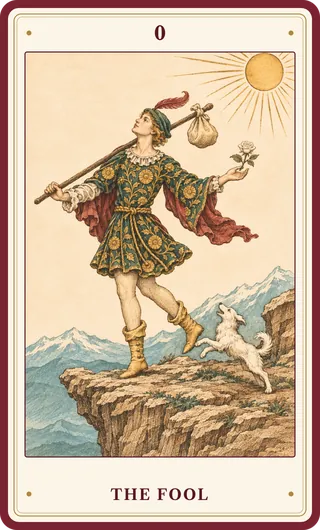
Cliff edge
The Fool stands at the brink of a drop, which is the moment before a decision becomes an action. The card asks you to step forward, not to pretend the drop isn't there.
White sun
A pale, radiant sun sits behind the figure, showing clear light and good faith over the whole scene. It supports the yes: the conditions for a fresh start are favourable.
White rose
The Fool holds a single white rose in one hand, a sign of pure intention and open desire. It says you can begin with sincerity rather than a perfect plan.
Bundle on a stick
A small bag hangs from a stick over the shoulder, holding only what is needed to start. It reminds you that you do not need to carry everything to begin.
White dog
The little dog leaps at the Fool's heels and seems to bark or encourage. It is the voice of instinct and common sense, the part of the yes that says watch your step.
Snow-capped mountains
Tall peaks rise in the distance behind the Fool, showing that the path ahead is long and has real challenges. The yes is for the first step, not for an effortless arrival.
Feather in the cap
A feather sits in the Fool's hat, a symbol of air, thought and a light, free spirit. It points to curiosity and mental freedom, with a hint that the head may be in the clouds.
Health, safety and serious decisions
Tarot is not a substitute for medical, legal or financial advice, and the Fool is a good example of why. A cheerful yes about “starting something new” cannot tell you whether a treatment is safe, whether a contract is fair or whether a risky activity is wise. For those questions, the card’s own warning (the dog and the cliff) applies: use it as encouragement to take a first step, such as booking the appointment or asking the question, not as a sign to skip professional guidance.
On lighter health questions, the Fool is a yes to trying something new: a gentle class, a different routine, a new kind of movement. Reversed, it warns against going to extremes or ignoring your body’s signals.
If your question comes from distress, fear or a crisis, slow down before you draw. A yes or no card is a conversation starter with your own intuition, not an order, and the Fool’s best advice is always to stay curious and keep your common sense close.
When the Fool is only a weak yes
Not every Fool is a confident yes. A few things can weaken it. If the question is about something old, stable or long-running, such as a decade-long marriage or a settled career, the Fool’s fresh-start energy may not fit and the answer can be unclear.
The card also weakens when it appears in a position of warning or obstacle. In a spread, a Fool in the “challenge” position points to naivety or a lack of planning as the very thing in your way. And if the question is leading, for example “Should I do this reckless thing I already know is bad for me?”, the card may be reflecting the recklessness back, not endorsing it.
Pay attention to your own reaction too. If you feel relief when you see the Fool, the yes probably matches your instinct. If you feel a pit in your stomach, that is useful information. The dog in the card exists for that moment.
Reading the Fool in a three-card yes or no
A single card gives a quick answer, but a three-card draw adds context. A simple method: card one is the situation, card two is what supports or blocks the answer, card three is the likely direction. The Fool in any of these positions says that beginnings are present in the picture.
The Fool in position one with two steady cards after it (such as the Four of Pentacles or the Nine of Pentacles) is a good sign: the beginning has a stable follow-through. The Fool followed by heavy or fear-based cards suggests the leap is real but the landing is rough, so prepare more. Our 3 card tarot guide explains how to set up and read this kind of spread.
A yes from the Fool is strongest when the rest of the spread agrees. If most cards are upright and forward moving, take that as a clear go. If they are mixed, take it as “yes, but with care.”
Fool combinations that change the answer
Some cards next to the Fool shift the yes. The Magician next to the Fool says yes, and you have the skills to follow through. The Tower beside it says the leap may be forced by sudden change: you can read more in the Tower as a yes or no answer. The Eight of Cups says you are leaving something behind to start fresh, and the Hanged Man says the right move is a pause before the leap.
Cups cards tend to emphasise the emotional side of the yes, Pentacles add practicality and Swords bring honest thinking. The Seven of Swords next to the Fool can hint at a plan that is not fully above board, and the Two of Pentacles may say you are juggling too much to begin something new.
Treat these as prompts, not rules. The answer comes from the whole spread and your question, and the Fool’s general lean toward yes is the starting point, not the end.
What to do after you draw the Fool
Once you get a yes, the most useful next step is to make it concrete. Choose one small action that moves you from thinking to doing, and set a time for it. The Fool’s gift is movement, and a yes that stays in your head turns into the reversed card’s problem.
If you get the Fool reversed, treat it as a prompt for better preparation. Ask what you would need to feel ready: more information, a savings buffer, a conversation, a trial run. Then draw again later, once something has changed, rather than redrawing immediately to chase a better answer.
Try this: After drawing the Fool, write down one thing you would regret not trying and one thing you must check before you begin. Do the check first, then the attempt.
Quick reference: the Fool as an answer
Here is a short summary you can use when you draw the card:
- Upright: yes, especially for new starts and small experiments.
- Reversed: maybe or no, usually “not yet” or “not like this.”
- In love: yes to beginning, no promise about the end.
- At work: yes to exploring and trying, caution about reckless exits.
- With money: yes only to affordable experiments.
Remember that a yes or no card is guidance, not a verdict. The Fool is among the friendliest cards you can draw for a decision, and the best way to honour it is to take the step it points to while keeping your eyes open.
Try this: Pull a card with the random tarot card generator tomorrow morning with the question “What can I begin today?” and see whether the Fool’s spirit shows up in the answer.
Questions readers ask
Is the Fool a yes or no card?
Upright, the Fool is a yes. It supports beginnings, experiments and acts of trust. Reversed, it becomes a maybe or a gentle no, advising you to wait and prepare.
Is the Fool reversed a no?
Usually it is a 'not yet' rather than a hard no. The reversed Fool warns against recklessness or, less often, against fear that keeps you from starting. Check what the surrounding cards say about which one applies.
Does the Fool mean yes in love?
Yes, in most love questions, especially about a new relationship, a first date or a fresh start. It is a hopeful yes, not a promise of long-term commitment, so keep your judgment switched on.
Should I quit my job if I draw the Fool?
The Fool supports a change of direction, but it does not tell you to leave with no plan. Treat it as a yes to exploring and preparing, and use the other cards and your finances to decide the timing.
Can the Fool be a no?
Yes, when you ask a question the card does not fit, such as whether something old and steady will continue, or when it lands in a negative position next to cards like the Tower or Five of Swords. Context can turn the yes into a caution.
Is the Fool a good card to get in a yes or no reading?
Yes, it is one of the more encouraging answers in the deck. It is lighthearted, hopeful and forward moving, though it asks you to bring awareness along with your enthusiasm.