
The Fool Reversed: Meaning in Love, Work & Life

- Arcana
- Major Arcana, card 0
- Element
- Air, Uranus
- Yes or no
- Yes
beginningstrustspontaneitya leap of faith
recklessnesshesitationpoor judgmentfear of the unknown
The Fool reversed means that the free, trusting energy of the first card in the deck has gone off course. It most often points to recklessness, naivety and poor judgment: jumping without looking. It can also mean the reverse, a fear of beginning that keeps you standing at the edge. The card asks you to find the sensible middle between those two.
In a reading, this is rarely a doom card. It is a prompt to slow down, gather what you are missing, and make your next step a chosen one rather than an accident or an avoidance. Below you will find how to tell which side applies, what it means in love, work, money and health, how it works as feelings or as a person, and what to do when it shows up.
Why The Fool reversed has two faces
Upright, The Fool is card zero: the start before the story begins, with trust, curiosity and very little baggage. Turn it upside down and that same energy can fail in two opposite directions. One is too much leap: acting on impulse, ignoring risk, and assuming it will all work out. The other is too little: stalling, over-worrying, and never leaving the cliff edge because you cannot guarantee how things will land.
This is why you will see apparently contradictory meanings online, with some sources saying “reckless” and others saying “afraid”. Both are correct. The Fool is about taking a first step, so when it is reversed the problem is always about that step: you are taking it badly, or you are not taking it at all.
A third, quieter reading also exists. Sometimes the reversed Fool shows an idea that is still forming. You have conceived something new, but you are not ready to bring it out yet, and keeping it private for a while is the right call.
How to tell which side you are on
The surrounding cards help, but your own question helps most. Ask yourself whether the situation already involves movement or only talk. If you have already quit, moved, signed or confessed, the reversed Fool is almost certainly a warning about haste. If you have been circling a decision for months, it is far more likely about fear.
A few quick signs can help you decide:
- Reckless side: you feel a rush, you are skipping research, you are ignoring advice, and the plan fits on a napkin.
- Frozen side: you keep rehearsing the worst case, you wait for certainty that never comes, and you tell yourself you are “not ready” without saying what ready would look like.
- Immature side: you expect someone else to catch you, fix it or pay for it.
Nobody lives in just one of these, and the same person can be reckless in love and frozen at work. Treat the card as a mirror for the specific area you asked about.
The Fool reversed in love
In a love reading, the reversed Fool often describes rushing: falling fast, making big promises early, or overlooking details that your gut has already noticed. The innocence that makes upright Fool romance charming becomes gullibility, so the card can warn you against trusting someone who has not shown consistency. It is especially pointed if you are asking about someone who has let you down before and is asking for another chance.
It can just as easily describe fear. You may be holding back from dating or opening up because you dread looking foolish, being rejected or repeating an old mistake. Cold feet before a commitment fit here too. The reversed Fool does not say the relationship is wrong. It says you have not yet decided to be present in it.
If you are in a long relationship, the card can point to a loss of play and adventure, with both of you running on routine. It can also show immaturity: dodging serious conversations, leaving the practical side to one partner, or treating the relationship as a game. When you ask what it means for your own conduct, look at where you may be avoiding adult responsibility.
Try this: Write down three things you know for certain about the person or situation, and three things you are assuming. If the second list is longer, hold back from any big step until you have turned some assumptions into facts.
Read The Fool for your question
Upright: A fresh, open-hearted start where honesty and playfulness matter more than a plan.
Reversed: Rushing in blindly, ignoring red flags, or holding back from love because you fear looking foolish.
Upright: Excitement, curiosity and a willingness to see where things lead.
Reversed: Nervous hesitation, avoidance, or feelings that are strong but not yet thought through.
Upright: A new role, a bold idea or a pivot that is worth trusting.
Reversed: Impulsive moves with no plan, or a change you keep postponing out of fear.
Upright: A calculated risk or a first step into something financially new.
Reversed: Impulse spending, unvetted investments, or freezing and avoiding your finances altogether.
Upright: Take the leap, stay curious and trust yourself.
Reversed: Pause, check the facts, and find the middle ground between recklessness and fear.
Upright: Trying something new for your wellbeing with an open mind.
Reversed: Careless habits, ignoring symptoms, or putting off a check-up you already know you need.
The Fool reversed as feelings
When you ask what someone feels, the reversed Fool suggests their emotions are real but unsettled. They may be impulsive and intense one week, then distant the next. They may be attracted but unsure whether they want something serious, and so they send mixed signals rather than a clear answer.
It can also mean the person is wary of commitment, still working out what they want, or too emotionally immature to say it plainly. That does not make them a bad person. It does mean you should not build your plans on a feeling they have not stated. For more on how this card reads when you are asking about someone’s heart, see The Fool in love and as feelings.
If you drew it about your own feelings, it can mean you are excited but scared, or that you are acting on a crush without checking whether it is grounded in the real person.
The Fool reversed as a person
As a person in your life, the reversed Fool is someone who struggles to take things seriously or follow through. They may be charming, funny and undeniably free-spirited, but their lack of planning or accountability affects the people around them. They make big promises on a whim, then disappear when it gets hard.
It can also be a naive person: someone who trusts easily, has little experience, and is at risk of being taken advantage of. If it points to you, it may be a nudge that you are acting younger or more carefree than your situation allows, or the opposite, that you have made yourself so cautious that you stopped being yourself.
Court cards nearby can sharpen the picture. A Knight of Swords reversed next to it, for instance, strengthens the theme of speed without thought.
The Fool reversed in career and work
At work, the reversed Fool is the card of the leap or the lurch. On the reckless side, it warns against quitting without a plan, taking on a project you are not equipped for, signing something you have not read, or pitching an idea before you have tested it. Enthusiasm is not the issue. The missing piece is preparation.
On the frozen side, it describes a career move you know you need but keep delaying. You may feel like an impostor, worry that others will discover you do not know everything, or hold back an idea because you are afraid it will look silly. This is a very common reading, and it is often the more useful one.
The card can also show a role with little direction: you are in a job that lacks growth, nobody is guiding you, and you are not sure what comes next. Whichever applies, the practical advice is similar. Get information, ask someone more experienced, set a small first action and put a date on it.
The Fool reversed in money
Money questions bring out the sharper side of the card. Reversed, The Fool warns of impulse purchases, speculative investments you have not researched, lending money you cannot afford to lose, and treating a budget as optional. It can also suggest a gap in financial skills, or dependence on others for support when you could be building your own footing.
Again there is an opposite reading: avoidance. You may not be opening statements, looking at what you owe, or making any decision about savings because it feels overwhelming. Doing nothing is also a financial choice.
Tarot cannot replace a licensed adviser or an accountant, and a reversed Fool is a good moment to book that conversation. If you want a spread to look at your finances calmly, our money tarot spread is a good place to start.
The Fool reversed in health and wellbeing
In a health context, the reversed Fool can point to careless habits: ignoring warning signs, skipping rest, taking risks with your body because you feel invincible, or pushing off an appointment that you already know matters. It can also describe anxiety about starting a new routine, so you never begin.
Tarot is not a diagnostic tool, so treat any card as a reminder to look after yourself rather than as a statement about your body. If something worries you physically or mentally, a doctor or qualified professional is the right person to talk to.
On the gentler side, the card may suggest you need more play and lightness in your life, and have been taking everything so seriously that your energy has dried up.
The Fool reversed in personal growth
For self-development questions, the reversed Fool often shows the inner critic at work. It is the voice that asks what people will think, insists you are not qualified and says you should wait until you feel more confident. The result is a comfort zone that grows smaller each year.
The card can also describe a time of feeling lost or overwhelmed by too many unknowns, where life seems to be pulling you in several directions and you cannot find your footing. In this case, simple steps matter more than big gestures.
Spiritually, it may signal a quieter, more private kind of exploration. Rather than a loud new adventure, the reversed Fool might be inviting a period of reflection before the next beginning, which pairs naturally with The Hermit in a reading.
Try this: Think of the one thing you keep calling “not the right time”. Write the smallest possible version of it (one email, one phone call, one page) and do it within 48 hours. Notice what changes once it is no longer hypothetical.
The Fool card symbols
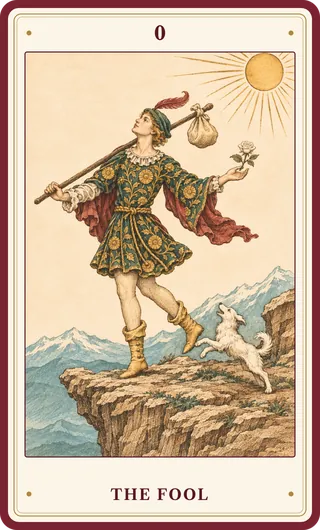
Choose a symbol to read what it means on the card.
The cliff edge
The Fool stands at the brink of a drop, which stands for a threshold and a choice. Reversed, the question becomes whether you can see the edge at all, or whether you are too frightened to step near it.
The small white dog
The dog is instinct and a loyal warning voice at the Fool's heels. Reversed, it asks whether you are ignoring that voice or letting it bark so loudly that you cannot move.
The white rose
The rose in the Fool's hand is purity and honest intention. Reversed, innocence can slide into naivety, so the question is whether your trust has been earned.
The bundle on the stick
The small bag holds everything the Fool is carrying, which is very little. Reversed, it can mean you set out underprepared, or that you are refusing to pack anything and so never leave.
The bright sun
The sun behind the Fool is optimism and life energy. Reversed, that light is dimmed or ignored, so hope may be blocked or poorly directed.
The mountains
The white peaks in the distance show the heights still to be climbed. Reversed, they can feel too far away, or you may be rushing toward them without a route.
The feather in the cap
The feather suggests a mind that is light, free and open to air and ideas. Reversed, the mind can drift, scatter or lose its grip on practical reality.
The Fool reversed as a yes or no answer
For a yes or no question, the reversed Fool generally leans toward no, or at least not yet. The card is not forbidding the action. It is saying that you have not yet looked at the whole picture, or that you are not yet ready to commit. If you want a fuller breakdown, see The Fool as a yes or no answer.
The exception is when the question is something you have thought through for months and are scared to do. In that case, the reversed Fool may be telling you that fear, not facts, is what is saying no. Read the card against how well prepared you actually are.
For a clear result, pair it with other cards or ask a more specific question, such as “What do I need to know before I do this?” rather than a flat yes or no.
What to do when The Fool is reversed
The most useful response is to match your action to the problem. If the card shows haste, slow down on purpose. If it shows fear, speed up in a small way. Either way, the aim is a step that is chosen, not impulsive and not avoided.
A simple routine works well:
- Name the leap in one plain sentence, including what you are leaving behind.
- List the worst realistic outcome (not the catastrophe) and decide whether you could survive it.
- Find one fact or person that can fill your biggest gap in knowledge.
- Set a small, reversible first step with a date.
- Review after the step, then decide on the next one.
This turns the Fool’s trust into something grounded. You are still going, but with your eyes open and a pack that has more than a stick and a handkerchief.
The Fool reversed in past, present and future positions
In a past position, the reversed Fool suggests a decision made too fast, or a chance you declined out of fear. It is worth asking what you learned, and whether that old lesson is still shaping your choices today. Often the card is pointing at a pattern more than an event.
In the present position, it describes where you are standing right now: on the edge, unsure, or about to jump without a plan. In the future position, it is a heads-up rather than a fixed outcome. It says that if you carry on as you are, you may rush or stall. You still choose which.
As an advice card in a three card tarot reading, it reads simply: look before you leap, or leap after you have looked.
What The Fool reversed means with other cards
Cards nearby decide which face of the Fool you are seeing. Some combinations to watch for:
- With The Magician reversed: ideas without skill or follow-through, or someone persuasive whose promises do not hold up.
- With the Eight of Cups: walking away on a whim rather than after real consideration, or struggling to leave something you have outgrown.
- With the Two of Pentacles: juggling too much without a plan, and money or time slipping through the gaps.
- With the Seven of Swords: a risk that involves secrecy or cutting corners, so check who benefits.
- With The Hanged Man: hesitation and suspension, where waiting may be needed but should not become a hiding place.
Major Arcana cards around it raise the stakes, while Minor Arcana cards bring the matter down to daily details. Court cards often point to a person who embodies the pattern.
The Fool reversed vs upright
Upright, The Fool says go, and trust the unknown. Reversed, it says check, because the unknown is either being treated carelessly or feared too much. The core energy of the card, a new beginning, does not vanish. It is just blocked, rushed or poorly aimed.
That is why reading reversals is useful here. A reader who sees only the upright Fool would miss the difference between a leap that is ready and one that is not. If you are new to reading inverted cards, our guide to reversed tarot cards explains the main ways to approach them, including reading them as blocked energy, internal energy or the opposite meaning.
The reversed Fool also differs from the upright card in one other respect: it asks for an honest look at yourself. The upright card says the universe will catch you. The reversed card asks whether you are doing your part.
Is The Fool reversed a bad card?
Not really. A tarot card that tells you to pause before a mistake is doing you a favour. The Fool has no villain in it. Even reversed, there is no malice, only inexperience, fear or haste, all of which can be corrected.
It can feel unwelcome if you were excited about a plan and the card says to slow down. But it is not saying never. It is asking you to bring a little more information and a little more courage, depending on which you lack.
In a deck, The Fool is the beginning of the Major Arcana, and a reversed Fool is the beginning that has not yet been properly chosen. That is a surprisingly hopeful place to be, because the choice is still yours.
Questions to ask yourself when The Fool is reversed
A few questions can open the card up when the meaning does not click immediately:
- What am I avoiding starting, and what is the fear underneath it?
- Where am I acting without enough information, and who benefits if I do?
- Who or what would I listen to if I stopped trying to prove I am fine?
- What is one small risk I could take that I would be proud of?
You can also draw a clarifying card for each answer, using our random tarot card generator if you have no deck to hand. Write down what you pull and revisit it a week later. Patterns in how you respond to The Fool tend to show up quickly, and they often tell you more than any list of keywords.
Try this: Place The Fool upside down in front of you and look at the image for one minute. Then turn it upright and notice what changes. Ask whether you have been standing at the cliff edge or already falling, and write one sentence about what you will do differently this week.
Questions readers ask
What does The Fool reversed mean?
The Fool reversed usually points to recklessness, naivety or poor judgment, or the opposite problem of fear and hesitation about starting something new. Both come from the same place: the free spirit of The Fool is blocked or distorted. Look at your question to decide which side applies.
Is The Fool reversed a bad card?
No. It is a caution rather than a punishment. It tells you the leap is either premature or being avoided, and in both cases it gives you time to adjust.
What does The Fool reversed mean in love?
It can mean rushing into a romance without seeing the whole picture, trusting someone too quickly, or being afraid to open up. It can also describe a partner who avoids commitment or responsibility.
Is The Fool reversed a yes or no?
Usually it leans toward no or not yet. The card advises waiting, checking the details and preparing before you commit. If your question is about a leap you have already planned well, it is a prompt to double-check rather than a firm refusal.
What does The Fool reversed mean as someone's feelings?
It suggests the person's feelings are unsettled, impulsive or unspoken. They may be interested but unsure, or pulling back because commitment feels heavy. Look at the cards around it for clues.
Should I read reversed cards at all?
That is up to you. Many readers use reversals because they add nuance, and The Fool is a good example, as it splits into reckless and frozen. If you prefer upright only, you can read the card's shadow side whenever it appears.