
Six of Pentacles Reversed (Meaning in Love, Work & Life)

- Arcana
- Minor Arcana, Suit of Pentacles
- Element
- Earth
- Yes or no
- Yes
generositygiving and receiving
setbackspoor planningfinancial worry
The Six of Pentacles reversed means that giving and receiving have become unbalanced. You may be giving more than you can afford, taking more than you offer, or dealing with help that comes with strings attached. It can also point to unpaid debts, loans that never come back, and money used as a way to hold power over someone.
Upright, this card is about fair and generous exchange. Reversed, the exchange has gone wrong, and the question is who is carrying the weight. Below you will find what the reversal means in love, work, money, health and family, how to tell which side of the imbalance you are on, and what to do about it.
Six of Pentacles reversed at a glance
The core idea is simple: the scales have tipped. Common keywords for the reversed card are imbalance, strings attached, selfishness, debt, dependency, one-sided giving, unpaid loans and unequal power. It can describe you, another person or the whole situation you are asking about.
Most of the time the card is not predicting a dramatic event. It is describing a pattern that has been going on for a while and that someone has stopped checking. A friend who always pays, a partner who always receives, a boss who gives favours and expects loyalty in return: the card names those patterns so you can see them.
If you want the full picture of the card before reading its reversal, the upright Six of Pentacles covers its generous, healthy side in detail.
What the card shows, and what flips
In the Rider-Waite-Smith image, a prosperous merchant weighs something on a pair of scales with one hand and drops coins into the hand of a kneeling beggar with the other. A second beggar waits beside the first. The scene looks charitable, but it is also a picture of unequal power: one person decides, the others depend on that decision.
Upright, the card is read mainly as the kind side of that picture. The merchant shares, the scales are fair and everyone gets what they need. Reversed, attention moves to the parts the image already contains but that stay quiet: who chooses, who waits, who is watching the scales and whether the giving is truly free.
That is why the reversed card is so useful. It does not say generosity is bad. It asks you to look at the terms.
Upright versus reversed
The upright card shows fair exchange, shared prosperity, mentorship, charity and the comfort of both giving and accepting help. The reversed card shows the same themes gone wrong: gifts with conditions, help that creates obligation, resources hoarded or one-way giving that wears someone out.
A useful way to hold the difference is to ask what happens after the exchange. Upright, both sides leave better off and nobody feels in debt. Reversed, at least one person leaves feeling smaller, drained, resentful or owing more than they agreed to.
If you are still getting comfortable with flipped cards in general, how to read reversed tarot cards explains the main approaches, including reading them as blocked, excessive or internal energy.
Read Six of Pentacles for your question
Upright: Both partners give and receive freely, and support flows in both directions without keeping score.
Reversed: One person carries the effort, money or emotional work while the other takes, and resentment or dependency builds.
Upright: They feel grateful, generous and happy to look after you.
Reversed: They feel either drained from giving or entitled to receive, and the exchange between you feels uneven.
Upright: Fair pay, mentorship and a workplace where effort is rewarded.
Reversed: You feel underpaid or overused, or a boss, client or colleague offers help that comes with strings.
Upright: Money moves well: you can lend, donate or accept help and it comes back in balance.
Reversed: Loans go unpaid, debt weighs on you, or you are giving more than your budget allows.
Upright: Share what you have and let others share with you.
Reversed: Check the balance, set limits on what you give, and say plainly what you need.
Upright: Support from others, good care and a sense of being looked after.
Reversed: Burnout from caring for everyone else, or pride that stops you from asking for help.
The three ways this card tends to show up
The reversed Six of Pentacles usually appears in one of three forms, and working out which one fits is the fastest way to read it.
- You are giving too much. You lend, pay, cover for others or offer your time, and little or nothing returns. You may feel tired, quietly resentful or unable to say no.
- You are receiving with strings. Someone is helping you, but it comes with expectations: loyalty, gratitude, silence or favours owed later.
- Someone is withholding. Resources are held back out of fear, selfishness or a need for control, and a person who could help is choosing not to.
Sometimes you are on more than one side at once. A person can give endlessly at work and also be borrowing from family, for example. Let the question and the neighbouring cards show where the weight sits.
Try this: Write down the last three times you gave or received something significant (money, time, a favour). Next to each, note whether it felt free or conditional, and whether it came back. The pattern across all three is usually the message of the card.
Six of Pentacles reversed in love
In a relationship reading, this card points to an unequal exchange. One partner may be paying for more, planning more, apologising first or doing most of the emotional work, while the other receives and offers little in return. Over time that creates tiredness on one side and entitlement or dependency on the other.
It can also show control through generosity. A partner who pays for everything and then uses it in arguments, or who gives gifts that come with expectations, fits this card well. The kindness is real on the surface, but the effect is to make the other person feel they owe something.
If you are single and the card describes a new interest, it can warn that they take more than they give. Watch how they handle small, ordinary exchanges: who picks up the bill, who makes the effort, who remembers what you said. When you are ready to talk it through, a relationship tarot spread can help you look at what each person brings.
As feelings and as an ex
When the Six of Pentacles reversed describes how someone feels about you, think fairness before affection. They may feel taken for granted and tired of giving without return. Or they may feel uncomfortable about owing you, so they pull away to avoid being in your debt.
It can also describe someone who holds back. They may be cautious with their time, money or emotions because they have been burned before, or because they fear being used. That is not the same as not caring, but it does mean they will not open up until the exchange feels safe.
For an ex, the card often points to an old imbalance: one of you gave more, or support was unequal. It rarely points to reconciliation by itself. If you are asking about getting back together, look to the other cards for whether anything has changed.
At work and in your career
At work, the reversed card commonly shows underpayment, overwork and unfair recognition. You may be doing more than your role asks without a raise, a promotion or even thanks. Or you may be the person who always covers for others while credit goes somewhere else.
It can also describe a workplace power gap. A manager might offer favours, flexible hours or special treatment and then expect unquestioning loyalty. A client may dangle exposure instead of payment. The help looks generous, but you are paying for it in other ways.
If you are the one in charge, the card asks how you share rewards and responsibility. Are you handing out the credit, or only the tasks? If this is part of a bigger career question, compare the card with the Eight of Pentacles reversed, which describes effort that is not leading to the progress you want.
Money, debt and loans
Money is where this card becomes most literal. Reversed, it often shows debt, especially borrowing that has become heavy or interest that is growing faster than you expected. It can also show money you lent to someone that has not been repaid, with the friendship now complicated by it.
It can point to generosity beyond your means too. You might be giving to charity, family or friends in a way that your own budget cannot support. Giving is a good thing, but a gift that leaves you unable to pay your own bills is not balanced.
On the other side, it can describe holding on too tightly: refusing to share, tip, donate or help when you easily could. If your reading is mostly about finances, a money tarot spread gives you more positions to work with, and the Four of Pentacles reversed shows what happens when the grip on money loosens or turns to greed.
Family and friendships
In family readings, the reversed Six of Pentacles often shows one person receiving most of the support. Everyone else may give time, money or patience to a single relative who never gives back. It can also point to inheritance disputes, favouritism or an older family pattern where love and money have become mixed together.
In friendships, it looks like the friend who always has a crisis and never asks about yours, or the one who keeps score of every favour. It can also show a friend who has quietly stopped giving because they feel unseen. Either way, the friendship needs honesty about what each person is able to offer.
Where there is real need, it matters to separate help from rescue. Helping someone stand up is generous. Paying for the same problem again and again can keep both of you stuck.
Six of Pentacles card symbols
Choose a symbol to read what it means on the card.
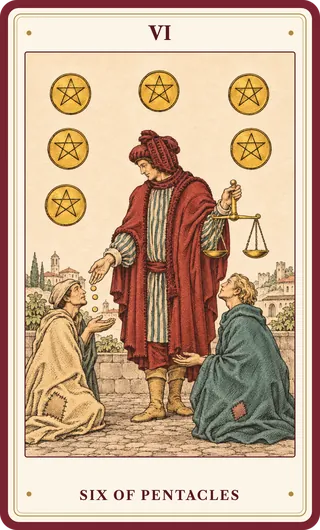
The merchant
A well-dressed man stands at the centre and holds the power in the scene. Reversed, he asks whether his generosity is truly free or whether it quietly buys loyalty and control.
The scales
He holds a balance in one hand, which stands for fairness and measured exchange. Reversed, the scales tip, showing that giving and receiving are no longer even.
The coins in his hand
He drops coins into a beggar's palm, the act of giving itself. Reversed, it points to gifts with conditions, loans that are never repaid or charity that is more about image than help.
The two kneeling figures
They are poor and in need, and they depend on the man's decision. Reversed, they show the weak side of receiving: dependency, shame or the feeling of owing someone.
The six pentacles
Two coins sit at the top and the rest are in the exchange below. Reversed, they raise the question of who holds most of the wealth and who is left with little.
The rich red and ragged clothing
The merchant's robes contrast with the worn cloth of the beggars. Reversed, the contrast stresses the gap in power and status that any act of giving can carry.
The empty ground
The scene has no home, no crowd and no witnesses. Reversed, it hints that the exchange is private and unchecked, so nobody is holding it to account.
Health and self-care
In health readings, the card is mostly about the cost of giving too much. Carers, parents and people in helping jobs often see it when they are running on empty. The advice is practical: rest, delegate, say no more often and accept support without guilt.
It can also describe the opposite problem: a reluctance to ask for help. Pride, embarrassment or a belief that you should manage alone can keep you from the care you need. The card is a reminder that receiving is part of a healthy exchange, not a failure.
This card is not a medical diagnosis, and it should never replace advice from a doctor or therapist. Use it as a prompt to look at how much you are giving compared with how much you are taking in.
Spiritual meaning
On a spiritual level, the reversed card asks you to look at your motives for giving. Are you giving from fullness, or to be seen as good, to avoid guilt or to feel in control? Giving that needs applause or repayment is a transaction, whatever it looks like.
It also questions how you receive. Many people find receiving harder than giving because it makes them feel exposed or in debt. The card invites you to practise accepting help and kindness with a simple thank you, with no urge to pay it back immediately.
Try this: For one week, give one small thing with no expectation (a coffee, an hour, a compliment) and accept one small thing without apologising or repaying it. Notice which of the two is harder. That is usually where the card is pointing.
The Six of Pentacles reversed as a person
As a person, this card describes someone whose relationship with giving is out of balance. They may be the over-giver who cannot say no and then feels resentful, or the taker who expects support and offers little. They can also be the controlling benefactor whose help always has a price.
Their behaviour tends to show in small, repeated ways: always letting someone else pay, bringing up past favours, keeping a mental ledger or giving in a way that makes the other person feel small. Look at what they do when you try to give back or when you refuse their help.
If the person is you, treat it as information rather than an accusation. Most people with this card are not villains. They learned a pattern around money, care or worth, and it can be changed.
Yes or no
As a yes or no answer, the reversed Six of Pentacles leans towards no, or “not on these terms.” It suggests that the situation as it stands is unbalanced, so agreeing to it without changes would probably leave one person worse off. The answer can shift to yes once the terms become fair.
For example, if you ask whether you should lend money to a friend, the card says to think hard about whether you could cope if it is never repaid. If you ask whether to accept a generous offer, it says to read the conditions first. For a fuller breakdown of both positions, see the Six of Pentacles as a yes or no answer.
Reading it with other cards
Neighbouring cards show which side of the imbalance you are on. With the Five of Pentacles reversed, you may be recovering from a period of hardship and learning to accept help without shame. With a court card, look at who the figure might be: the generous giver or the one who takes.
Cards of justice or fairness suggest the imbalance can be settled formally, through a contract, an agreement or a clear conversation. Swords cards point to conflict or hard truths, while Cups cards show the emotional cost behind the numbers.
In a three-card spread, try the Six of Pentacles reversed in the middle position: past, present, future, with this card as the present tension. A simple 3 card tarot layout is enough to show what led to the imbalance and where it is heading.
What to do when this card appears
Start by naming the imbalance. Ask yourself what you are giving, what you are getting and what each of those costs you. Often just writing it down makes the uneven parts easy to see.
Then decide on one change. That might be:
- Saying no to a request that you would usually agree to.
- Asking for repayment, or setting a clear date.
- Telling someone directly what you need.
- Refusing help that comes with conditions you are not happy with.
- Giving more freely where you have been holding back.
Keep the change small and specific. The card is about restoring fairness, not cutting off generosity, so the goal is a version of giving you can keep up without resentment.
Questions to ask yourself
When the card appears, these questions help you apply it to your own situation:
- Is my giving free, or do I expect something back?
- Who in my life takes more than they give, and have I told them?
- Is there help I need and have been too proud to ask for?
- Do I owe someone, and does it weigh more than it should?
- Where am I holding back out of fear instead of choice?
Your answers will usually show whether you are the giver, the receiver or both. For more on the suit this card belongs to, the Pentacles suit overview shows how the Six sits among the other money, work and material cards.
Questions readers ask
What does the Six of Pentacles reversed mean?
It means giving and receiving have fallen out of balance. Someone may be giving too much, taking too much, or offering help with conditions attached. It can also point to debt, unpaid loans or a power gap between two people.
Is the Six of Pentacles reversed a bad card?
Not really. It is a warning about fairness, not a disaster. It tells you where an exchange has become uneven so you can correct it, and for many people it is a prompt to set boundaries or ask for what they are owed.
What does the Six of Pentacles reversed mean in love?
It usually means one partner gives more time, money or emotional effort than the other. It can also show control through generosity, or a new interest who is more focused on taking than sharing. Talk openly about what each of you contributes.
Does the Six of Pentacles reversed mean debt?
It often does. The card can point to unpaid loans, borrowing you cannot comfortably repay, or money you have lent that has not come back. Read the surrounding cards to see whether you are the lender or the borrower.
What does the Six of Pentacles reversed mean as feelings?
The person may feel taken for granted, or they may feel uneasy about owing you. In some readings they are holding back generosity out of fear or selfishness. The feeling is about fairness, not necessarily a lack of affection.
Is the Six of Pentacles reversed a yes or no?
It leans towards no, or at least not yet. The answer is usually yes only if the terms become fair for both sides. Treat it as a request to renegotiate before you agree to anything.