
Six of Pentacles as a Yes or No Answer

- Arcana
- Minor Arcana, Suit of Pentacles
- Element
- Earth
- Yes or no
- Yes
generositygiving and receiving
setbackspoor planningfinancial worry
The Six of Pentacles is a conditional yes in a yes or no reading. Upright, it says yes when the exchange is fair, the help is freely offered and everyone involved gains something. Reversed, it leans no or “not yet”, usually because the terms are uneven, the help has strings attached, or someone is giving far more than they receive.
That condition is the useful part. This card is about giving and receiving, so the answer depends on what is being exchanged and who holds the scales. Below you will find how to read it for love, money, work and health, what to do when you are the giver instead of the receiver, and how to tell when a yes is too good to take at face value. For the full card, see the Six of Pentacles meaning.
The short answer: yes, if the balance is right
Think of the Six of Pentacles as a yes with a quality check. It confirms that help is available, that resources can move to where they are needed, and that fair dealing is possible. If your question is about support, repayment, funding, charity, mentoring or sharing, the answer leans yes.
The card does not promise a windfall or a fast result. Its yes is steady and practical, closer to “someone will help, and it will be fair” than “everything will go your way.” That makes it a gentler, more grounded yes than cards like the Ace of Pentacles, which points to a new opportunity arriving.
If the question has nothing to do with exchange, such as “will I move abroad” or “will they text me”, the card still leans yes, but only mildly. In those cases, read it as a note that support is around you, not as a firm verdict.
Why this card says yes
The Rider-Waite-Smith image shows a merchant weighing out coins and handing them to two people kneeling at his feet. Nothing in the scene is chaotic. The scales are in his hand, the coins are being counted and the help is moving in the right direction. The card sits at number six in its suit, the point where the struggles of the earlier cards ease into stability and generosity.
In yes or no terms, that means the energy of the card is open and flowing. It supports questions that ask “will I be helped”, “will I be paid fairly” and “will this exchange work for both of us.”
There is a second layer, though. The merchant has power, and the kneeling figures do not. A yes that comes from the Six of Pentacles is a yes with an awareness of who holds the advantage. That is why the card rewards questions about fairness and warns against questions about control.
Six of Pentacles reversed: no, or not yet
Upside down, the scales tip. The Six of Pentacles reversed leans no when help comes with conditions, when a loan has bad terms, or when one person keeps giving to someone who only takes. It can also describe charity used to gain influence, or generosity offered so the giver can feel superior.
Often “not yet” is the more accurate reading. The money may be coming, the help may exist, but the terms have not been agreed or the balance has not been found. In that case the reversed card is asking you to clarify before you commit. Read the Six of Pentacles reversed page for the full meaning, and see how to read reversed tarot cards if you are not sure how reversals work for you.
Not every reversal is negative. If your question is “should I stop giving to someone who drains me”, a reversed Six of Pentacles can say yes, you should. The card is then agreeing that the balance is off and needs to change.
Try this: Before you draw, write your question so the exchange is clear: “Will this loan be fair to me?” is a better question than “Will I be okay?” The card answers the shape of the question you give it.
Read Six of Pentacles for your question
Upright: Yes to a relationship where care moves both ways and neither person keeps score.
Reversed: No or not yet when one person gives and the other takes, or when affection comes with conditions.
Upright: They feel generous and warm toward you and want to support you.
Reversed: Their care feels uneven, tinged with obligation, resentment or a need to feel superior.
Upright: Yes to fair pay, a raise, a bonus, funding, a mentor or a team that shares credit.
Reversed: No to an offer with hidden strings, unequal pay, or a boss who gives help only to hold it over you.
Upright: Yes to a loan, grant, repayment or financial help arriving on fair terms.
Reversed: No to lending or borrowing until the terms are clear, and a warning about debt that controls you.
Upright: Give and receive openly, and trust exchanges that are balanced and transparent.
Reversed: Check the terms, protect your limits, and stop giving from an empty cup.
Upright: Yes to support, treatment and community care reaching you when you need it.
Reversed: Not yet: you may be overgiving, or help is not reaching you in a form that works.
Are you the giver or the receiver?
Two figures kneel and one stands. Before reading any yes or no answer, decide which one you are in your question. This is the detail most quick answers skip, and it changes the meaning.
If you are the receiver, asking “will I get help” or “will I be paid”, the upright card is a clear yes. Help is on the way, and you can accept it without shame. If you are the giver, asking “should I lend this money” or “should I help them”, the card says yes only if you are giving freely and can afford it. Giving that leaves you resentful or short is a reversed Six of Pentacles in disguise.
If you cannot tell which one you are, that is itself the answer. A relationship or deal in which neither side can say who gives and who receives is probably not balanced yet, and the card asks you to clear that up first.
Six of Pentacles yes or no in love
In love, the upright Six of Pentacles leans yes for reciprocity. It suits questions like “do we support each other”, “is this relationship fair” and “will they be there for me.” The care in this card is real and practical, shown through time, effort and kindness rather than grand gestures.
It is not the card to pull for “do they love me” or “is this passion.” It describes balance, not chemistry. For those questions, the Six of Pentacles gives a quieter yes: the relationship has a healthy exchange, but you may need other cards for the romantic detail. The Two of Cups and Ten of Cups speak more directly to love itself.
Reversed, the card leans no for relationships where one person carries the emotional or financial load. It can also point to keeping score, using favours as leverage, or giving in the hope of being owed something later. If you are asking about getting back with an ex, the upright card is a cautious yes only if both of you are willing to give equally this time, and the reversed card says the old pattern is still in place.
Six of Pentacles yes or no for money
Money is where this card is most direct. For questions about a loan, a grant, a bonus, back pay, an inheritance or someone repaying a debt, the upright Six of Pentacles leans yes. It also says yes to charitable giving that you can afford and want to do.
The card suggests help is possible, but it does not say how much. Treat it as a yes to the principle, then check the numbers. A yes to “will I get the loan” does not mean you should accept any terms offered.
Reversed, the answer is no for debt that tightens around you, for lending money you cannot afford to lose, or for support that will cost more than it gives. If you are asking “should I lend money to a friend”, the reversed card is a reminder to set clear terms or to give only what you would be fine never seeing again. For a broader look at money questions, try a money tarot spread.
Six of Pentacles yes or no for work and career
At work, the upright card leans yes for fair pay, a raise, a promotion with proper compensation, a mentor, funding for a project or a team that shares credit. It often shows up when your effort is about to be recognised, or when a senior person is willing to invest in you.
It also says yes to you becoming that person for someone else. If you are asking about mentoring, training or sharing your skills, the card approves. It matches the Eight of Pentacles, where you build skill, and gives it a generous second half: you pass something on.
Reversed, it leans no for offers where the pay is uneven or the benefits come with hidden costs. It can describe a boss who gives help only to hold it over you, or a workplace where credit flows upward and work flows down. If you are weighing a job offer, ask what the terms are, not whether the card says yes.
Six of Pentacles card symbols
Choose a symbol to read what it means on the card.
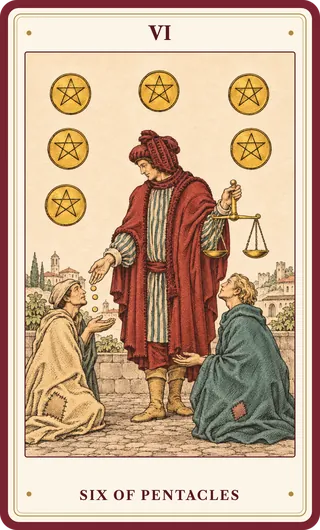
The scales
The merchant holds a pair of scales in one hand. They stand for fairness, judgement and the question of whether a gift is measured and balanced.
The merchant
A well-dressed man stands at the centre with power over what is shared. He shows that generosity is a choice made from a position of strength.
The coins in his hand
He drops coins into an outstretched hand. This is the act of giving itself, and it shows resources moving from one person to another.
The two kneeling figures
Two poorly dressed figures kneel below the merchant, one looking up and one looking down. They show need, and they raise the question of who receives and who decides.
The six pentacles
Six coins hang in the air above the scene, some above the merchant and some above the kneelers. They suggest that wealth is a shared circulation and that the balance can shift.
Red and purple robes
The merchant's richly coloured clothing signals status, wealth and authority. It reminds you that power over resources carries responsibility.
Questions about health and wellbeing
For health questions, the Six of Pentacles says yes to support reaching you: treatment, a helpful practitioner, family or community care. It suggests you do not have to manage alone and that accepting help is a strength.
It cannot diagnose anything or predict a medical outcome, and a card should never replace professional advice. Use it to ask softer questions such as “will I find the right support” or “should I ask for help.”
Reversed, it often points to overgiving. If you are a carer, a parent or the person everyone leans on, the reversed Six of Pentacles may say no to taking on more and yes to asking for something in return. Rest and boundaries are part of generosity too.
Try this: Draw the Six of Pentacles in your mind and ask yourself, “Where am I the merchant, and where am I the one kneeling?” Write down one place in your life for each, then notice which side feels unbalanced.
How to ask a good Six of Pentacles question
The card works best with open, specific questions about exchange. Compare these:
- “Will I get the funding I applied for?” (Clear, about receiving)
- “Is it a good idea to lend my sister money?” (Clear, about giving)
- “Will my boss be fair about my raise?” (Clear, about balance)
- “Will I be rich?” (Too vague for this card)
Avoid asking the same question again after a result you do not like. If you want to refine the question first, the list of questions for tarot reading has examples. And if you prefer a quick pull, the yes or no tarot reading tool is a good place to begin.
A good habit is to treat the card as the verdict and the question as the frame. If the answer surprises you, ask what you expected the card to say. Often the gap between the two is where the real answer sits.
When a yes should make you pause
A yes from the Six of Pentacles is trustworthy when the terms are open, the amounts are fair and you can say no without penalty. If any of those three is missing, slow down. The same coins can be a gift or a lever.
Watch for help that arrives with pressure to decide quickly, favours that are later called in, or generosity from someone who needs you to feel grateful. The kneeling figures in the image are not shamed, but the card shows how easily gratitude can turn into dependence. A real yes leaves you more free, not less.
Also check your own side. If you are giving because you cannot bear to refuse, or hoping to be repaid with affection or loyalty, the card’s yes is really a question: is this generosity or an attempt to buy something?
Combinations that change the answer
The Six of Pentacles rarely lands alone in a spread, and its neighbours can sharpen the answer. A few pairings worth knowing:
- With the Ten of Pentacles, the yes becomes long-term security, often through family or lasting wealth.
- With the Five of Pentacles, the yes is real but follows hardship, so help arrives after a difficult stretch.
- With the Four of Pentacles, the answer is mixed: someone is holding on tightly, and the flow may be blocked.
- With the Two of Cups, the yes strengthens in love and points to mutual care.
You can also test pairings with the tarot card combination calculator if you want to see how two cards read together.
Six of Pentacles compared with similar cards
Other Pentacles cards can look like the Six in a yes or no reading, but they say different things. The Ace of Pentacles is a clean yes to something new, a gift or an opening. The Six is a yes to an exchange already under way. The Ten of Pentacles is a deep, lasting yes, while the Six is a yes in the moment.
The Four of Pentacles is the opposite in spirit: holding tight rather than letting resources move. When the Four turns up, the answer to a giving question tends to lean no. When the Six turns up, it leans yes.
Cards from other suits can echo it too. The Six of Cups also involves giving, but through memory and nostalgia rather than money. If your question is about the past or an old connection, that card may speak louder.
What to do after you draw it
If the card is upright and you are happy with the answer, act on it with care. Ask for the help you need, make the offer you have been thinking about, or accept the support in front of you. Then get the terms in writing where money is involved.
If it is reversed, do not read it as a door slammed shut. Ask what would make the exchange fair. Sometimes the fix is a conversation, a clearer agreement or a smaller commitment. Sometimes it is walking away from a deal that was never balanced.
Either way, a yes or no card is a starting point. If you want more detail, pull two more cards for context, or use a 3 card tarot spread: one for the situation, one for what you give and one for what you receive. The answer is usually clearer when you can see both sides of the scales.
Questions readers ask
Is the Six of Pentacles a yes or no card?
Upright, the Six of Pentacles is a conditional yes. It says yes when the exchange is fair, the terms are clear and the help is freely given. Reversed, it leans no or not yet.
What does the Six of Pentacles mean for a yes or no question about money?
It usually means yes to money arriving through fair channels: a loan, a bonus, repayment or a grant. Reversed, it warns of strings attached, unequal terms or debt you should not take on.
Is the Six of Pentacles a yes for love?
It is a yes for a relationship built on reciprocity, where both people give and receive. It is not a strong yes for passion or fast commitment, since it describes care and balance rather than romance.
Does the Six of Pentacles reversed always mean no?
No. It leans no or not yet, but it often means the answer changes once the terms are fairer. It is a warning about imbalance more than a closed door.
Does the Six of Pentacles mean yes if I am the one giving?
Yes, as long as you are giving freely and can afford to. If you feel pressured or drained, the card is asking you to rebalance before you say yes.
Can the Six of Pentacles tell me if someone will pay me back?
Upright, it leans yes that repayment or fair compensation is possible. Check the facts as well: a written agreement matters more than any card.