
Queen of Cups as a Yes or No Answer

- Arcana
- Minor Arcana, Suit of Cups
- Element
- Water
- Yes or no
- Yes
compassioncalmemotional care
emotional blockswithdrawalimbalance
The Queen of Cups is a yes. Upright, she gives a warm, steady answer that says your feelings are trustworthy and the situation is emotionally sound. Reversed, she softens into a “not yet”: the answer may still be yes, but something emotional needs settling before you can rely on it.
That is the short version, and it matches how most readers treat this card. The longer version matters because her yes is not the same as the bold, fast yes of the Ace of Wands. It is quieter, and it depends on what you asked, what you feel and what surrounds her in the spread. Below you will find how to read her answer for love, work, money and timing, and when to question it.
Why the Queen of Cups leans yes
The Queen of Cups is the part of the suit that has learned to live with emotion without being thrown around by it. She rules empathy, intuition, compassion and emotional security. Most of that is supportive energy: she nurtures, listens and accepts. Cards that stand for support, openness and care tend to read as yes, and she is one of the clearest examples.
Her element is water, and in the Rider-Waite-Smith image she sits right at the sea’s edge on a throne carved with sea figures. Water here is calm, not stormy. When a calm, caring figure answers your question, the natural reading is that things are flowing in your favour, or at least that nothing is fighting you.
Her yes is also personal. She answers in terms of what feels right to you and the people involved. If you want the full card first, read the Queen of Cups tarot card meaning. This page is about how to use her as a straight answer.
The upright answer: a warm yes with a condition
Upright, treat the Queen of Cups as a yes that carries one quiet condition: the decision should be emotionally honest. She says yes when your gut feeling, your values and the people affected all point the same way. She does not say yes to something that feels hollow but looks good on paper.
In practice, this means the card confirms what you already half know. If you asked whether to reach out, forgive, take a creative risk or trust someone, and you felt a small lift of relief when she appeared, that relief is the answer. If you felt a knot in your stomach instead, she is asking you to look at why before you treat her as permission.
Try this: Before you read any meaning into the card, notice your first physical reaction to seeing the Queen of Cups: relief, tightness or nothing. Write down one word for it. Compare that word with the yes you were told.
The reversed answer: not yet, or yes with boundaries
Reversed, the Queen of Cups loses her balance. The water that was calm becomes overwhelming, or it dries up and she goes numb. You may be reading other people’s moods as your own, giving too much, or acting on a feeling you have not looked at honestly. Different readers resolve this differently, and you will see “gentle no,” “not yet” and “yes with boundaries” all used. The first and second are the more cautious reading, the third the more generous.
I lean toward “not yet.” The yes underneath is usually still there, but it is not safe to act on until you are steadier. That makes the reversed card a good prompt to sleep on it, speak to someone you trust, or get clear on what you need before you answer anyone else. For the reversed card in depth, see Queen of Cups reversed, and if reversals are new to you, how to read reversed tarot cards explains how to approach them.
If you do not read reversals at all, the upright answer stands every time. Just keep the same condition in mind: the yes has to feel emotionally honest.
Read Queen of Cups for your question
Upright: A clear yes to emotionally mature love: a caring, steady partner or a relationship that feels safe to be honest in.
Reversed: A maybe leaning to not yet: someone is overgiving, clinging or hiding their real feelings, so slow down before committing.
Upright: They feel deeply and warmly toward you, and their care is sincere rather than performed.
Reversed: Their feelings are real but tangled, and they may be overwhelmed, guarded or giving more than they can sustain.
Upright: Yes to work that uses empathy and intuition, such as caring, counselling, teaching, creative or client-facing roles.
Reversed: Not yet if the role drains you emotionally or you are absorbing a team's stress, so set boundaries first.
Upright: A gentle yes when the choice feels right and still holds up against the numbers.
Reversed: A cautious no or wait: emotion, guilt or generosity may be steering a decision that needs a cooler head.
Upright: Trust your intuition, speak kindly and honestly, and let your feelings inform the decision.
Reversed: Pause, steady yourself, and check your gut feeling against one hard fact before you act.
Upright: Yes to rest, emotional support and gentle routines that settle the nervous system.
Reversed: Not yet: stress or emotional overload is showing up in your body, and you need care before effort.
Questions where her yes is strongest
The Queen of Cups answers best when the question has an emotional centre. These tend to get a confident yes:
- Will this relationship be emotionally healthy for me?
- Should I forgive them or talk it through?
- Is my intuition right about this person?
- Should I follow a creative or caring path?
- Will I feel at peace if I choose this?
Notice that these are about trust, care and inner knowing. She is a natural fit for questions you cannot answer with a spreadsheet. A good yes or no question for her is often phrased around how something will feel or whether a connection is real.
She is also strong when you are asking about someone else’s good intentions. If you ask whether a friend, family member or partner genuinely cares, the Queen of Cups is a reassuring yes, since compassion is her natural territory.
Questions where her yes is weaker
Because she speaks the language of feeling, she is a poor judge of cold facts. If your question is about a deadline, a legal outcome, whether a document will arrive, or whether a business plan adds up, the Queen of Cups may technically say yes while telling you very little. In those cases, pair her with a card that handles logic and evidence. The Queen of Swords as a yes or no answer is a useful contrast: her yes is built on clear thinking and honest boundaries, where the Queen of Cups builds hers on feeling.
She can also over-reassure. A caring card is easy to read as “everything will be fine,” and that is not always what she means. She says your feelings are valid and your approach is kind. She does not say the other person will behave well, or that you will get the exact outcome you hope for.
The other weak spot is a question that is really about control. “Will they come back if I wait?” is a hard question for a card that favours acceptance. If she appears, she may be telling you to look after your own emotional state, not predicting their return.
The Queen of Cups yes or no in love
In love, she is one of the best cards you can pull for a yes. She points to a caring, devoted and emotionally open partner, or to you becoming one. Questions like “Is this a healthy relationship?” or “Can I trust how they feel?” get a reassuring answer. The connection is likely to feel safe, tender and honest.
For “Does he or she have feelings for me?”, the upright Queen of Cups is a yes: the feelings are warm and sincere. It is a good sign for depth and tenderness, but it does not say whether they will act on those feelings or when. If you want a fuller picture of what someone’s heart is doing, a spread such as the relationship tarot spread can show what each person feels and wants.
Reversed in love, watch for codependency, emotional distance, or someone who gives so much that they lose themselves. The yes becomes “yes, if you both keep your own centre.” If you are the one who has been pouring everything out, the card may be asking you to refill your own cup before you decide anything about them.
The Queen of Cups yes or no for career
At work, the Queen of Cups says yes to roles and decisions that use empathy and intuition. Think counselling, teaching, healthcare, coaching, design, writing, hospitality and any job where reading people matters. If you asked whether to apply for something like that, she is encouraging.
She is less enthusiastic about environments that run on pure competition or cold targets. If the job would require you to harden yourself every day, her yes weakens, and a reversed Queen can mean you are already absorbing too much stress from colleagues. In that case the answer is to protect your energy first.
She also speaks to how you decide, not only what you decide. Upright, she supports a choice you feel calm about. If you are agonising and cannot find that calm, ask whether you are missing information or whether your hesitation is a message.
The Queen of Cups yes or no for money
Money is where her yes needs the most care. She is a gentle yes when a financial choice feels right and also holds up under scrutiny, such as supporting a cause you care about or investing in a creative project with a sensible budget. She is not a card of spreadsheets, and her water element can wash away boundaries.
Reversed, she can warn that emotion is driving the spending: guilt, generosity beyond your means, or a wish to rescue someone financially. In that position she leans towards no or wait. For a practical, grounded counterpart, the Queen of Pentacles as a yes or no answer shows how a more material court card answers money questions.
If you pulled her for a money question, a good rule is that her yes covers the heart of the choice and you still need to check the figures yourself.
Try this: Ask your money question again and add the words “and I can afford it.” Draw a second card. If the answer changes, the first yes was about feeling, not about numbers.
Queen of Cups card symbols
Choose a symbol to read what it means on the card.
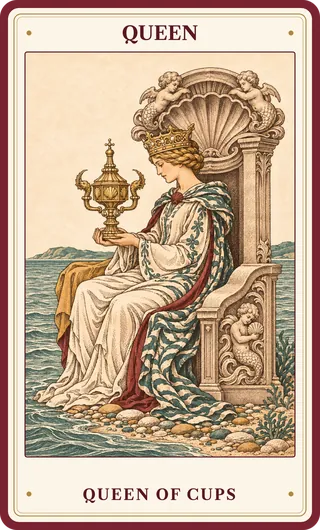
The closed cup
Unlike the open cups elsewhere in the suit, her cup has a lid. Her feelings and intuition are held with care, so her yes is considered rather than impulsive.
The throne carved with sea figures
Cherubs and sea creatures decorate her throne, tying her authority to the emotional and imaginative world. Her answers come from the heart, not from rules.
The sea at her feet
She sits right at the water's edge, between the conscious shore and the unconscious sea. Intuition is her ground, but she stays out of the waves.
Pebbles and shells
Small stones and shells gather around the base of her throne. They point to the quiet details that intuition notices and logic often misses.
The blue gown and flowing cloak
Blue and flowing fabric echo the water element and a calm, receptive temperament. Her mood is steady, which is why her yes feels reliable.
The cherubs on the cup
The ornate cup has angels on the handles and a cross on the lid. It suggests that love and compassion are treated as something close to sacred.
Her steady gaze
She looks into the cup rather than out at the world. Her answer comes from reflection and from listening inward first.
Health and wellbeing
For health questions, the Queen of Cups says yes to rest, emotional support, gentle routines and anything that settles the nervous system. She is a good sign for therapy, journalling, time near water, and conversations that you have been putting off. Tarot cannot diagnose or replace a doctor, so treat her as a nudge towards care, not a medical answer.
Reversed, she can show emotional exhaustion or stress that your body is carrying. The answer to “Should I push on?” is not yet. Rest first, and speak to a professional if the strain is more than a rough week.
Timing: how soon is her yes?
The Queen of Cups moves at the speed of feeling, which is rarely fast. Upright, she suggests the right moment arrives when you feel settled rather than rushed. Her timing is steady and gradual, more like a tide than a switch.
If you need a rough sense, think of weeks to a couple of months, and read it as “when the emotional groundwork is done.” For a dependable time frame, ask a separate timing question and read it with a method built for it. Our guide to tarot timing covers the common ways to do this.
Reversed, timing stretches. The delay is usually not a refusal. It is the time you need to sort out what you feel.
Reading her with the cards around her
A single card is only as clear as its neighbours. The Queen of Cups takes on the flavour of what sits beside her. Next to a card of action, such as the Knight of Wands, her yes becomes more energetic. Next to a card of grief or loss, such as the Five of Cups, her yes carries sadness and asks you to tend to a wound before you move.
Pairing her with other Cups cards usually deepens the emotional yes. Pairing her with Swords can add clarity or conflict, depending on the card. If the surrounding cards are mostly heavy, read her as a source of comfort within a hard situation, not as a promise that the situation will resolve.
If you pull her in a larger reading, she can show a person in your life who fits her description: a warm, intuitive, supportive woman or someone with that energy. A 3 card tarot reading is a good size for seeing how she interacts with what came before and what comes next.
How to ask the question so she can answer
Her answers are clearest when your question is simple, specific and framed around your own choice. “Should I tell them how I feel?” works well. “Will they leave their partner?” does not, since it asks about someone else’s free will and gives her nothing to work with. If you want help phrasing things, this list of questions for a tarot reading has examples.
Three habits help:
- Ask one question, not three joined together.
- Avoid asking the same question again until something has changed.
- Decide beforehand what you will do with a yes and with a no.
If you want a faster set-up with defined yes, no and maybe cards, the yes or no tarot reading tool is built for it. Use the Queen of Cups as your reading of her own answer when she comes up there.
Reading the answer from the image
The Rider-Waite-Smith image is itself a clue to how she answers. She sits at the sea’s edge, not in it. That says she is connected to deep feeling but not carried away by it. Her cup is closed and ornate, which means her answer is considered and private, not blurted out.
Her gaze is on the cup. She looks inward before she speaks. When you draw her, borrow that habit: before you accept the yes, look inward for a moment and ask whether it matches what you feel. If the image of a calm woman by the sea settles you, the yes is probably sound. If it unsettles you, the reversed reading may suit you better.
How she compares with other Cups court cards
Each court card gives a different flavour of yes. The Page of Cups is a yes with surprise and a little uncertainty in it, an early and tender “maybe this is real.” The Knight of Cups is a yes that arrives as an offer or an invitation, with some romance and some inconsistency. The King of Cups is a yes that has been thought through, one where feeling and judgment are in balance.
The Queen sits in the middle of that range. She is the deepest and most personal yes, the one that comes from knowing yourself well. See Page of Cups as a yes or no answer and King of Cups as a yes or no answer to compare how the family answers the same question differently.
A simple way to apply her answer
When the Queen of Cups appears, accept the yes, then test it gently. First, say the yes out loud and see how your body responds. Second, ask what the kindest honest action would be, for you and for anyone else involved. Third, take one small, caring step instead of a big dramatic one.
If she shows up reversed, do the same but add a pause. Name what is overwhelming you, set one clear boundary, and come back to the question when you are calmer. In both cases, her advice is the same: listen to your feelings, and then act on them with kindness and a clear head.
Questions readers ask
Is the Queen of Cups a yes or no card?
Upright, the Queen of Cups is a yes. It is a warm, emotionally grounded yes that works best when the question is about love, care, creativity or trust. It is not a rushed or guaranteed yes.
What does the Queen of Cups reversed mean as a yes or no answer?
Reversed, it is best read as not yet or yes with conditions. Strong emotions, weak boundaries or insecurity are clouding the picture, so steady yourself before you trust the answer.
Is the Queen of Cups a yes in love?
Yes, usually. It points to a caring, honest and emotionally safe connection. Reversed, it can mean someone is overgiving, clingy or not being open about how they feel.
Does the Queen of Cups mean someone has feelings for me?
Upright, it suggests yes, and that their feelings are warm and sincere. It does not promise a relationship or a timeline, so look at how they act as well as how they feel.
Is the Queen of Cups a yes for money and career questions?
It is a gentle yes for work that involves people, care or creativity. For money it is a conditional yes: it supports the choice if your gut feeling also survives a look at the numbers.
Can the Queen of Cups be a no?
On its own, rarely. A no usually comes from the reversed position, from the cards around it, or from a question that asks for facts, deadlines or logic instead of feelings.