
King of Cups Reversed: Meaning in Love, Work & Life

- Arcana
- Minor Arcana, Suit of Cups
- Element
- Water
- Yes or no
- Yes
emotional balancediplomacykindness
emotional blockswithdrawalimbalance
The King of Cups reversed means emotional mastery has slipped. The calm, wise and generous king of the upright card is either being swamped by his feelings or holding them down so tightly that they leak out sideways. In practice that looks like moodiness, emotional withdrawal, passive-aggression, or using someone’s feelings to get your own way.
The card can describe another person (a partner, boss or relative) or it can describe you. Court cards are flexible like that. The rest of this guide covers what the reversal means in love, work, money and health, how to tell whether it is about you or someone else, and what to do about it.
King of Cups reversed: the short version
Upright, the King of Cups is the person who has felt everything and stayed steady. He is diplomatic, kind and hard to rattle. Reversed, that steadiness is no longer reliable. The feeling is still there, but it is not being handled well.
Common keywords for the reversal are emotional imbalance, volatility, moodiness, suppression, coldness, manipulation, passive-aggression, emotional immaturity and an inability to regulate feelings. Not all of these apply at once. They split into two broad directions, covered next, and the right one depends on your question.
The two ways this king falls
The first direction is overflow. The sea has climbed onto the throne. Feelings are driving behaviour instead of informing it, so you get sudden swings, anxiety, overreaction, tears at odd moments, or decisions made while upset. This version often belongs to someone who is under real strain and has run out of ways to cope.
The second direction is the freeze. The king keeps a calm face while the waves roll underneath. Nothing is processed, nothing is said, and the feelings come out later as sarcasm, silence, sulking or a sudden blow-up that seems to come from nowhere. This is suppression dressed up as composure.
There is a third, sharper version. Someone who understands feelings very well, including other people’s, can use that skill as a tool. They charm, soothe or guilt you in order to steer you. It is the reversed king’s darkest expression, and it is worth taking seriously, but it is not the default reading. Treat it as a possibility to check, not a verdict.
King of Cups reversed in love
In a love reading, this card asks whether feeling is being handled cleanly. With a partner it often points to inconsistency: warm one week, distant the next, with no clear reason. It can also mean someone who is kind in public and cold in private, or who avoids hard conversations by going quiet.
If the card describes you, it often means you are holding back what you feel, or giving so much emotional energy that the relationship is lopsided. Selfishness can also appear here, where one person’s moods set the weather for both. For a fuller picture of how this king behaves with partners, see King of Cups in love.
If you are single, the card often points backwards. Old hurt or an old relationship may still be keeping part of you closed. It can also warn about a love interest who leads you on or keeps you guessing. That does not mean every new person is a problem, only that you should watch for the gap between what someone says and how they behave over time.
Is it a breakup card?
Not by itself. It describes an emotional pattern, not an ending. Whether the relationship survives depends on whether the pattern is noticed and changed. If one person keeps denying or dismissing the issue, the card becomes a more serious warning.
Try this: Think of the last three disagreements in your relationship. Write one line on each: who said what they really felt, and who changed the subject or went silent. If the same person did the avoiding every time, that is the pattern the card is pointing to.
Read King of Cups for your question
Upright: A steady, emotionally mature partner who listens before reacting and keeps their word.
Reversed: A partner (or you) who is moody, closed off or quietly manipulative, so warmth feels unpredictable.
Upright: Deep feeling that is calm, honest and expressed with care.
Reversed: Feelings that are either flooding out in swings or locked away behind a calm face.
Upright: A diplomatic leader or mentor who keeps the team's mood steady under pressure.
Reversed: A boss, colleague or your own habits turning stress into mood swings, favouritism or cold control.
Upright: Calm, well-judged financial decisions made with experience behind them.
Reversed: Spending, lending or investing driven by mood, guilt or the wish to rescue someone.
Upright: Stay composed, listen first and let wisdom lead.
Reversed: Name what you actually feel, then act from that instead of from the mood or the mask.
Upright: Emotional balance supports rest, good habits and a steadier body.
Reversed: Bottled-up stress shows up as tension, poor sleep or leaning on drink and other numbing habits.
King of Cups reversed as feelings
When you ask what someone feels about you, this card says they do feel something, and often a lot. The trouble is that they cannot express it in a steady, readable way. They may pull away when things get close, send mixed signals, or seem calm while being unsettled inside.
Their feelings may also be tangled up with insecurity or old pain. That can make them hard to read and hard to rely on, even if the affection is real. The card does not say they are indifferent. It says their feelings are not coming through clearly.
If you are asking about your own feelings, the reversal suggests confusion or disconnection. You may be telling yourself you are fine when you are not. Sit with the question before acting, because the answer you give today may be the mood talking.
When the card is a person
Court cards often stand for real people. A reversed King of Cups is usually an older or more senior figure, but the card is about temperament, not age or gender. Think of the parent who gave love and withdrew it, the manager who is charming until challenged, or the friend who always has advice but never shares anything real.
Watch for these signs when deciding whether the card fits someone you know:
- Their mood sets the mood of the room, and others adjust around it.
- They listen well but later use what you told them against you.
- They say they are fine while their behaviour says otherwise.
- Their warmth seems to arrive when they need something.
- They rarely apologise directly, and they rarely admit being hurt.
One or two of these does not make someone manipulative. Everyone has bad weeks. The card becomes meaningful when the pattern repeats and you find yourself managing their feelings more than they manage them.
King of Cups reversed in career
At work, the reversal points to poor emotional regulation under pressure. It can be a boss who is calm and supportive on good days and sharp, moody or punishing on bad ones. It can also be a colleague who plays favourites, withholds information, or uses charm to avoid accountability.
If it describes you, look at how stress comes out. Do you snap in meetings, go silent, or take on everyone’s problems until you are exhausted? Leaders and carers often draw this card when they have been holding the emotions of a whole team and have nowhere to put their own.
It can also signal a quieter problem: a job that pays well but no longer feels right. You keep going out of habit or security, and the lack of passion slowly drains you. If that sounds familiar, the card is asking whether you are choosing the work or just staying put.
King of Cups reversed in money
Money decisions made from mood are the main theme. That can mean overspending to soothe stress, lending to someone out of guilt, or making an investment because a person you like talked you into it. The card asks you to separate how you feel from what the numbers say.
It can also warn against trusting someone too easily with your finances, especially if they are charming and vague about details. Put agreements in writing and take a night before any large commitment.
If the card describes a stressful period, it may simply mean you are anxious about money and that anxiety is shaping your choices. For a steadier, more practical counterweight, see the King of Pentacles, who treats money as a matter of patience and plain sense.
Try this: Before your next non-essential purchase or loan, wait 24 hours and rate your mood from 1 to 10 at the moment you wanted it. If you were below 5, check the decision again when you feel steadier.
King of Cups reversed in health and wellbeing
Health readings with this card focus on emotional load. Bottled-up stress can show up as tension, poor sleep, digestive trouble or fatigue. Some people lean on alcohol, overwork or other numbing habits to keep feeling under control, and this card can be a gentle flag for that.
Tarot is not a diagnosis, and the card does not replace medical or mental health care. If it appears when you are struggling, treat it as a nudge to talk to someone: a friend you trust, a counsellor, or your doctor. Emotional mastery is a skill, and skills are easier to learn with help.
Small daily habits help too. Regular sleep, time near water or outdoors, movement, and a few minutes of writing down what you feel can all lower the level of the sea before it reaches the throne.
When the reversal is about you
Many readers expect this card to be about someone else, but often it is a mirror. Ask yourself two questions. Do I express feelings, or do I dump them? Do I keep feelings in, or do I hide them? Most of us lean one way.
If you tend to overflow, your work is containment: pausing before you send the message, taking a walk before the conversation, and learning that a strong feeling is information, not an instruction. If you tend to freeze, your work is expression: saying one honest sentence a day about how something landed.
You might also be seeing the card because you are the one holding everyone else’s emotions. The upright king is a steady presence for others, and the reversed king is what happens when he gets no care himself. If you recognise that, rest is not a luxury here. It is the fix.
King of Cups card symbols
Choose a symbol to read what it means on the card.
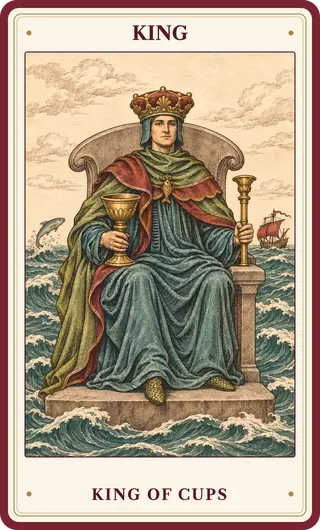
Stone throne on a rough sea
The king sits on solid ground that floats on moving water. Reversed, the waves feel higher, and the question is whether he is still in command or being soaked.
Golden cup
He holds the cup of feeling in his right hand, level and steady. Reversed, it is spilled, gripped too tightly or held out as bait.
Short sceptre
The sceptre in his left hand shows authority exercised gently. Reversed, that authority can turn into control or be dropped altogether.
Fish pendant
The fish around his neck is a sign of the subconscious worn openly. Reversed, it suggests feelings that are hidden, ignored or used as leverage.
Leaping fish
A fish jumps from the water beside him, showing that deep feeling can rise without drowning him. Reversed, it points to emotion breaking the surface at the wrong moment.
Ship on the water
A ship sails calmly behind him, a sign of purposeful movement through emotional waters. Reversed, it suggests drifting or being tossed about.
Blue and yellow robes
Blue is the water of feeling and yellow is clear thought, so the colours show heart and mind working together. Reversed, they pull apart.
Is the King of Cups reversed a yes or no?
For yes or no questions, the reversal leans towards no, or at least not yet. The situation needs more honesty, a calmer head or a clearer read on someone’s motives before it can go well. That is different from a flat refusal. It often means wait, talk first, and decide when emotions have settled.
If your question is about trusting a person, the card suggests caution until their actions match their words. If it is about your own plan, it suggests checking whether you are acting from mood. You can read more on how this king answers direct questions in King of Cups as a yes or no answer.
Reading the symbols upside down
The Rider-Waite-Smith image is a useful guide. The king’s throne is a block of stone floating on rough water, and that is the heart of the card: stability that depends on staying composed while the sea moves. In the upright card, the fish leaps beside him and the ship sails on, and he does not flinch.
Reversed, picture the opposite. The cup is tilted and spilling, or clutched tight. The fish pendant, which is a sign of the subconscious, hangs hidden or ignored. The waves wash the throne, and the sceptre of gentle authority is either dropped or held like a weapon. Ask which of those pictures feels closest to your question.
The blue and yellow of his clothing also help. Blue is feeling and yellow is thought. When the card is reversed, heart and head are out of sync, and the reading often improves when you bring them back together.
Is the reversal always negative?
No. Reversed cards are not always bad news. The reversal can show a milder blockage: you are tired, you are in a season of emotional growth, or you are learning to handle your feelings better and have not got there yet. Many readers also treat a reversed court card as a quieter or less visible form of the upright energy.
Another gentle reading is that the king is temporarily out of reach. A mentor, partner or version of yourself who would normally be steady is unavailable right now. That is frustrating but not harmful, and it asks for patience rather than alarm. For a deeper look at how reversals work across the deck, see how to read reversed tarot cards.
What to do when the King of Cups appears reversed
Start by deciding whether the card is about you or someone else. Look at the question you asked, and notice your first reaction when you saw the card. A quick flash of recognition is usually accurate.
Then take a few simple steps:
- Name the feeling that is actually present, in one plain sentence.
- Decide whether the issue is overflow, suppression or manipulation.
- Choose one small action: a honest conversation, a boundary, a break, or a call to a professional.
- Check back in a week and see what has shifted.
If the card describes someone else, protect your energy. You are not responsible for managing another adult’s feelings. You can be kind and still say what you will and will not accept.
Try this: Write down the feeling you have been avoiding this week. Then write one sentence you could say aloud about it to a person you trust. Say it to them, even if it comes out clumsily.
Cards that change the meaning
The surrounding cards tell you which direction the king has fallen. A few pairings come up often:
- With the Queen of Cups reversed, both court cards of the suit are out of balance, which often points to codependence or an emotionally overloaded household.
- With the Five of Cups, grief or regret is behind the moodiness, and healing starts with the loss.
- With the Seven of Swords, be alert to deception rather than simple mood swings.
- With the Ace of Cups, a fresh start in feeling is on offer once the old patterns are faced.
Cards of thought, like the King of Swords, can show the cure: bringing clarity and honest speech to an overheated or frozen situation. A calm head does not replace feeling, but it can give feeling a shape.
King of Cups reversed versus the other court cards
Court cards can be tricky because several of them can describe a person. The reversed King of Cups differs from the others in being about emotional maturity specifically. The question is not whether someone is ambitious, stubborn or practical. It is whether they can hold their feelings and other people’s without harm.
If you are unsure which court card fits a person, my overview of court cards in tarot walks through how to tell them apart by temperament, role and element. The suit of Cups is water, so any cup court card concerns the emotional life above everything else.
Questions to ask yourself with this card
Reversed cards work best when they lead to a real question. These prompts are useful for journaling or for a follow-up pull:
- Where am I letting a mood make a decision that I should make calmly?
- What am I pretending not to feel?
- Who around me is managing their feelings by managing me?
- Where do I give more emotional energy than I get back?
- What would steady look like in this situation, and what is one step towards it?
If you can answer even two of these honestly, the card has done its work. The reversed king is not asking you to be perfect. He is asking you to stop pretending the water is calm when it is not, and to learn to keep your seat on the throne anyway.
Questions readers ask
What does the King of Cups reversed mean?
It means the emotional maturity of the upright card has broken down. That can look like moodiness and volatility, cold withdrawal, or emotional intelligence used to manipulate. It can describe another person or your own current state.
Is the King of Cups reversed a bad card?
It is a warning card, not a doom card. It points to an emotional imbalance you can still address, and in milder readings it simply means you are tired, stressed or holding too much in.
What does the King of Cups reversed mean in love?
It usually points to an emotionally unavailable, inconsistent or subtly controlling partner, or to you struggling to express what you feel. It asks you to look at whether affection is being given freely or used to get something.
What does the King of Cups reversed mean as someone's feelings?
The person has strong feelings but is not handling them well. They may withdraw, blow hot and cold, or hide what they feel behind a calm front, so their words and actions may not match.
Is the King of Cups reversed a yes or no?
Leaning no, or at least not yet. The situation needs emotional honesty or a calmer head before it can work out well.
Does the King of Cups reversed always mean manipulation?
No. Manipulation is one possible meaning, but suppression, mood swings, burnout and emotional overwhelm are just as common. Look at the question and the surrounding cards to decide which fits.