
Five of Pentacles as a Yes or No Answer

- Arcana
- Minor Arcana, Suit of Pentacles
- Element
- Earth
- Yes or no
- No
hardshiplossisolation
setbackspoor planningfinancial worry
The Five of Pentacles is a no in a yes or no reading. It is the card of hardship, lack and feeling shut out, so when you draw it upright the answer is usually “not like this” or “not yet”. Reversed, it leans yes, because the cold stretch is ending and support is within reach.
The full answer is a little more useful than a flat no, though. This card describes the present conditions around your question, not your fate. Below you will find how it reads for love, money, work and health, the specific questions where it flips to a yes, and how to get a clearer answer when it shows up.
Why the Five of Pentacles leans no
A yes or no answer depends on whether the card shows momentum, ease and resources. The Five of Pentacles shows the opposite. Two people trudge through snow, one on crutches, both underdressed, passing a lit window they do not look at. There is little energy to spare and little security to build on.
Pentacles are the suit of money, work, the body and material security. A five in any suit is the number of disruption, a point where something has gone wrong and has to be dealt with. Put those together and you get hardship in the most practical area of life. A question that needs stability, funds or good health to succeed gets a no.
The no is also protective. The card tells you that pushing ahead right now would cost more than you can safely carry. If you want the full picture beyond yes and no, the Five of Pentacles card meaning covers the imagery and themes in depth.
Upright: a no about current conditions
Think of the upright card as a no about the situation as it stands, not a verdict on you. It says the conditions behind your question are not supportive today. Money is short, energy is low, or you are cut off from the people who could help.
That is why the answer feels different from the Tower or Death. Those cards describe sudden change. The Five of Pentacles describes a long, grinding, cold stretch, and the no belongs to that stretch. When the season changes, the answer can change too.
This is also why readers who treat it as a “never” get it wrong. The picture contains a lit window. Help is visible. The no applies to the plan as currently built, which probably leans on resources you do not have yet.
Reversed: a yes that arrives slowly
Reversed, the card turns toward yes, but a patient one. The hardship is lifting, you are asking for help, or a long period of lack is ending. If you want the full picture, see Five of Pentacles reversed for the deeper meaning.
Read it as a yes with conditions. The footing is returning, but it is not solid yet. A reversed Five suits questions like “Am I recovering?”, “Will things get easier?” and “Can I rebuild?” It is less suited to “Can I make a big risky purchase?”, because the ground is still being repaired.
Reversals can also point inward. In some readings the card reversed means you are refusing help or stuck in a scarcity mindset even though support exists. If the surrounding cards feel stuck, not hopeful, take it as a warning that the no is coming from your own guardedness. Our guide to reading reversed tarot cards explains how to tell which flavour you have.
Try this: Before you draw, write down whether you read reversals. If you do not, treat the Five of Pentacles as a no. If you do, decide in advance that reversed means “yes, slowly”, so you are not bending the answer after the fact.
Read Five of Pentacles for your question
Upright: No for now: someone feels shut out, unsupported or emotionally short on resources, and the relationship question needs care before it can get a yes.
Reversed: A slow yes: loneliness is easing, a thaw or reconciliation is possible, and you are ready to let someone in.
Upright: They feel left out, worried or too proud to ask for help, so a warm yes is not what is being felt right now.
Reversed: Feelings are recovering: they are opening up, accepting support and starting to feel they belong again.
Upright: No: the role, move or promotion faces real obstacles, unstable footing or a lack of backing.
Reversed: Yes, gradually: work stress is lifting, support is arriving and you can rebuild steady footing.
Upright: A firm no to easy gains: expect tight funds, debt pressure or a shortfall, and focus on getting help.
Reversed: Leaning yes: finances are stabilising, you are catching up and the worst of the shortage is behind you.
Upright: Look up and ask for help: support exists, but you have to walk through the door to reach it.
Reversed: Keep accepting support and rebuild slowly, without rushing back into the habits that left you stretched.
Upright: A run-down period: rest, treatment and company matter more than pushing on alone.
Reversed: Recovery is under way: keep the routines and the people who are helping you heal.
Five of Pentacles yes or no for love
In love questions, the upright Five is usually a no for now. It often shows one or both people feeling excluded, emotionally undernourished or unable to ask for what they need. It is a hard card for “Will they come back?”, “Is this person the one?” and “Should we get serious?” because the foundation looks thin.
Context matters. If you are asking about a relationship strained by money worries, illness or a rough season, the card is honest about the cause. The answer is no to moving forward right now, with the door left open if you both get stability and support. If you are single and ask “Will I meet someone soon?”, expect the card to say that loneliness and self-protection are in the way.
Reversed, it softens. A thaw is possible, a difficult patch is ending, or someone is willing to be cared for. For reconciliation questions that is a cautious yes, and best confirmed by a warm card such as the Six of Pentacles, which shows help flowing both ways.
Five of Pentacles yes or no for career and work
For career questions, the upright Five is a no. It warns against a job move, a business launch or an ask for promotion that depends on money, backing or a secure base you do not have yet. It can also describe redundancy, a company in trouble or a workplace where you feel left out.
The card also points to what is missing, which is useful. Often the answer is “no, not until you have a safety net”, or “no, not without a mentor or ally”. If the question is “Should I quit without another job lined up?”, the card is clear that the cold season would be harder to survive without support.
Reversed, you can say yes to work questions that are about recovery: finding stable income, returning after a layoff or being included on a team again. Take steps, not leaps. A job offer you can verify beats a vague promise.
Five of Pentacles yes or no for money
Money is the card’s home ground, and the upright answer is the clearest here: no to easy gains, windfalls and risky spending. Expect tight funds, bills, debt or a loss. If you ask “Will I get this loan?” or “Will my income rise this month?”, the honest answer from the card is no.
That said, a no from the Five of Pentacles does not mean you should give up. It means the plan needs more support. Look at the practical side: a budget, a conversation with a creditor, a benefits check, a loan from a family member or a community resource. The window in the image is a reminder that charity and help are real options.
Reversed, finances are stabilising. It leans yes to “Will I get back on my feet?” and “Is the worst over?”, but you will see it first in smaller wins, not big ones. The Ace of Pentacles turning up next is the strongest sign that a real new beginning follows.
Try this: Write your money question as “Will I have enough for X by [date]?” Draw one card. If the Five of Pentacles appears, list three people or services you could ask for help, and contact one of them this week.
Five of Pentacles yes or no for health
Tarot cannot diagnose or replace medical care, but the card does describe a run-down body. The crutches and bandages in the image are not subtle. Upright, it answers no to “Am I fully recovered?” and “Can I push through this?”, and it argues for rest, treatment and company.
Because it is also a card of isolation, it can point to mental health struggles made worse by being alone. The most useful reading is practical: this is a time to see a professional, tell a trusted person how you are really doing and stop trying to carry it silently.
Reversed, the card shows recovery and renewed energy. It leans yes to “Am I getting better?”, especially when you are accepting care. Keep the routines that are working, and do not rush to prove you are fine.
When the Five of Pentacles means yes
The card gives a yes to some questions, and these are worth knowing, because many readers miss them. If you ask a question where the “yes” is the hardship itself, the card confirms it. “Am I going through a difficult time?” gets a yes. So does “Is this situation costing me more than it is giving?”
It also supports yes when the question is about leaving or seeking help. “Should I leave this unhealthy situation?” or “Should I ask for support?” often get a yes, because the card is about stepping out of the snow and toward the window. Here are the types of question where it tends to say yes:
- Should I ask for help?
- Is support available to me?
- Should I leave a situation that is draining me?
- Do I need to rest and recover?
The pattern is simple. If the question asks you to move toward shelter, the card says yes. If it asks you to expand, risk or spend, it says no.
Reading the image to refine your answer
The artwork gives you a quick test. Look at where the figures are facing and what they are not seeing. They are walking past the window, eyes down. If your question is about something that depends on noticing an offer of help, the answer depends on whether you are willing to look up.
Notice too that there are two figures. Even in this card, the people are together, which suggests hardship shared is hardship halved. When you pull it for a relationship question, look for who in the situation is stuck in lack and who has something to give.
Finally, the snow tells you about timing. A snowstorm passes. The card shows the middle of a hard season, not the end of one. That is why the no is about now.
Five of Pentacles card symbols
Choose a symbol to read what it means on the card.
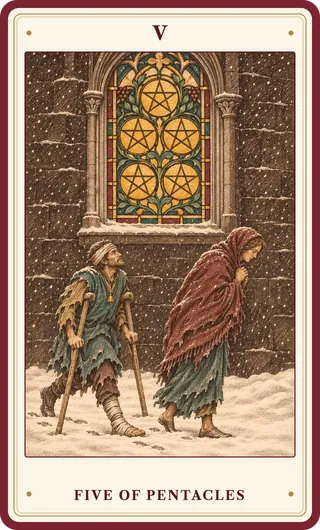
Two figures in the snow
A barefoot man and a woman wrapped in a shawl walk through a blizzard together. They show hardship, but also that you are not strictly alone, which is why help is often closer than it feels.
The lit stained-glass window
Behind them glows a church window with five pentacles. It stands for shelter, charity and spiritual support that is in plain sight but not yet entered.
The crutches
The man on crutches signals injury, illness or a body worn down by struggle. He suggests the situation costs more energy than a simple yes can afford.
The bandaged head and bare feet
Wounds and missing shoes show exposure and unmet basic needs. They tell you the answer must start with care and protection.
The woman's downcast eyes
She looks at the ground, not at the window. The card points to a mindset of lack that can hide the help available.
The five pentacles
Five coins form the window's pattern, and five is the number of disruption and testing. The wealth exists, but it is out of reach from where they stand.
The snow and night
Cold, dark weather sets the season of the card. Winter ends, which is why the no reads as a no for now and not a no forever.
Cards that shift the answer
The Five of Pentacles rarely stands alone in a longer reading, and its neighbours matter a lot. A clarifying card can soften or harden the no:
- Six of Pentacles: help arrives and the answer moves toward yes.
- The Star: hope returns, and the no softens (see the Star for why).
- Ace of Pentacles: yes, but not yet. A new material beginning follows the hardship.
- Four of Pentacles: the no deepens, as clinging to what little you have keeps you stuck.
- The Tower: a harder no, with sudden upheaval on top of the lack.
If the neighbour is a Cups or Wands card, read the energy of that suit. A Cups card brings emotional support, a Wands card brings drive to act, though neither erases the need for practical resources.
How to ask a better question
Vague questions get vague answers, and the Five of Pentacles shows up often when the question is too big or too hopeful. “Will I be happy?” gives the card too much to fill. “Will this job offer give me financial stability this year?” gives it something concrete.
Keep the question specific, time-bound and honest about what you want. Avoid asking the same question again and again in the hope of a different card, because that is usually a sign the first answer was heard and not accepted. If you want ideas, our list of questions for a tarot reading shows how to phrase them.
If you want a fast answer from a full deck, you can use the yes or no tarot reading tool and compare the result with what you find here.
Try this: Rewrite your question in the form “What would help me most with X right now?” and draw one card. Then do the yes or no draw. The first draw gives you the action, the second gives you the verdict.
What to do after a no
A no from this card is a prompt to act, not a reason to despair. The five steps below fit most situations:
- Name the shortage clearly: money, health, support or belonging.
- Ask one specific person for one specific kind of help.
- Look for formal sources of support, such as advice services, community groups and professionals.
- Pause the big decision until your footing is firmer.
- Draw again in a few weeks and compare.
The aim is to move from the snow to the window. Pride and shame are common reasons people stay outside, and they are the things the card most wants you to set down.
How long does the no last?
The Five of Pentacles does not give a date, but it does suggest a duration. It is a season, not a moment, so weeks or months fits better than days. If you repeat the question after you have taken steps, and the card turns to reversed or is replaced by a Six or an Ace of Pentacles, that is your sign that the season is changing.
For more on how to read timing across the deck, our guide to tarot timing walks through the usual systems. As a rule of thumb, pair the Five with practical milestones, such as a pay date, a recovery appointment or a deadline, and check whether the conditions have shifted by then.
Using a second draw to confirm
When you pull the Five of Pentacles and want to be sure, a three-card draw gives context without turning the reading into a puzzle. A simple layout is situation, obstacle, outcome. The Five of Pentacles in the first position usually describes the lack you are living with, in the second it names the obstacle as isolation or pride, and in the third it warns that the outcome is still cold.
The 3 card tarot spread is a good frame for this. Draw it once, write down what you see and resist pulling extra cards until you have processed the answer. If the outcome card is warm, the no is about timing. If it is cold as well, the plan itself needs rethinking.
Common mistakes when reading it as yes or no
The biggest mistake is treating the no as a prophecy. The card describes conditions, and conditions change when you act. Reading it as “you will always struggle” ignores the lit window, which is the most hopeful part of the picture.
The second is ignoring the question’s wording. A question about leaving, asking for help or resting often gets a yes, as covered above. A question about growth, spending or risk gets a no. Check which way your question points before you decide the card has contradicted itself.
The third is using it in place of real help. If your reading points to money trouble or poor health, tarot is a way to reflect, and a professional or a trusted person is the way to fix it.
Quick reference
To keep it simple: upright means no for now, with the door open once you have support. Reversed means a slow yes, with recovery under way. In love, money and work, the upright card asks you to build a safer base first. In health, it asks you to rest and accept care.
When in doubt, ask yourself one thing: who could I let in? That is usually what the card wants you to answer, and it often does more to change the outcome than any second draw.
Questions readers ask
Is the Five of Pentacles a yes or no card?
Upright, it is a no, or at least a firm not yet. It describes hardship, lack and isolation, which are conditions that do not support an easy yes. Reversed, it leans yes because recovery has begun.
Is the Five of Pentacles a yes or no for love?
Upright, it is usually a no for now, because someone is struggling, feeling excluded or too guarded to connect. Reversed, it becomes a yes or a hopeful maybe as warmth returns and support is accepted.
Can the Five of Pentacles ever mean yes?
Yes, when the question is about leaving a bad situation, asking for help or whether you will find support. The card then confirms the hardship is real and the right move is to seek shelter. It also reads as yes to the question of whether you are going through a hard time.
What does the Five of Pentacles reversed mean as a yes or no answer?
It leans yes, usually a slow one. The worst is passing, help is arriving and you are regaining stability. Treat it as a yes that needs patience, not a quick win.
How do I get a clearer answer if I draw the Five of Pentacles?
Reword the question so it is specific and time-bound, then draw one clarifying card. A card such as the Six of Pentacles or the Star softens the no, while the Four of Pentacles or the Tower hardens it.
Does the Five of Pentacles mean I will be poor forever?
No. The card describes a current season of difficulty, not a permanent fate. The image itself shows a window of help in plain view.